Social Media Privacy Concerns: How Platforms Use Your Data
Your social media privacy concerns often stem from metadata that reveals location and habits, not just the photos you consciously choose to share with friends.

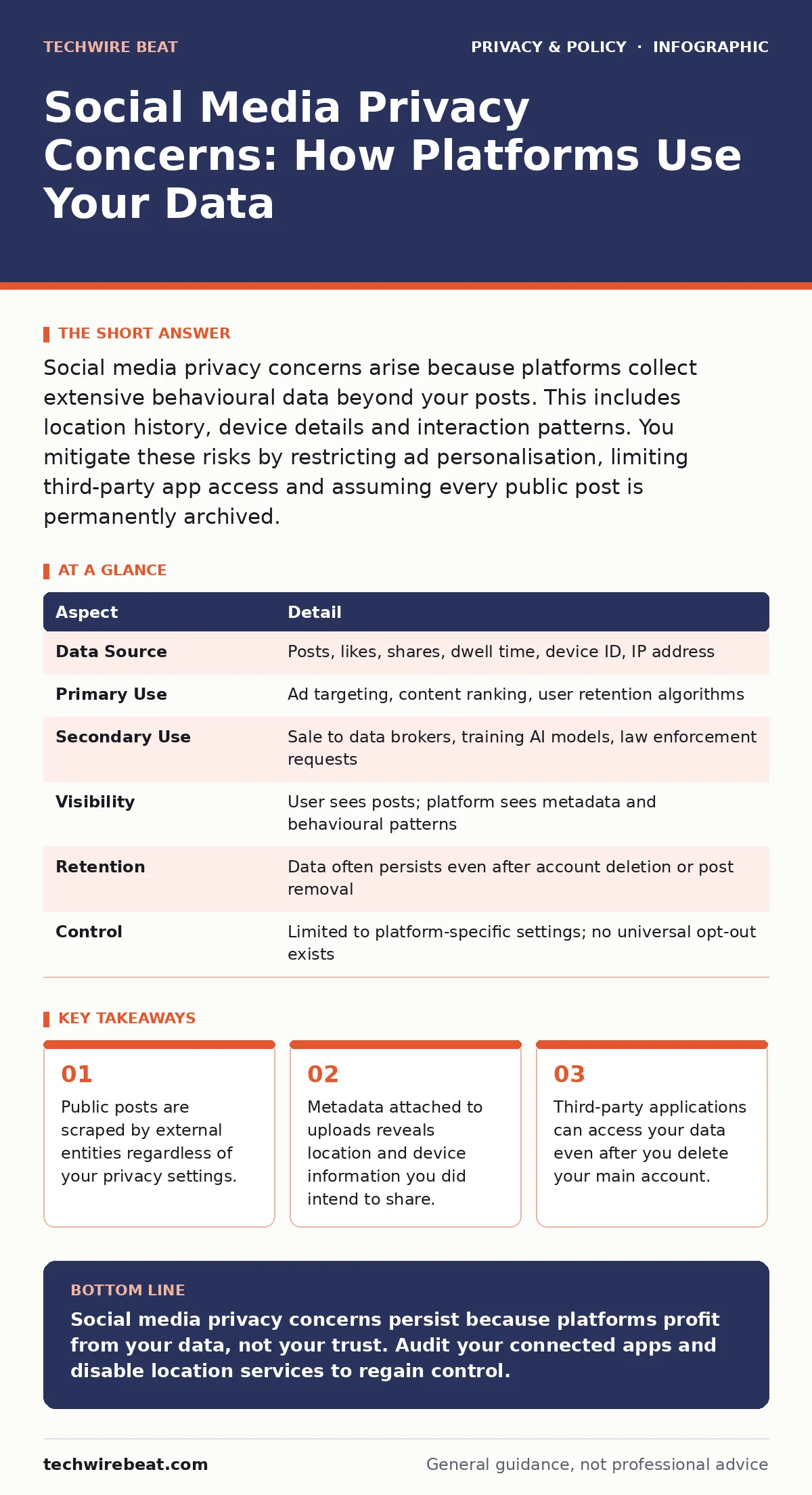
Social media privacy concerns arise because platforms collect extensive behavioural data beyond your posts. This includes location history, device details and interaction patterns. You mitigate these risks by restricting ad personalisation, limiting third-party app access and assuming every public post is permanently archived.
Social Media Privacy Concerns Explained
Imagine you hand a stranger a polaroid photo of your dinner. You believe you are sharing only the image. In reality, you are also handing over the receipt, the time of day, the restaurant location and the names of everyone sitting at your table. Social media platforms operate on this exact principle.
Social media privacy concerns refer to the risks associated with the collection, storage and potential misuse of personal data by network platforms. These platforms do not merely host your content. They analyse your behaviour to build detailed profiles.
The mechanism relies on data aggregation. Platforms combine your explicit actions, such as liking a post, with implicit signals, such as how long you hover over an advertisement. This creates a digital twin of your habits. This twin is used for targeted advertising and content recommendation.
| Aspect | Detail |
|---|---|
| Data Source | Posts, likes, shares, dwell time, device ID, IP address |
| Primary Use | Ad targeting, content ranking, user retention algorithms |
| Secondary Use | Sale to data brokers, training AI models, law enforcement requests |
| Visibility | User sees posts; platform sees metadata and behavioural patterns |
| Retention | Data often persists even after account deletion or post removal |
| Control | Limited to platform-specific settings; no universal opt-out exists |
You affect these systems every time you log in. The data collected influences not only what you see but also what your contacts see. The ripple effect extends to your network.
How Data Collection Works
The process begins with consent. You agree to terms of service that grant the platform broad rights to use your data. This agreement is rarely read. It covers everything from your profile picture to your browsing history within the app.
Platforms use cookies and device fingerprinting. Cookies are small text files stored on your device. They track your session and preferences. Device fingerprinting creates a unique identifier based on your screen resolution, battery level and installed fonts. This identifier persists even if you clear your cookies.
Metadata is the hidden layer. Every photo contains EXIF data. This includes GPS coordinates and camera model. Every message has a timestamp and sender ID. Even deleted messages often remain in server logs for regulatory compliance.
The algorithm does not care about your intent. It cares about engagement. If controversial content keeps you scrolling, the algorithm serves more of it. Your privacy is traded for convenience and entertainment. The trade-off is often invisible until a breach occurs.
Who Is Affected
Everyone who creates an account is affected. The impact varies by user type. High-profile users face doxxing risks. Ordinary users face identity theft and social engineering.
Children are particularly vulnerable. Their digital footprint forms before they understand consent. Data collected during childhood can affect future employment and insurance opportunities. The concept of children's privacy laws attempts to address this but enforcement varies.
Professionals face reputational risks. Employers often screen candidates via social media. A single offensive post from years ago can derail a career. The permanence of the web means mistakes are rarely forgotten.
Vulnerable groups face targeted harassment. Algorithms may inadvertently promote hate speech to users who engage with sensitive topics. This creates echo chambers that radicalise users. Privacy settings cannot fully prevent this exposure.
What People Usually Get Wrong
Many users believe private accounts provide full protection. They do not. A private account only restricts who can view your posts. The platform still collects your data. Third-party apps can still access your profile if you grant permission.
Users often think deleting an account removes their data. It does not. Platforms retain backups for legal reasons. They may also sell aggregated data to brokers before deletion. Your digital ghost remains.
Another misconception is that privacy settings are sufficient. They are not. Settings change frequently. New features often default to public sharing. You must review settings regularly. Automation helps but is not foolproof.
People assume that if they post nothing, they are invisible. They are not. Metadata reveals your location and device. Your connections reveal your interests. The network effect exposes you even if you remain silent.
Practical Mitigation Steps
You can reduce risk through specific actions. Start by auditing your connected apps. Revoke access for any application you do not use daily. Each connection grants the app access to your data.
Limit ad personalisation. Most platforms allow you to opt out of interest-based ads. This reduces the granularity of the profile built on you. It does not stop data collection but limits its commercial use.
Use strong, unique passwords. Enable two-factor authentication. This prevents account takeover. A compromised account exposes all your data to the attacker.
Review your public profile. Search your name on search engines. Remove personal details like phone numbers and home addresses. Assume everything public is permanent.
Consider the data you upload. Blur license plates and street signs in photos. Disable location services for camera apps. This removes EXIF data before upload.
You may also want to conduct a privacy audit to understand your digital footprint. This process identifies gaps in your security posture. It helps you prioritise which settings to change first.
See also: Email breach checkers: what they reveal and what they miss
The Role of Consent and Law
Consent management is the legal framework governing data use. Regulations require platforms to ask for permission. However, the complexity of terms of service makes informed consent difficult.
Users often click "Agree" without reading. This consent is legally binding. It grants the platform wide-ranging rights. The burden of understanding falls on the user.
Privacy laws for small businesses differ from those governing tech giants. Small businesses have fewer resources for compliance. They may inadvertently mishandle data. Tech giants have dedicated legal teams.
Data privacy regulations evolve. New laws emerge constantly. Staying informed is challenging. You must rely on the platform to update their practices.
End-to-End Encryption and Limits
End-to-end encryption protects message content. It ensures only the sender and receiver can read the message. The platform cannot access the content.
However, metadata remains visible. The platform knows who you talk to and when. This data is valuable. It reveals your social graph and habits.
Encryption does not protect against phishing. If you click a malicious link, encryption offers no help. It protects data in transit, not data at rest or user behaviour.
Public Wi-Fi risks compound these issues. Unsecured networks allow attackers to intercept unencrypted traffic. Always use a VPN on public networks.
Mobile app permission abuse is another vector. Apps may request access to your contacts or microphone. Deny unnecessary permissions. Each permission is a potential leak.
The Future of Privacy
Privacy will remain a balancing act. Convenience often outweighs security. Users must make active choices. Passive compliance leads to exposure.
Technology will advance. New methods of data collection will emerge. Biometrics and AI will make profiling more accurate. The fight for privacy is continuous.
You must stay informed. Subscribe to security newsletters. Update your software regularly. Patch vulnerabilities quickly.
Advocate for stronger privacy laws. Support organisations that fight for digital rights. Pressure platforms to adopt privacy-by-design principles.
The goal is not total invisibility. It is control. You should decide what data is shared and with whom. This requires vigilance and effort.
Key takeaways
- Public posts are scraped by external entities regardless of your privacy settings.
- Metadata attached to uploads reveals location and device information you did intend to share.
- Third-party applications can access your data even after you delete your main account.
Social media privacy concerns persist because platforms profit from your data, not your trust. Audit your connected apps and disable location services to regain control.
Frequently asked questions
Can I delete all my data from social media?
You can request deletion, but platforms often retain backups for legal reasons. Aggregated or anonymised data may remain in their systems indefinitely.
Do private accounts protect me from data scraping?
No. Private accounts only restrict user viewing. External scrapers and platform algorithms can still access your metadata and profile information.
Is end-to-end encryption enough for privacy?
No. It protects message content but not metadata. The platform still knows who you contact, when and how often.
How often should I review privacy settings?
Review them every 6 months. Platforms update terms and default settings frequently. Regular checks ensure your preferences remain intact.
How this guide was produced: written by the TechWire Beat editorial team with AI assistance, checked against the public references listed below, and reviewed when the facts change. See our editorial policy or report an error.