Children’s Privacy Laws: Fixing Six Common Compliance Errors
Most organisations fail because they treat age limits as the only rule, ignoring how data processing methods and consent mechanics actually define legal compliance.

Children’s privacy laws do not simply ban data collection under a certain age. They require specific consent mechanisms, restrict behavioural advertising, and mandate data minimisation. Misunderstanding these rules leads to non-compliance even when you believe you are following the letter of the law.
Misreading: The age threshold is the only trigger
Many organisations assume that if a user is over the legal age limit, standard privacy rules apply. This view ignores the concept of heightened protection for vulnerable data subjects. The law often extends special safeguards to any data that reveals a child’s identity, regardless of the specific age cutoff in your jurisdiction.
Correct reading: You must assess whether the data you hold is linked to a child, even if the account was created by an adult. If the service is directed at children, stricter rules apply to all users of that service. You cannot rely solely on self-reported age fields. Implementing age verification that is robust yet privacy-preserving is necessary. See our guide on data privacy for methods to verify identity without storing excessive personal details.
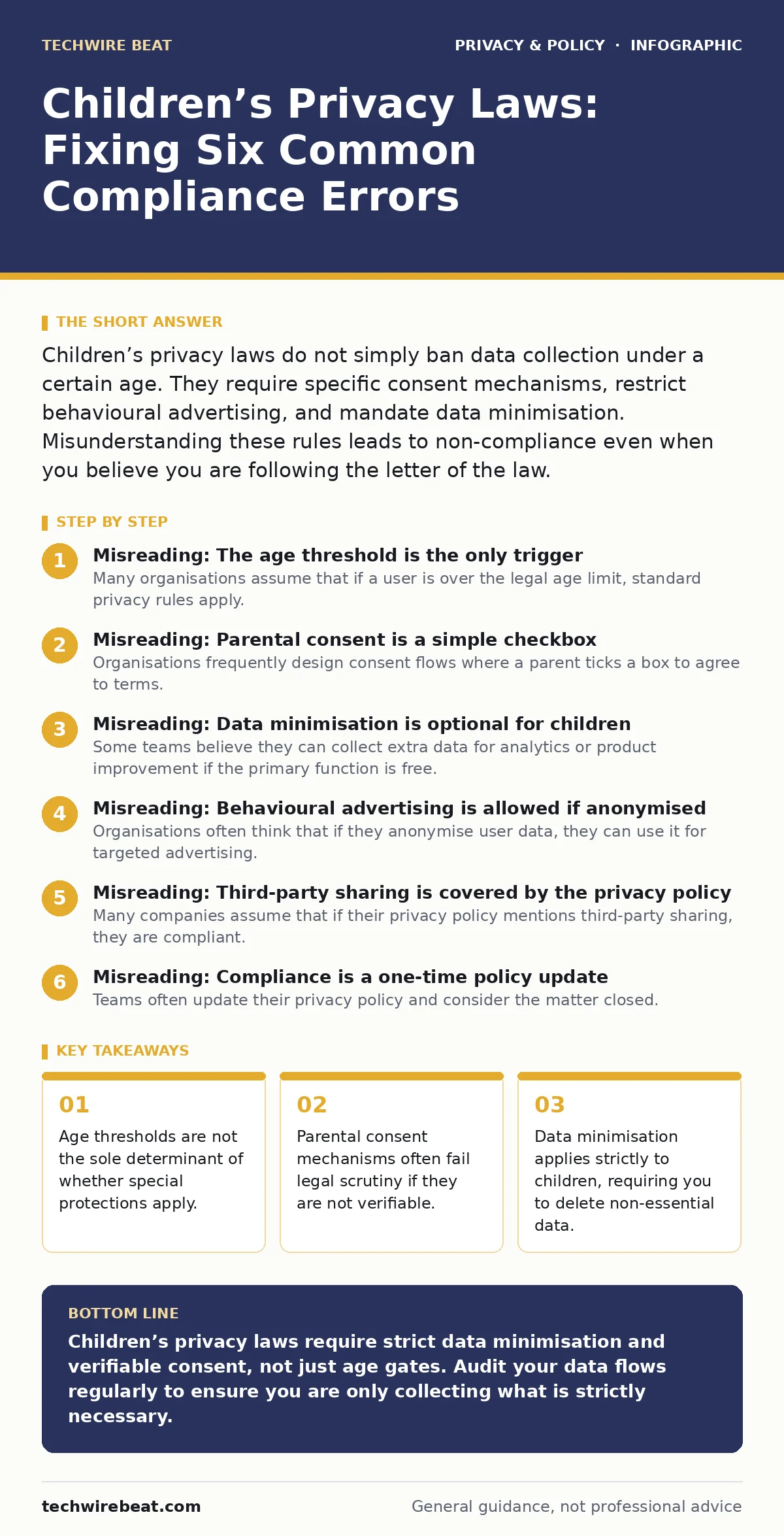
Misreading: Parental consent is a simple checkbox
Organisations frequently design consent flows where a parent ticks a box to agree to terms. This mechanism is often legally insufficient. The law requires verifiable parental consent, meaning you must take reasonable steps to confirm the person consenting is actually the parent or guardian. A simple checkbox does not prove identity.
Correct reading: You need a process that verifies the parent’s identity. This might involve a credit card transaction that does not charge the card, or a government ID check. The method must be proportionate to the risk. If you cannot verify the parent, you cannot legally process the data. This verification step adds friction to the user experience, which is a hidden cost of compliance. Read more on consent management to understand how to build these flows without breaking usability.
Misreading: Data minimisation is optional for children
Some teams believe they can collect extra data for analytics or product improvement if the primary function is free. This is a dangerous assumption. Children’s privacy laws mandate strict data minimisation. You may only collect data that is strictly necessary for the explicit purpose of the service. Any data collected for secondary purposes, such as profiling or market research, is generally prohibited.
Correct reading: You must audit your data collection points and remove any that are not essential for the core functionality. If you collect location data for a game, you cannot use it to build a marketing profile. You must also establish clear retention periods. Data that is no longer needed must be deleted, not just archived. This approach reduces your liability and storage costs. Consult our guide on privacy audits to identify unnecessary data collection.
Misreading: Behavioural advertising is allowed if anonymised
Organisations often think that if they anonymise user data, they can use it for targeted advertising. This misunderstands the definition of behavioural advertising in the context of children’s privacy. The law typically prohibits any form of advertising that relies on data collected over time to build a profile, even if that profile is technically anonymised. The act of profiling itself is the issue.
Correct reading: You must disable all forms of behavioural advertising for users identified as children. This includes contextual advertising that uses browsing history to infer interests. Even if the ad is not directly tied to a name, the mechanism of tracking user behaviour to serve relevant ads is restricted. You should use static, non-personalised ads instead. This limits your revenue potential but ensures compliance. See ad blockers for insights into how users perceive and react to intrusive ad technologies.
Misreading: Third-party sharing is covered by the privacy policy
Many companies assume that if their privacy policy mentions third-party sharing, they are compliant. This is incorrect. Children’s privacy laws require specific, separate consent for sharing data with third parties. General consent buried in a long privacy notice is not sufficient. You must clearly identify who the third parties are and what data they will receive.
Correct reading: You must obtain explicit consent for each category of third-party sharing. This means a separate opt-in mechanism for each vendor or service provider. You cannot bundle consent for analytics, advertising, and social media sharing into a single agreement. If a third party changes their data practices, you may need to re-obtain consent. This creates an ongoing administrative burden. Review your vendor contracts carefully. See smart home privacy risks for examples of how third-party integrations can expose user data unexpectedly.
See also: How to Stop Location Leaks on X and Protect Your Privacy
Misreading: Compliance is a one-time policy update
Teams often update their privacy policy and consider the matter closed. This view fails to account for the dynamic nature of data processing. Compliance is an ongoing operational requirement. As you add new features, integrate new tools, or change your data retention policies, you must reassess your compliance status. A static policy quickly becomes outdated and legally risky.
Correct reading: You need a continuous compliance programme. This includes regular reviews of your data flows and consent mechanisms. You must train staff on the specific requirements of children’s privacy laws. You should also monitor for changes in the law and in your technology stack. This proactive approach prevents accidental non-compliance. See reducing your digital footprint for strategies that can help you minimise the data you hold in the first place.
Misreading: Anonymisation fully removes legal obligations
Some believe that if they strip names and emails from data, they no longer have privacy obligations. This is a common error. Anonymisation is difficult to achieve perfectly. If the data can still be linked back to an individual, even indirectly, it remains personal data. Furthermore, the process of anonymisation itself must be secure and documented.
Correct reading: You must ensure that anonymisation is irreversible. This often requires removing all metadata and combining data sets in a way that prevents re-identification. If there is any risk of re-identification, the data is still subject to privacy laws. You should treat anonymised data with caution and avoid using it for purposes that could harm the individuals involved. See end-to-end encryption for methods to protect data in transit, though note that encryption does not equate to anonymisation.
Misreading: International laws do not apply to local users
Organisations sometimes think that if they are based in one country, they only need to follow local laws. This ignores the extraterritorial reach of many privacy regulations. If your service is accessible to children in other jurisdictions, you may need to comply with those laws too. This is particularly relevant for online services that do not have physical borders.
Correct reading: You must assess the reach of your service. If you target or are aware of users in other jurisdictions, you should consider adopting the highest standard of protection. This often means complying with the strictest laws applicable. This approach simplifies your compliance framework by applying a single, high standard globally. It also builds trust with users who are increasingly aware of their rights. See public Wi-Fi risks for context on how data can travel across borders unexpectedly.
Key takeaways
- Age thresholds are not the sole determinant of whether special protections apply.
- Parental consent mechanisms often fail legal scrutiny if they are not verifiable.
- Data minimisation applies strictly to children, requiring you to delete non-essential data.
- Behavioural advertising restrictions extend beyond explicit ads to include content personalisation.
Children’s privacy laws require strict data minimisation and verifiable consent, not just age gates. Audit your data flows regularly to ensure you are only collecting what is strictly necessary.
Frequently asked questions
Do I need parental consent for users aged 13?
It depends on your jurisdiction and the nature of the service. Some laws set the threshold at 13, others at 16. You must check the specific laws that apply to your users.
Can I use cookies on a site for children?
Only if they are strictly necessary for the functionality of the site. Analytical or advertising cookies generally require parental consent and are often prohibited.
What happens if I fail to comply?
You face significant fines and reputational damage. Regulators can also order you to delete all collected data, which may disrupt your service.
How do I verify parental consent without storing sensitive data?
Use methods that verify identity without storing the verification data. For example, a credit card check that confirms validity but does not store the card number.
How this guide was produced: written by the TechWire Beat editorial team with AI assistance, checked against the public references listed below, and reviewed when the facts change. See our editorial policy or report an error.