How to Stop Location Leaks on X and Protect Your Privacy
Media attachments often contain hidden geographic coordinates that broadcast your exact physical whereabouts to anyone inspecting the file.

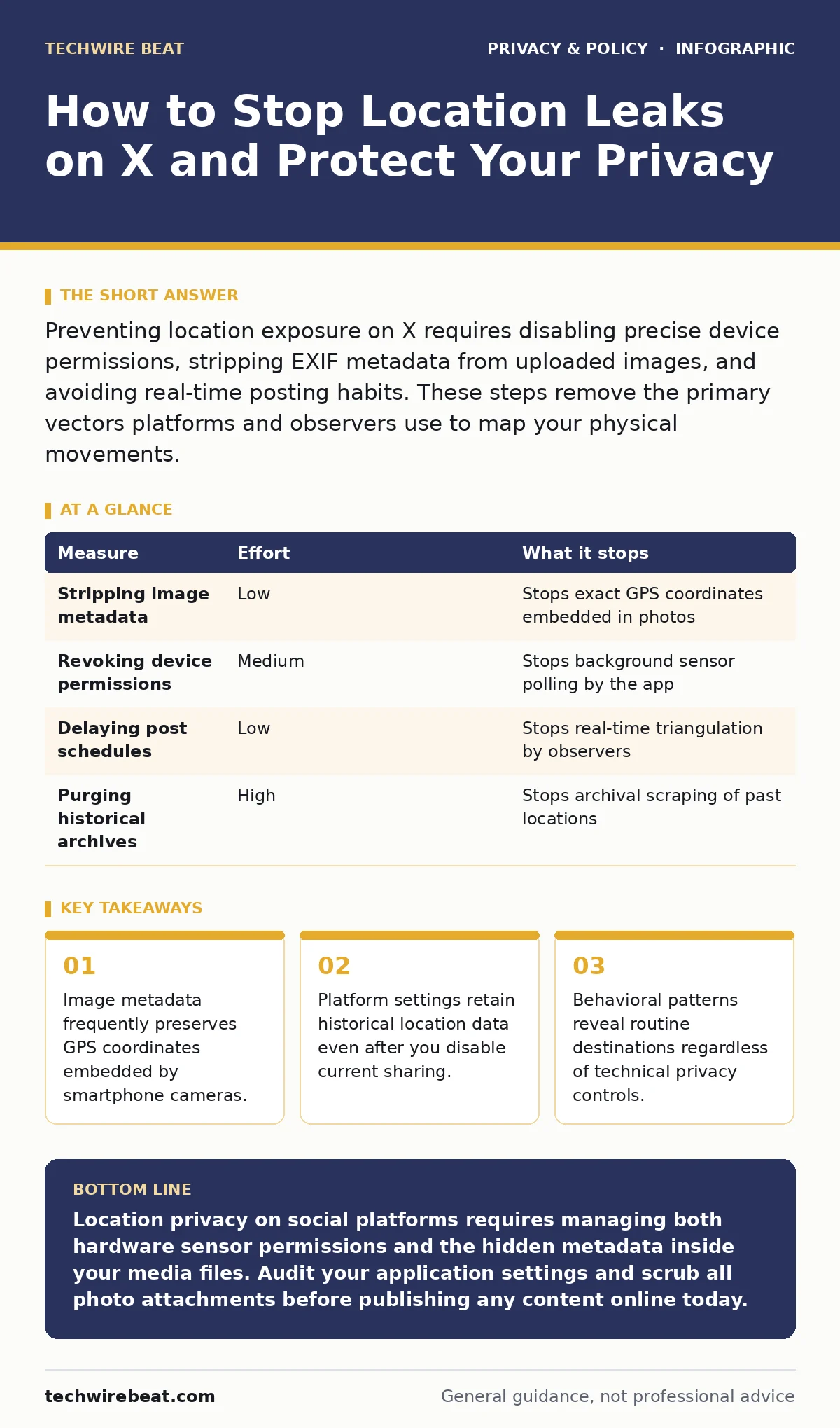
Preventing location exposure on X requires disabling precise device permissions, stripping EXIF metadata from uploaded images, and avoiding real-time posting habits. These steps remove the primary vectors platforms and observers use to map your physical movements.
Stripping Metadata from Uploaded Media
Smartphone cameras embed exchangeable image file format data directly into every photograph you capture. This hidden information includes precise latitude and longitude values alongside device identifiers and timestamps. Removing these details before publishing requires processing images through stripping software or relying on operating system sharing sheets that scrub metadata automatically. Neglecting this step exposes your home address even when your account profile lists no geographic information.
Digital cameras and modern handsets treat location tagging as a default feature designed to organise photo galleries. Turning off location access inside your camera application settings stops new files from acquiring coordinates at the moment of capture. Older photographs stored in your cloud archive retain their original geographic stamps unless you manually edit or delete them. Treating every image file as a potential tracking beacon changes how safely you share visual media online.
Managing Device Permissions for Location Services
Operating systems grant applications granular access to your device GPS sensors through specific software toggles. Revoking location permissions for the platform client prevents background polling that records your movements throughout the day. Mobile app permission abuse occurs when secondary utilities harvest sensor data and share telemetry across connected services. Restricting access to never or only while using the application limits the continuous stream of spatial coordinates sent to remote servers.
Background refresh capabilities allow applications to update content and transmit telemetry while your phone rests in your pocket. Disabling background data exchange for the platform client reduces the frequency of automated location check-ins. Operating system settings provide master switches to sever communication between hardware sensors and specific software packages. Combining OS-level sensor blocks with strict internal privacy configurations creates multiple layers of defence against spatial tracking.
Eliminating Real-Time Posting Habits
Temporal correlation links your physical presence to published text through simple observation of timestamps and local events. Tweeting about a sudden traffic delay or a local weather anomaly instantly narrows your physical radius to a few city blocks. Delaying your publishing schedule by several hours breaks the direct chain between your physical arrival and digital broadcast. Maintaining strict discipline regarding when you publish updates neutralises the threat of real-time triangulation by interested observers.
Routine travel patterns expose your recurring destinations regardless of technical anonymity measures applied to individual posts. Leaving work at the exact same minute each weekday and publishing immediately afterward establishes a predictable spatial baseline. Varying your transit routes and publishing schedules introduces enough noise into your timeline to defeat automated tracking algorithms. Understanding data privacy principles helps you recognize how seemingly unrelated fragments combine to reveal your habits.
Reviewing Historical Data and Connected Services
Platform accounts accumulate years of archived location tags, geotagged posts, and connected third-party application authorizations. Requesting an archive download allows you to inspect every geographic data point the platform associates with your identity. Deleting historical posts that contain location tags requires systematic searching or third-party script automation. Removing old digital footprints prevents archival scraping tools from reconstructing your past travel history.
Third-party client applications often bypass primary platform privacy controls and log location data independently. Revoking authorization for external schedulers and analytics tools closes hidden backdoors into your account telemetry. Public Wi-Fi risks compound spatial tracking when unencrypted networks broadcast your device identifiers to local routers and gateway operators. Securing your connection parameters ensures that local observers cannot intercept the metadata packets your device transmits during normal operation.
| Measure | Effort | What it stops |
|---|---|---|
| Stripping image metadata | Low | Stops exact GPS coordinates embedded in photos |
| Revoking device permissions | Medium | Stops background sensor polling by the app |
| Delaying post schedules | Low | Stops real-time triangulation by observers |
| Purging historical archives | High | Stops archival scraping of past locations |
Securing Account Infrastructure Against Inference
Inference attacks combine public statements, local check-ins, and follower networks to deduce your coordinates without direct GPS disclosures. Mentioning local businesses, sports teams, or regional slang provides strong probabilistic clues about your residential area. Limiting your follower list and auditing profile descriptions reduces the surface area available for social engineering and spatial deduction. Treating your public profile as an open intelligence dossier shifts your operational security mindset.
Platform algorithms track your interaction history to infer where you live, work, and socialise based on local engagement patterns. Interacting predominantly with accounts from a specific neighbourhood signals your geographical anchor to platform analytics engines. Resetting your ad personalization preferences and limiting local engagement breaks the feedback loop that refines your inferred location profile. Diligence across both technical settings and behavioral habits remains the only reliable method for maintaining spatial privacy.
Key takeaways
- Image metadata frequently preserves GPS coordinates embedded by smartphone cameras.
- Platform settings retain historical location data even after you disable current sharing.
- Behavioral patterns reveal routine destinations regardless of technical privacy controls.
Location privacy on social platforms requires managing both hardware sensor permissions and the hidden metadata inside your media files. Audit your application settings and scrub all photo attachments before publishing any content online today.
Frequently asked questions
Can someone find my exact address from a text-only post on X?
Text posts rarely reveal exact coordinates unless you mention specific local landmarks, but they can narrow your location down to a neighbourhood through contextual clues and timestamps.
Does turning off my phone GPS stop all location tracking on social media?
Disabling GPS stops direct sensor readings, but platforms can still infer your location using internet protocol addresses, Wi-Fi network associations, and metadata from uploaded media files.
Why do my old posts still show up in location searches after I changed my settings?
Changing your current privacy settings only affects future data collection, meaning historical posts and previously harvested metadata remain intact until you manually delete them.
Are images taken with professional cameras safer to upload than smartphone photos?
Professional cameras often lack built-in GPS modules, but they still record camera serial numbers, lens details, and creation timestamps in the file headers that can link media back to specific owners.
How this guide was produced: written by the TechWire Beat editorial team with AI assistance, checked against the public references listed below, and reviewed when the facts change. See our editorial policy or report an error.