Data Privacy Principles: How to Protect Your Digital Life
Most privacy failures occur because organisations collect data they do not need, rather than because hackers steal data that was properly secured and minimised.

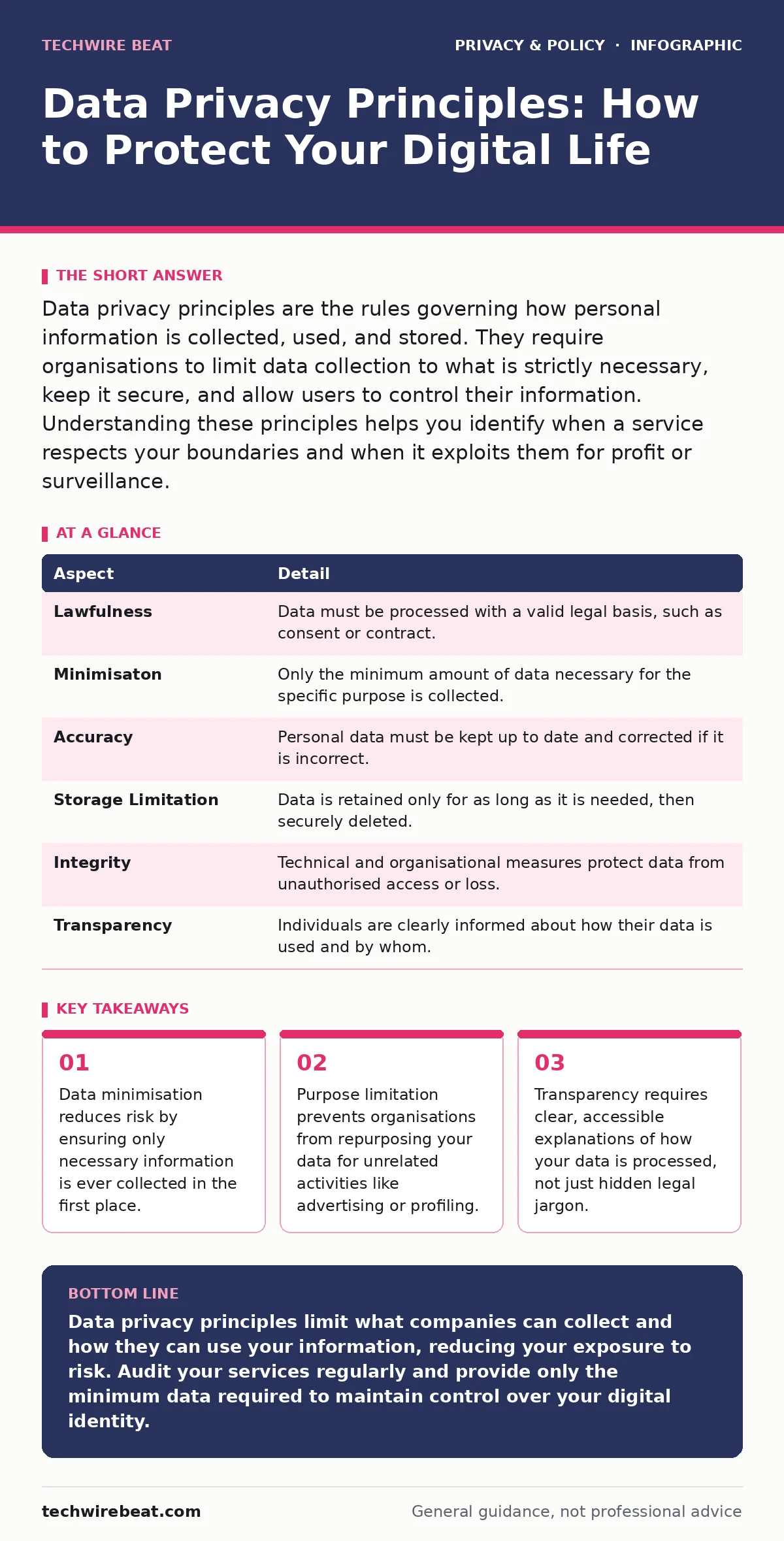
Data privacy principles are the rules governing how personal information is collected, used, and stored. They require organisations to limit data collection to what is strictly necessary, keep it secure, and allow users to control their information. Understanding these principles helps you identify when a service respects your boundaries and when it exploits them for profit or surveillance.
The Library Analogy for Data Handling
Imagine you visit a library to borrow a single book. The librarian asks for your name and home address to calculate fines if the book is lost. This is reasonable. Now imagine the librarian also asks for your date of birth, your employer, and your political views. You would refuse. Data privacy principles operate on this same logic of proportionality. They ensure that any entity collecting your information takes only what it needs to perform a specific service. Nothing more.
This analogy highlights the core tension in digital interactions. Organisations often treat every piece of data as a potential asset, ignoring the privacy risk it creates. You must recognise that providing more information than necessary increases your exposure to identity theft and profiling. The goal is to restrict access to the minimum viable dataset required for the transaction.
What Are Data Privacy Principles?
Data privacy principles are the foundational rules that dictate how personal data should be handled throughout its lifecycle. These principles are not merely suggestions; they form the basis of modern legislation and ethical frameworks worldwide. They apply to any organisation that processes personal information, including health records, financial details, and online browsing habits.
The principles ensure that individuals retain control over their digital identity. They prevent companies from treating personal data as a free resource to be harvested and sold. By adhering to these standards, organisations build trust and reduce the likelihood of costly breaches. You benefit from these rules because they legally obligate entities to justify why they need your data.
At a Glance: Core Principles Table
| Aspect | Detail |
|---|---|
| Lawfulness | Data must be processed with a valid legal basis, such as consent or contract. |
| Minimisaton | Only the minimum amount of data necessary for the specific purpose is collected. |
| Accuracy | Personal data must be kept up to date and corrected if it is incorrect. |
| Storage Limitation | Data is retained only for as long as it is needed, then securely deleted. |
| Integrity | Technical and organisational measures protect data from unauthorised access or loss. |
| Transparency | Individuals are clearly informed about how their data is used and by whom. |
How Data Privacy Principles Work in Practice
These principles function as a checklist for data handling. When a company designs a new app, it must first determine what data is absolutely required. If a fitness tracker needs your heart rate, it does not need your email address or your contacts list. This is the principle of data minimisation in action. It reduces the attack surface for hackers and limits the damage if a breach occurs.
Purpose limitation is another critical mechanism. If you provide your address for shipping, the company cannot use that address to target you with local political ads. The data was collected for delivery, not marketing. Using it otherwise violates the principle of purpose limitation. This separation ensures that your data does not follow you everywhere you go.
Accountability requires organisations to prove they follow these rules. They must maintain records of their data processing activities. If a regulator asks, the company must show exactly how it collected, stored, and deleted your information. This shifts the burden of proof onto the data handler, not the individual. You do not need to prove your data was mishandled; they must prove it was handled correctly.
Who Is Affected by These Rules?
Every individual who interacts with digital services is affected by data privacy principles. This includes social media users, online shoppers, and remote workers. The rules also apply to organisations of all sizes, from multinational corporations to small local businesses. Even a sole trader collecting email addresses for a newsletter must adhere to these standards.
Employers are particularly affected because they handle sensitive employee data. This includes payroll information, performance reviews, and health records. Mishandling this data can lead to legal penalties and loss of employee trust. You should expect your employer to follow the same privacy standards as any other service provider. They cannot exempt themselves from these rules simply because they are your boss.
Service providers who process data on behalf of other companies are also bound by these principles. This includes cloud storage providers and payment processors. They act as data processors and must implement strong security measures. If they fail to protect your data, they share liability with the company that hired them. This creates a chain of responsibility that protects your information at every stage.
See also: Social Media Privacy Concerns: How Platforms Use Your Data · Data Brokers Opt Out: How to Remove Your Personal Information
What People Usually Get Wrong
Many people believe that privacy settings alone protect their data. This is incorrect. Privacy settings control visibility, not collection. The company may still collect and store your data even if you hide it from friends. You cannot opt out of data collection through a simple toggle if the service’s business model relies on harvesting that information.
Another common misconception is that anonymised data is safe. Researchers often strip names and addresses from datasets to protect identity. However, combining anonymised data with other public records can often re-identify individuals. This is known as the re-identification risk. You should assume that any data linked to your behaviour can eventually be traced back to you.
People also assume that if a service is free, their data is not being used. In reality, free services usually monetise user data directly. The cost of the service is your attention and personal information. Understanding this trade-off is vital for making informed choices. You are not getting something for nothing; you are paying with your privacy.
For deeper context on how this applies to smaller entities, read our guide on privacy laws for small businesses. It explains how even minor data handling mistakes can have significant legal consequences.
What To Do About It
You can enforce these principles by auditing the services you use. Start by reviewing the privacy policies of your most-used apps. Look for clear statements on data retention and third-party sharing. If a policy is vague or overly complex, consider it a red flag. Transparency is a principle itself; if a company hides its practices, it likely violates other principles too.
Limit the data you share proactively. Use alternative email addresses for sign-ups that do not require your primary inbox. Provide only the minimum required information during registration. If a field is optional, leave it blank. This practice of data minimisation protects you by reducing the amount of information available to hackers or data brokers.
Regularly request access to your data. Most jurisdictions grant you the right to see what companies hold about you. Use this right to verify accuracy and request deletion of unnecessary records. This keeps your digital footprint small and manageable. You are in control of your information, not the companies that store it.
To understand how your location data is tracked, see our analysis of smart home privacy risks. These devices often collect more data than users realise, violating the principle of minimisation.
The problem of data aggregation is widespread. See our guide on data brokers to understand how your scattered information is combined into detailed profiles. These profiles are often sold without your explicit consent.
Mobile apps frequently request excessive permissions. Our guide on mobile app permission abuse details how to restrict access to your contacts, camera, and location. Limiting these permissions enforces the principle of data minimisation at the device level.
Children require stronger protections due to their inability to understand data risks. Our article on children's privacy laws explains the additional safeguards required for young users. Parents should audit the apps their children use to ensure compliance with these stricter standards.
For secure communication, end-to-end encryption ensures that only you and your recipient can read your messages. This technical measure supports the principle of integrity by preventing unauthorised access to your content.
If your personal information appears online unexpectedly, check our guide on people-search sites. These platforms aggregate public records and often violate the spirit of purpose limitation by making private data publicly searchable.
Data Privacy Principles for Long-Term Protection
Adopting these principles is not a one-time task. It requires ongoing vigilance. Technology evolves, and so do the methods used to collect and exploit personal data. You must regularly review your digital habits and update your privacy settings. New features often come with new data collection practices that you may not have noticed.
Education is key. Understand the mechanisms behind data collection. When you know how data is harvested, you can better identify when a service is violating these principles. Look for services that publish transparency reports and adhere to open standards. These companies are more likely to respect your privacy because their practices are visible to the public.
Ultimately, data privacy principles are tools for empowerment. They give you the legal and ethical framework to demand respect for your personal information. Use them to hold companies accountable. Your data is yours, and you have the right to control how it is used.
Key takeaways
- Data minimisation reduces risk by ensuring only necessary information is ever collected in the first place.
- Purpose limitation prevents organisations from repurposing your data for unrelated activities like advertising or profiling.
- Transparency requires clear, accessible explanations of how your data is processed, not just hidden legal jargon.
Data privacy principles limit what companies can collect and how they can use your information, reducing your exposure to risk. Audit your services regularly and provide only the minimum data required to maintain control over your digital identity.
Frequently asked questions
Do data privacy principles apply to small businesses?
Yes, data privacy principles apply to any organisation that processes personal data, regardless of size. Small businesses must still follow rules on consent, security, and transparency.
Can I delete my data from a company's servers?
In most jurisdictions, you have the right to request the deletion of your personal data. Companies must comply unless they have a legal reason to retain it, such as tax records.
Is anonymised data truly private?
Anonymised data is safer but not perfectly private. Advanced techniques can sometimes re-identify individuals by combining anonymised datasets with other public information.
How do I know if a company follows these principles?
Look for clear privacy policies, transparency reports, and easy-to-use data management tools. If a company is vague about its practices, it likely does not adhere to these principles.
How this guide was produced: written by the TechWire Beat editorial team with AI assistance, checked against the public references listed below, and reviewed when the facts change. See our editorial policy or report an error.