Privacy Laws For Small Businesses: The Hidden Security Advantage
Treating privacy compliance as a security framework reduces attack surface and prevents data leaks before they occur.

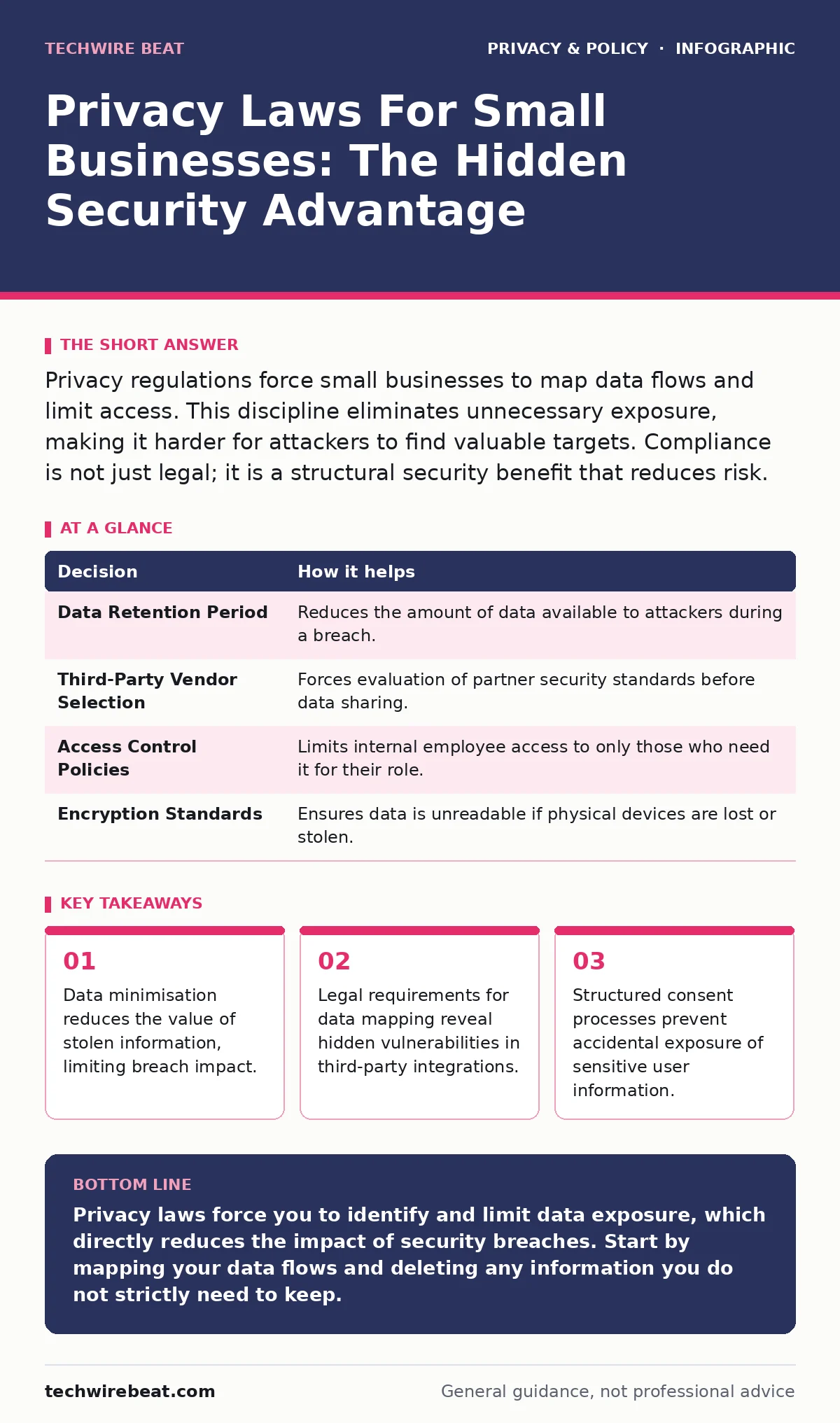
Privacy regulations force small businesses to map data flows and limit access. This discipline eliminates unnecessary exposure, making it harder for attackers to find valuable targets. Compliance is not just legal; it is a structural security benefit that reduces risk.
The Security Value of Privacy Compliance
Most small business owners view privacy laws as a legal burden. They see checklists, forms and potential fines. This perspective misses the primary benefit. Privacy regulations require you to know exactly what data you hold. This knowledge is the foundation of effective security. When you do not know where your data lives, you cannot protect it.
Privacy laws mandate data inventory. You must list every piece of personal information you collect. You must record where it goes and who accesses it. This process, often called data mapping, exposes weak points in your infrastructure. It reveals legacy systems holding obsolete records. It highlights third-party vendors with poor security practices.
Decisions Informed by Data Mapping
The act of mapping data forces concrete architectural decisions. You can no longer rely on vague assumptions about data flow. You must choose specific storage locations and retention periods. These choices directly impact your security posture.
| Decision | How it helps |
|---|---|
| Data Retention Period | Reduces the amount of data available to attackers during a breach. |
| Third-Party Vendor Selection | Forces evaluation of partner security standards before data sharing. |
| Access Control Policies | Limits internal employee access to only those who need it for their role. |
| Encryption Standards | Ensures data is unreadable if physical devices are lost or stolen. |
What Goes Wrong Without Structure
Imagine a small e-commerce team that ignores privacy requirements. They store customer addresses in a plain-text spreadsheet. They share this file via an unsecured cloud link. They never delete old records. An attacker discovers the link through a search engine. The breach is immediate and total.
Without privacy-driven structure, data sprawl occurs. Information accumulates in email attachments, local drives and cloud folders. Employees create their own copies for convenience. Security tools cannot protect what you have not identified. You are defending a perimeter that does not exist. The attack surface grows with every new employee and every new software tool.
How Teams Use Privacy for Security
Effective teams use privacy audits as a security diagnostic. They treat the legal requirement as a free vulnerability assessment. They start by identifying high-value data. They then restrict access to that data. This principle, known as least privilege, limits the damage of compromised accounts.
Teams also use consent management to control data collection. By asking users for specific permissions, they collect only what is necessary. This reduces the volume of sensitive data stored. Less data means fewer targets for attackers. It also simplifies the process of securing what remains.
Consider the role of secure DNS. This protocol encrypts domain name queries. Privacy laws often require you to protect user data in transit. Implementing secure DNS satisfies both privacy and security needs. It prevents attackers from seeing which websites your users visit. This adds a layer of protection without significant cost.
The Cost of Ignoring Privacy Laws
Ignoring privacy laws creates a false sense of security. You may have firewalls and antivirus software. But if you are storing unnecessary data, you are vulnerable. Attackers often target small businesses because they assume weak controls. They look for easy access to large datasets.
When a breach occurs, the lack of privacy structure worsens the outcome. You do not know what was taken. You cannot notify affected users accurately. Regulatory fines are only part of the cost. Reputational damage drives customers away. Trust is difficult to rebuild. The financial impact can be existential for a small business.
See also: AI Governance for Small Teams: Practical Controls and Cost
Integrating Privacy into Daily Operations
Privacy is not a one-time project. It is a continuous process. Integrate privacy checks into your software development lifecycle. Ask developers to consider data minimisation at the design stage. Do not wait until the product is built. This approach, called privacy by design, prevents vulnerabilities from being coded in.
Train employees on data handling procedures. They are often the weakest link. Phishing attacks target human error. Clear policies on data sharing reduce accidental exposure. Regular privacy audits keep these policies relevant. They ensure that new tools and processes comply with established standards.
Beyond Basic Compliance
Compliance is the minimum standard. True security goes further. Use the insights from privacy audits to improve overall resilience. Identify patterns in data access. Look for anomalies that indicate insider threats. Monitor third-party vendors for changes in their security posture.
Consider the risks of mobile app permission abuse. Many apps request more data than they need. If you develop apps, follow the same principle. Request only the permissions necessary for core functionality. This reduces the risk of data leakage. It also builds trust with users who are increasingly aware of their digital footprint.
The Long-Term Benefit
Privacy laws provide a framework for responsible data management. They force you to think critically about your data. This discipline leads to a more secure organisation. You reduce the amount of data at risk. You improve visibility into your systems. You build a culture of security awareness.
Small businesses often lack the resources of large corporations. They cannot afford massive security teams. Privacy compliance levels the playing field. It provides a structured approach to risk management. It turns legal requirements into security advantages. You protect your customers and your business.
Final Considerations
Implementing privacy-driven security does not require expensive tools. It requires discipline and attention to detail. Start with a data inventory. Identify where your most sensitive information lives. Restrict access to that information. Delete what you do not need.
Review your third-party relationships. Ensure they meet your security standards. Use encryption for data in transit and at rest. Train your staff on data handling. Conduct regular privacy audits. These steps create a resilient security posture. They protect you from attacks and regulatory penalties.
Key takeaways
- Data minimisation reduces the value of stolen information, limiting breach impact.
- Legal requirements for data mapping reveal hidden vulnerabilities in third-party integrations.
- Structured consent processes prevent accidental exposure of sensitive user information.
Privacy laws force you to identify and limit data exposure, which directly reduces the impact of security breaches. Start by mapping your data flows and deleting any information you do not strictly need to keep.
Frequently asked questions
Do small businesses really need to comply with privacy laws?
Yes. Most privacy regulations apply to any business that processes personal data, regardless of size. Compliance protects you from fines and security risks.
How do I start a data inventory?
Begin by listing all systems that store customer data. Identify what data is stored, who can access it, and where it is sent. Document this information in a central register.
Is encryption enough to satisfy privacy requirements?
No. Encryption protects data confidentiality, but privacy laws also require data minimisation, purpose limitation and user consent. You must manage the entire data lifecycle.
What happens if I ignore privacy audits?
You risk undetected data sprawl and security vulnerabilities. Without audits, you cannot verify that your controls are effective or that data is being deleted as required.
How this guide was produced: written by the TechWire Beat editorial team with AI assistance, checked against the public references listed below, and reviewed when the facts change. See our editorial policy or report an error.