AI Governance for Small Teams: Practical Controls and Cost
Small teams can secure AI by defining data boundaries and using standard frameworks, avoiding the need for expensive, dedicated compliance departments.

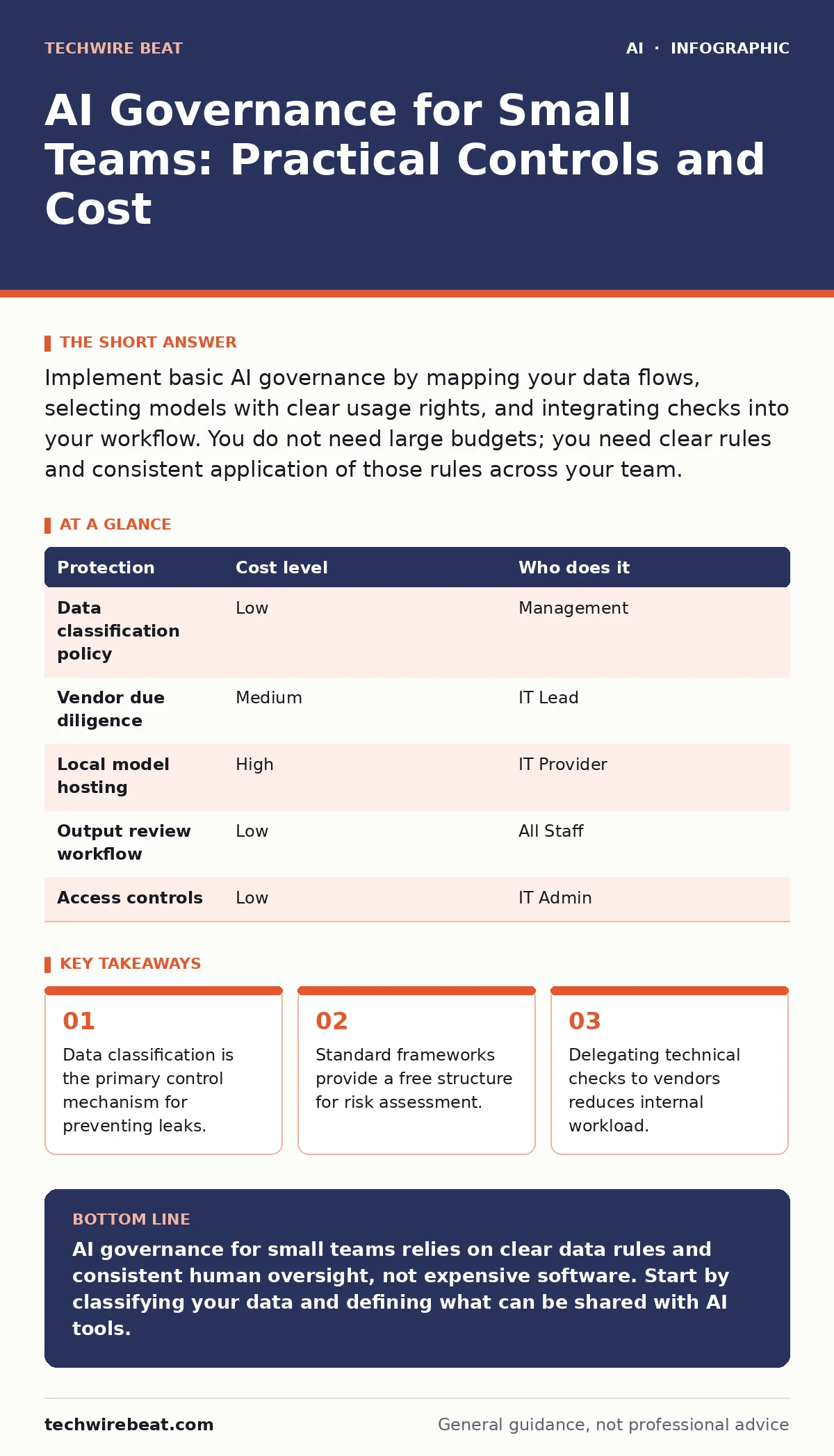
Implement basic AI governance by mapping your data flows, selecting models with clear usage rights, and integrating checks into your workflow. You do not need large budgets; you need clear rules and consistent application of those rules across your team.
Define Your Data Boundaries
The first step in AI governance is not selecting a tool, but understanding what data you possess. You must classify your information into categories such as public, internal, confidential, and restricted. This classification determines which AI systems can process the data. If you allow unrestricted access, you risk exposing sensitive details to models that may retain or reuse that information.
Most small businesses fail here because they assume the AI tool is "private" by default. It is not. Unless the service explicitly states that it does not use your inputs for training, your data becomes part of the model's learning material. This creates a permanent link between your proprietary information and the public model. You must verify the data retention policy of every AI service you adopt.
Consider the mechanism of context windows. These are the temporary memory spaces where the model holds your conversation. When the session ends, that memory is usually discarded. However, if you upload documents, the system may store those files for feature enhancement or debugging. You need to know where those files live and who can access them. This is a matter of checking the service's privacy documentation, not trusting marketing claims.
Apply Standard Frameworks
You do not need to invent a governance strategy from scratch. Established frameworks provide the structure you need. The NIST AI Risk Management Framework offers a set of functions to identify, assess, and manage risks. It is designed for organizations of any size and is freely available. Using it signals to clients and partners that you take technical risk seriously.
Another relevant area is AI risk management, which focuses on the lifecycle of the AI system. This includes how the model is trained, how it is deployed, and how it is monitored. For a small team, this means asking simple questions about the vendor's update process. Does the vendor patch the model when new vulnerabilities are found? How do they handle requests to remove data from training sets?
You should also review responsible AI practices. These practices address fairness, transparency, and accountability. For a small business, this often means ensuring that the AI does not produce biased outputs that could damage your brand. If you use AI for hiring or customer service, bias can lead to legal issues and reputational harm. You must test the outputs for fairness before publishing or acting on them.
Cost Effective Controls
Governance does not require expensive software. It requires discipline. The most affordable control is policy. Write down what your employees can and cannot put into AI tools. Post this policy in your shared workspace. Make it part of the onboarding process. This costs nothing but time, yet it establishes a clear baseline for behaviour.
Another low-cost measure is technical restriction. Many AI platforms offer enterprise settings that disable data retention. You can enforce these settings across your organization. This prevents accidental leakage without requiring constant supervision. If your budget allows, consider tools that perform local processing. These tools run on your own servers, keeping data within your network. This is more expensive than cloud services but eliminates third-party data exposure.
| Protection | Cost level | Who does it |
|---|---|---|
| Data classification policy | Low | Management |
| Vendor due diligence | Medium | IT Lead |
| Local model hosting | High | IT Provider |
| Output review workflow | Low | All Staff |
| Access controls | Low | IT Admin |
Delegate Technical Checks
You cannot monitor every prompt. Instead, delegate specific checks to your IT provider or vendor. Ask them to implement logging and alerting. These systems flag unusual activity, such as a sudden spike in data uploads or access from unexpected locations. You do not need to analyse the logs yourself; you need to know when something goes wrong.
When hiring an IT provider, ask specific questions about their capability to manage AI risks. Do they have experience with training data leakage prevention? Can they configure network filters to block access to unauthorized AI sites? Do they provide regular reports on data usage patterns? These questions help you assess their competence without needing deep technical knowledge yourself.
Another area to delegate is model monitoring. AI models can drift over time, meaning their performance changes as the world changes. A model trained on last year's data may produce outdated or incorrect results today. Your provider should monitor for this drift and recommend updates. This ensures your AI remains accurate and safe without requiring your team to retrain models manually.
Integrate Governance into Workflow
Governance fails if it is a separate, burdensome process. Integrate it into your daily workflow. For example, require a human review for any AI-generated content that will be published externally. This step adds time but catches errors and biases before they reach the public. It also reinforces the idea that AI is a tool, not a replacement for human judgment.
Use checklists to simplify the process. A simple list of three or four questions can guide your staff. Is this data confidential? Is the output accurate? Is the tone appropriate? Has the data been removed from the prompt after use? These questions take seconds to answer but provide a consistent standard for quality and security.
Consider the impact of agentic AI. These systems can take actions on your behalf, such as sending emails or booking appointments. Governance here is critical because the consequences of errors are immediate and automated. You must define clear boundaries for what these agents can and cannot do. Test them thoroughly in a sandbox environment before allowing them to interact with live systems.
See also: Privacy Laws For Small Businesses: The Hidden Security Advantage
Monitor and Adapt
AI technology evolves rapidly. Your governance strategy must evolve with it. Review your policies every six months. Check for new features in the tools you use. Assess whether new risks have emerged. This regular review ensures your controls remain effective and relevant.
Stay informed about developments in machine learning in cybersecurity. Adversaries are using AI to create more sophisticated attacks. Understanding these trends helps you anticipate potential threats. You do not need to become an expert, but you should be aware of the general direction of the field. This awareness allows you to adjust your defences proactively.
Finally, be aware of deepfake fraud. AI can now create convincing fake audio and video. Train your staff to verify requests for money or sensitive information through a secondary channel. This simple step protects you from social engineering attacks that use AI-generated media. It is a low-cost control with a high impact on security.
Key takeaways
- Data classification is the primary control mechanism for preventing leaks.
- Standard frameworks provide a free structure for risk assessment.
- Delegating technical checks to vendors reduces internal workload.
AI governance for small teams relies on clear data rules and consistent human oversight, not expensive software. Start by classifying your data and defining what can be shared with AI tools.
Frequently asked questions
Do we need a dedicated AI officer?
No. Small teams can assign AI governance responsibilities to existing roles, such as the IT manager or compliance officer. Clear policies and training are more effective than a new hire.
How do we prevent data leakage?
Classify your data and restrict which AI tools can access sensitive information. Use enterprise settings to disable data retention and train staff on what not to share.
Is open-source AI safer?
Open-source models offer transparency but require more technical skill to secure. You are responsible for all security configurations. Commercial tools often provide built-in safeguards but may use your data for training.
What if an AI tool makes a mistake?
Implement a human review step for all critical outputs. Maintain logs of AI usage to trace errors. Have a clear process for correcting mistakes and informing affected parties.
How this guide was produced: written by the TechWire Beat editorial team with AI assistance, checked against the public references listed below, and reviewed when the facts change. See our editorial policy or report an error.