Responsible AI Practices: Answering Eight Critical Questions
Auditing model decisions often reveals that the data collection method, not the algorithm itself, is the primary source of systemic unfairness.

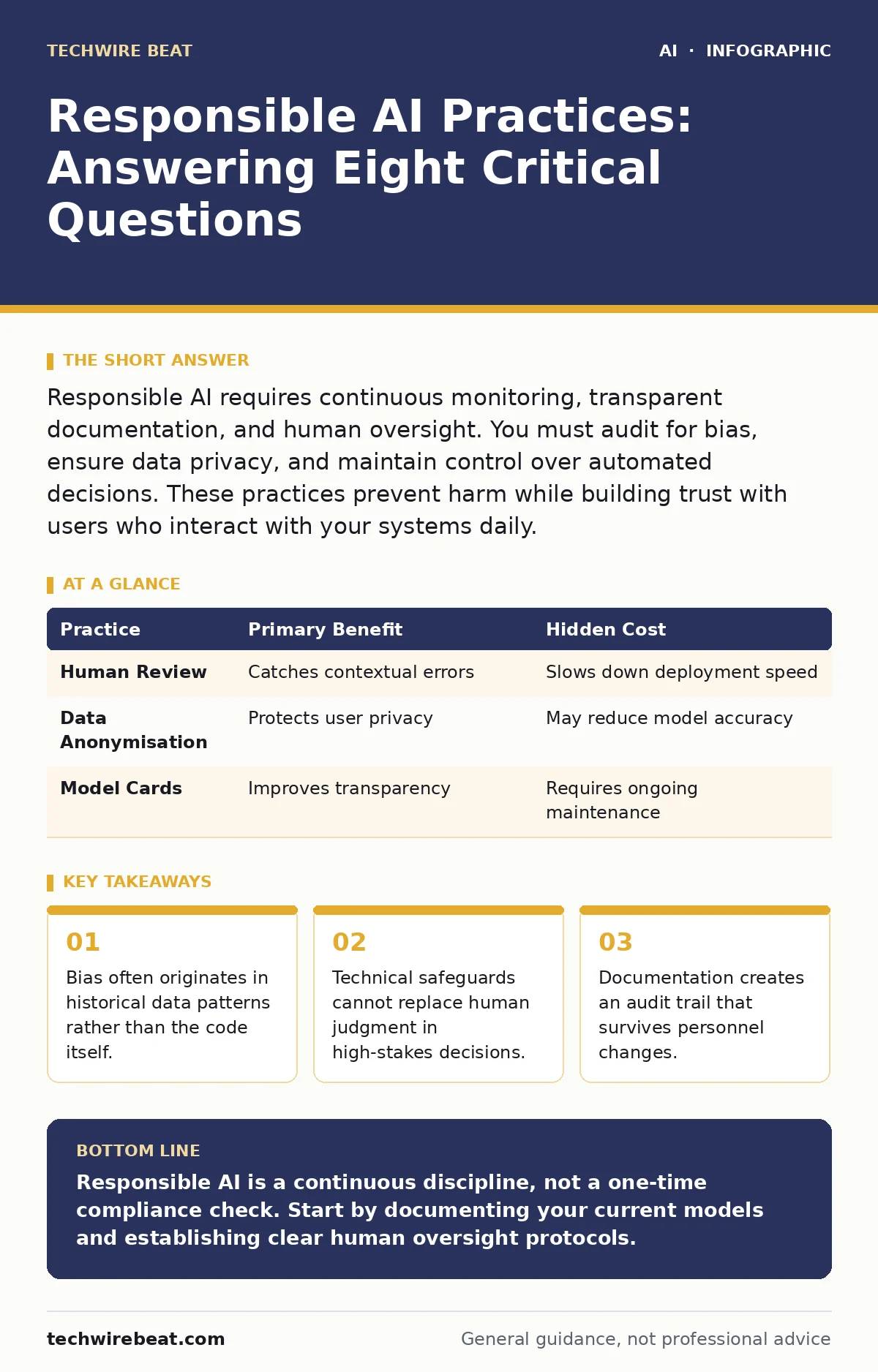
Responsible AI requires continuous monitoring, transparent documentation, and human oversight. You must audit for bias, ensure data privacy, and maintain control over automated decisions. These practices prevent harm while building trust with users who interact with your systems daily.
What does responsible AI actually mean?
Responsible AI means designing, deploying, and monitoring systems that act fairly, safely, and transparently. It is not a single technical fix but a continuous process of managing risk throughout the system’s lifecycle. You treat the model as a dynamic component that can degrade or behave unexpectedly over time.
How do you detect bias in training data?
You detect bias by analysing the distribution of your training data against the real-world population it represents. If certain groups are underrepresented, the model will likely perform poorly for them. This is not always obvious from accuracy metrics alone, as overall performance can mask specific failures.
Imagine you are building a hiring tool. If your historical data reflects past hiring prejudices, the model will learn to replicate those patterns. You must audit the data sources themselves, not just the output. For deeper technical context, see our guide on AI bias.
Why is model explainability difficult to achieve?
Model explainability is difficult because many high-performing algorithms, such as deep neural networks, operate as "black boxes." They make decisions through millions of internal calculations that are not easily mapped to human logic. You can see the input and the output, but the reasoning in between is opaque.
This creates a trade-off. More complex models often provide higher accuracy but lower transparency. You must choose between predictive power and the ability to justify a decision to a regulator or user.
Can you trust an AI to make safety-critical decisions?
You cannot fully trust an AI to make safety-critical decisions without human oversight. Automated systems lack context and moral reasoning, meaning they may optimise for efficiency at the cost of safety. Human-in-the-loop systems ensure that a person reviews high-risk outputs before they take effect.
This approach adds latency to the process, which is a significant operational cost. However, the cost of a single catastrophic failure far outweighs the delay. For related security applications, review machine learning in cybersecurity.
How do you protect user privacy when training models?
You protect privacy by minimising the data you collect and anonymising it before it enters the training pipeline. Techniques like differential privacy add statistical noise to datasets, making it impossible to identify individual contributors. You should also implement strict access controls on the raw data.
Even anonymised data can sometimes be re-identified if combined with other public records. This is a non-obvious risk: the more data you have, the easier it is to reverse-engineer identities.
See also: Social Media Privacy Risks: The Hidden Data Costs You Accept · Social Media Privacy Concerns: How Platforms Use Your Data
What is the role of documentation in AI governance?
Documentation acts as the single source of truth for how a model was built and what it does. Model cards and datasheets provide standardised records of a system’s intended use, limitations, and performance characteristics. This allows teams to understand the system years after the original developers have left.
Without this record, you cannot effectively audit the system or update it safely. It turns implicit knowledge into explicit, verifiable facts. For a structured approach, consult the NIST AI Risk Management Framework.
How do you handle model drift over time?
You handle model drift by continuously monitoring performance metrics against a baseline. Models degrade when the real-world data changes, a phenomenon known as concept drift. A model trained on last year’s customer behaviour may fail this year if market trends shift.
You need automated alerts that trigger when performance drops below a defined threshold. This allows you to retrain the model before it causes significant errors. This is a core component of effective AI risk management.
Is automated content detection reliable enough?
Automated content detection is useful but not reliable enough to stand alone. Adversaries can easily modify generated content to bypass detection filters. Relying solely on software creates a false sense of security and leaves you vulnerable to sophisticated attacks.
You should combine technical detection with manual review and user reporting mechanisms. For specific threats, see our analysis of deepfake fraud and deepfake detection.
| Practice | Primary Benefit | Hidden Cost |
|---|---|---|
| Human Review | Catches contextual errors | Slows down deployment speed |
| Data Anonymisation | Protects user privacy | May reduce model accuracy |
| Model Cards | Improves transparency | Requires ongoing maintenance |
How do you manage risks with autonomous agents?
You manage risks with autonomous agents by defining strict boundaries on their actions. Agentic AI can take multi-step actions to achieve goals, which increases the potential for unintended consequences. You must implement "guardrails" that prevent the agent from accessing sensitive systems or performing irreversible actions.
Testing these agents in sandboxed environments is mandatory before any production deployment. The complexity of their decision-making paths makes traditional testing insufficient. Explore the implications of agentic AI for a deeper understanding.
What is the impact of AI watermarking?
AI watermarking embeds invisible signals into generated content to identify its origin. This helps distinguish between human-created and machine-generated material, which is vital for maintaining trust. However, watermarks can be stripped or altered by simple processing steps.
It is a deterrent, not a guarantee. You should use it as part of a broader verification strategy, not as the sole proof of authenticity. Read more about AI watermarking techniques.
Key takeaways
- Bias often originates in historical data patterns rather than the code itself.
- Technical safeguards cannot replace human judgment in high-stakes decisions.
- Documentation creates an audit trail that survives personnel changes.
Responsible AI is a continuous discipline, not a one-time compliance check. Start by documenting your current models and establishing clear human oversight protocols.
Frequently asked questions
Do I need a legal team to implement responsible AI?
Legal guidance is helpful for compliance, but engineers and data scientists must implement the technical controls. Law cannot fix a biased dataset.
How often should I retrain my models?
Retrain when performance metrics degrade or when the underlying data distribution changes significantly. There is no fixed schedule.
Can I use public datasets without permission?
Check the licence terms of each dataset. Many public datasets have restrictions on commercial use or require attribution.
What is the biggest risk of ignoring responsible AI?
The biggest risk is reputational damage and loss of user trust, which can be irreversible once a system causes public harm.
How this guide was produced: written by the TechWire Beat editorial team with AI assistance, checked against the public references listed below, and reviewed when the facts change. See our editorial policy or report an error.