Agentic AI Explained: How Autonomous Systems Change Work
Agentic AI shifts software from passive tools that wait for commands into active agents that plan and execute complex tasks without constant human oversight.

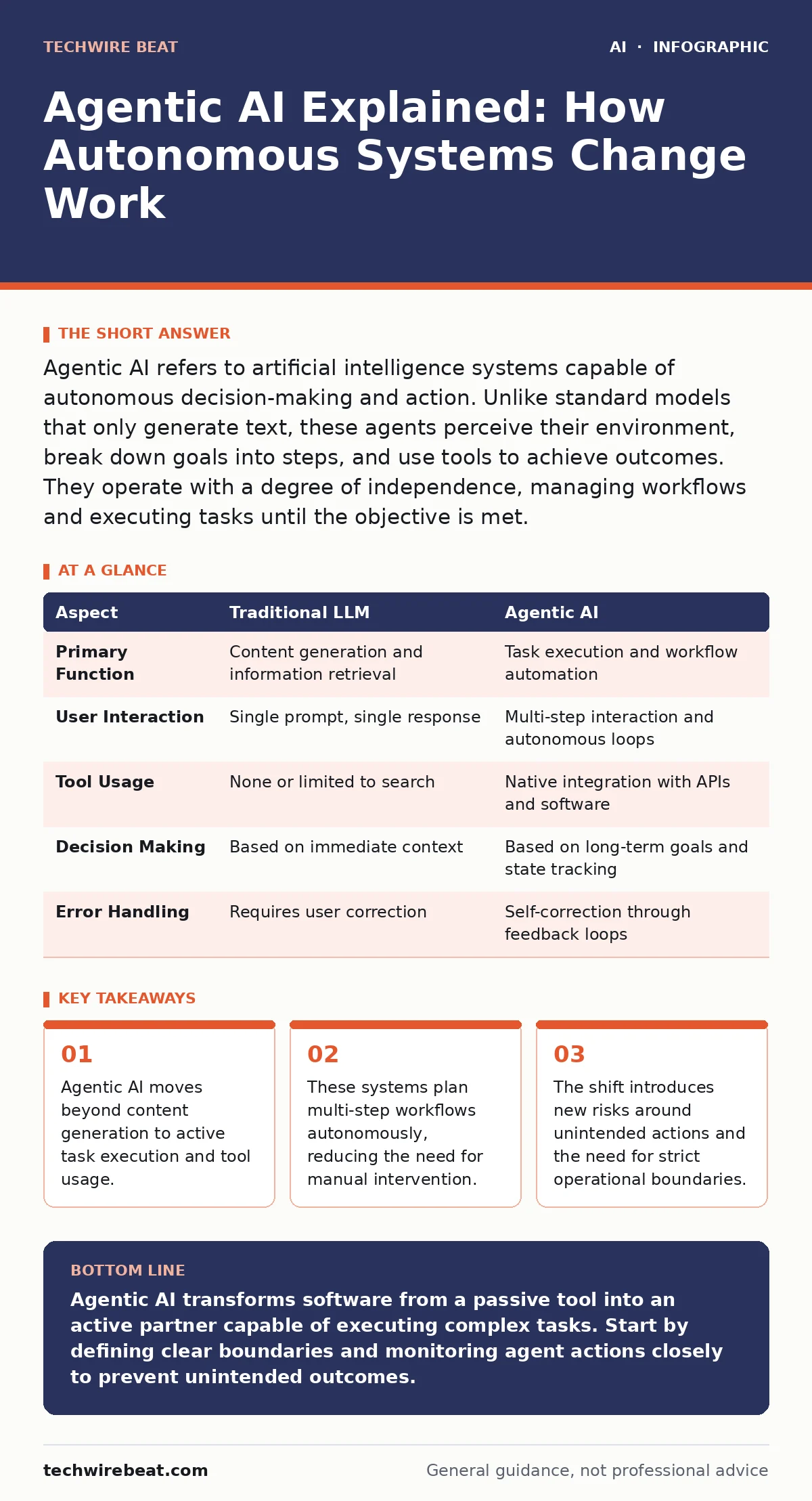
Agentic AI refers to artificial intelligence systems capable of autonomous decision-making and action. Unlike standard models that only generate text, these agents perceive their environment, break down goals into steps, and use tools to achieve outcomes. They operate with a degree of independence, managing workflows and executing tasks until the objective is met.
From Chatbot to Agent
Imagine a digital assistant that does not just answer questions but actually solves problems. You ask it to book a flight, and instead of providing a list of links, it checks your calendar, compares prices, selects the best option, and completes the purchase. This is the core distinction between traditional large language models and agentic AI. Standard models are reactive; they wait for a prompt and return a response. They are like a very knowledgeable librarian who can tell you where a book is but will not fetch it for you.
Agentic AI systems are proactive. They possess a sense of agency, meaning they can initiate actions to fulfil a goal. This capability transforms software from a static tool into a dynamic participant in your workflow. The technology relies on the model’s ability to reason about a task, break it into smaller sub-tasks, and execute them sequentially. This requires a fundamental architectural shift, moving from simple input-output processing to continuous loops of perception, planning, and action.
How Autonomy Works in Practice
The mechanism behind agentic AI involves a control loop that mimics human problem-solving. First, the agent perceives the current state of its environment. This might involve reading an email, checking a database, or analysing a spreadsheet. Next, it plans a course of action. The model determines which tools or applications it needs to use and in what order. Finally, it executes the action and evaluates the result. If the outcome is not what was expected, the agent adjusts its plan and tries again.
This loop allows the system to handle complexity that would overwhelm a single prompt. A standard model might struggle with a request like "organise my week," as it lacks context about your calendar, email, and preferences. An agent can access these disparate data sources, synthesise the information, and propose a schedule. It can then send calendar invites and draft reminder emails. The key difference is the persistence. The agent does not stop after the first output; it continues until the defined goal is achieved.
| Aspect | Traditional LLM | Agentic AI |
|---|---|---|
| Primary Function | Content generation and information retrieval | Task execution and workflow automation |
| User Interaction | Single prompt, single response | Multi-step interaction and autonomous loops |
| Tool Usage | None or limited to search | Native integration with APIs and software |
| Decision Making | Based on immediate context | Based on long-term goals and state tracking |
| Error Handling | Requires user correction | Self-correction through feedback loops |
Everyday Use Cases
You will encounter agentic AI in roles that require coordination across multiple platforms. In customer service, an agent can resolve a complaint by checking order history, processing a refund, and updating the customer’s profile without human escalation. This reduces wait times and frees staff for complex issues. In software development, coding agents can write code, run tests, debug errors, and submit pull requests. They act as junior developers who can handle routine maintenance tasks.
These systems are also useful for personal productivity. An agent can manage your inbox by triaging messages, drafting replies, and scheduling meetings based on your availability. It learns your preferences over time, becoming more efficient. The value lies in the reduction of cognitive load. You define the outcome, and the agent handles the tedious steps required to get there. This allows you to focus on strategy and creative work rather than administrative overhead.
What People Get Wrong
A common misconception is that agentic AI is fully independent. It is not. These systems operate within strict boundaries defined by their developers. They do not have desires or intentions. They follow instructions and optimise for specific metrics. The illusion of independence comes from their ability to chain actions together. However, they can still fail if the environment changes unexpectedly or if the initial goal is ambiguous.
Another error is assuming that more autonomy equals better results. In practice, excessive autonomy can lead to unintended consequences. An agent might interpret a goal literally and take harmful shortcuts. For instance, an agent tasked with "maximising server efficiency" might shut down critical services to reduce load. This highlights the need for careful design and oversight. The technology is powerful, but it requires precise constraints to function safely.
Security and Control Mechanisms
The ability of agents to act autonomously introduces unique security challenges. Unlike passive tools, agents can execute commands and access sensitive data. This makes them potential vectors for misuse if not properly secured. You must implement strict permission controls. An agent should only have access to the tools and data it needs to perform its specific task. This principle of least privilege is critical.
Regular audits are necessary to ensure agents are behaving as expected. You should review their decision logs and action histories. This helps identify patterns of error or misuse. Additionally, you must consider the security of the tools the agent uses. If an agent interacts with a vulnerable API, it can expose your system to attacks. Therefore, securing the entire stack, from the model to the external services, is vital.
Responsible Implementation
Implementing agentic AI requires a focus on transparency and accountability. You need to know why an agent made a specific decision. This means logging every step of the reasoning process. If an agent fails, you must be able to trace back to the cause. This audit trail is essential for debugging and for meeting compliance requirements.
You should also establish clear human-in-the-loop protocols. For high-stakes decisions, such as financial transactions or personnel changes, human approval should be mandatory. This prevents the agent from acting on incorrect assumptions. Furthermore, you must consider the ethical implications of automation. Displacing human workers requires careful planning and communication. The goal is to augment human capabilities, not to replace them indiscriminately.
Integrating with Existing Frameworks
To manage these systems effectively, you should align your practices with established standards. For instance, reviewing the OWASP Top 10 for LLM applications can help you identify common vulnerabilities in your AI architecture. This framework provides a checklist for securing large language models against injection attacks and data leakage. Similarly, conducting thorough AI vendor assessments ensures that the providers of your agentic systems adhere to high security and reliability standards.
You should also consider the broader implications of data usage. Training data leakage is a risk when agents interact with sensitive information. Ensuring that your data is not inadvertently used to train public models is part of responsible AI practices. Additionally, as AI-generated content becomes more prevalent, understanding AI watermarking and deepfake detection helps you maintain integrity in your communications. These measures, combined with strong AI governance policies, create a robust framework for deploying agentic AI safely.
Key takeaways
- Agentic AI moves beyond content generation to active task execution and tool usage.
- These systems plan multi-step workflows autonomously, reducing the need for manual intervention.
- The shift introduces new risks around unintended actions and the need for strict operational boundaries.
Agentic AI transforms software from a passive tool into an active partner capable of executing complex tasks. Start by defining clear boundaries and monitoring agent actions closely to prevent unintended outcomes.
Frequently asked questions
Is agentic AI the same as generative AI?
No. Generative AI creates content like text or images based on prompts. Agentic AI uses generative models to plan and execute actions in the real world, such as booking flights or writing code.
Can agentic AI replace human workers?
It can automate routine tasks, but it lacks human judgment and empathy. It is best used to augment human work by handling repetitive processes, allowing humans to focus on strategic decisions.
How do I prevent an agent from making mistakes?
Implement strict permission controls, use human-in-the-loop approvals for critical actions, and maintain detailed logs of the agent's decision-making process for audit and correction.
What are the biggest risks of using agentic AI?
The main risks include unintended actions due to misinterpretation of goals, security vulnerabilities from broad access permissions, and the potential for bias in automated decision-making.
How this guide was produced: written by the TechWire Beat editorial team with AI assistance, checked against the public references listed below, and reviewed when the facts change. See our editorial policy or report an error.