AI Vendor Assessments: The Hidden Costs and Concrete Benefits
Evaluating AI suppliers reveals that vendor transparency often masks architectural risks that standard security audits fail to detect.

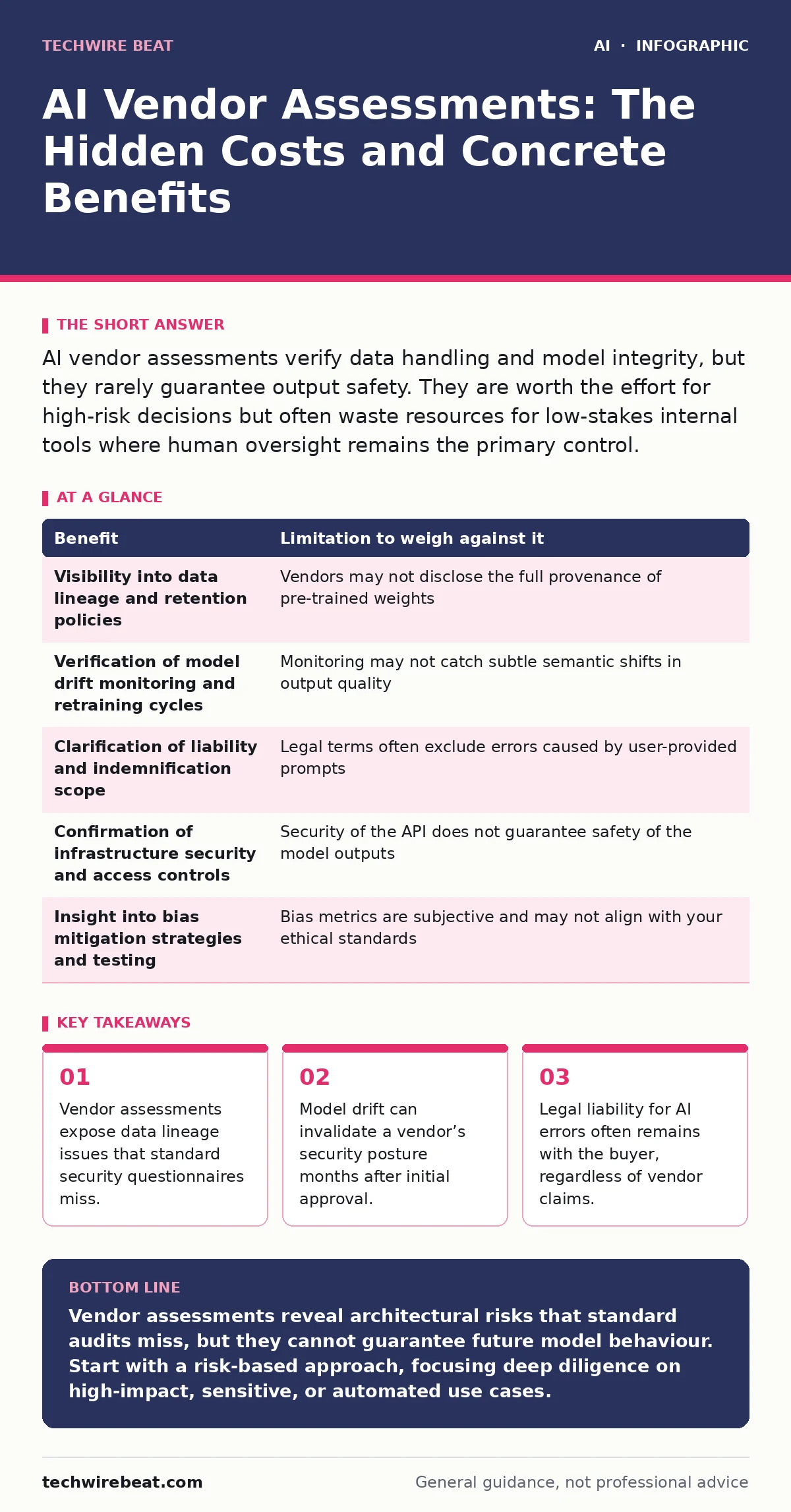
AI vendor assessments verify data handling and model integrity, but they rarely guarantee output safety. They are worth the effort for high-risk decisions but often waste resources for low-stakes internal tools where human oversight remains the primary control.
The Illusion of Security in Black Boxes
You cannot secure what you cannot see. When you integrate a third-party artificial intelligence service, you are trusting a complex system whose internal logic is often proprietary. Standard security audits check the perimeter: firewalls, encryption, and access controls. They do not check the reasoning engine. An AI vendor assessment shifts focus from infrastructure to behaviour. It examines how the model makes decisions and what data influences those decisions.
This distinction matters because a secure server can host a biased or unstable model. The model might leak sensitive information from its training set or produce outputs that violate compliance rules. You need to understand the mechanism of failure, not just the strength of the lock.
Concrete Benefits of Rigorous Evaluation
A thorough assessment provides visibility into the vendor’s data lifecycle. You learn where the training data originated and how it was cleaned. This is critical for preventing training data leakage, where proprietary information you provided for fine-tuning reappears in responses to other customers. Without this insight, your confidential data becomes part of the public model weight.
Assessments also clarify the vendor’s incident response capabilities. You discover how they handle model drift, which occurs when the model’s performance degrades over time as real-world data changes. A vendor with a robust monitoring framework will detect this shift and retrain the model. A vendor without this process will deliver declining accuracy, potentially leading to operational errors.
Furthermore, you gain clarity on liability. Some vendors offer indemnification for specific types of errors, such as copyright infringement. Others exclude all liability for output accuracy. Knowing this boundary allows you to structure your internal controls accordingly. You can align your usage with the NIST AI Risk Management Framework to map these risks to your business objectives.
Honest Limitations of Vendor Reviews
No assessment can predict every edge case. Large language models exhibit stochastic behaviour, meaning the same input can produce different outputs. An assessment might verify that the model avoids hate speech today, but it cannot guarantee it will not generate harmful content tomorrow due to subtle prompting changes. You are evaluating a snapshot, not a permanent state.
Vendors often provide high-level documentation that lacks technical depth. They may claim "advanced encryption" without specifying key management practices. They might assert "bias mitigation" without revealing the metrics used to measure fairness. This opacity makes it difficult to verify claims independently. You are often forced to trust their self-reported metrics.
Additionally, assessments do not cover the end-user interaction layer. A vendor might secure their API, but your application could expose the model to prompt injection attacks. These attacks trick the model into ignoring its safety instructions. The vendor’s assessment does not protect against misuse by your own users or malicious actors targeting your implementation.
Weighing Benefits Against Limitations
The value of an assessment depends on your risk tolerance. For high-stakes decisions, the benefit of visibility outweighs the cost of effort. For low-stakes tools, the limitation of incomplete coverage may make the process redundant. Use this table to balance the trade-offs.
| Benefit | Limitation to weigh against it |
|---|---|
| Visibility into data lineage and retention policies | Vendors may not disclose the full provenance of pre-trained weights |
| Verification of model drift monitoring and retraining cycles | Monitoring may not catch subtle semantic shifts in output quality |
| Clarification of liability and indemnification scope | Legal terms often exclude errors caused by user-provided prompts |
| Confirmation of infrastructure security and access controls | Security of the API does not guarantee safety of the model outputs |
| Insight into bias mitigation strategies and testing | Bias metrics are subjective and may not align with your ethical standards |
When It Is Worth It
You should conduct a deep assessment when the AI output influences human lives or legal standing. Suppose you are deploying a model to screen job applications. Errors here can lead to discrimination claims and reputational damage. You need to verify that the vendor has tested for AI bias across relevant demographic groups. You must ensure they have processes to audit and correct these biases regularly.
It is also worth it when handling sensitive personal data. If the model processes health records or financial details, you must confirm that the vendor does not use this data for further training unless explicitly consented. You need to understand their data isolation mechanisms. A breach in data separation could expose your customers’ information to the broader model, violating privacy regulations.
High-volume, automated decisions also warrant scrutiny. If the model makes thousands of decisions per minute without human review, the cost of error is amplified. You need confidence in the vendor’s stability and consistency. An assessment helps you determine if their monitoring is sufficient to catch failures before they cascade.
See also: Email breach checkers: what they reveal and what they miss · Social Media Privacy Risks: The Hidden Data Costs You Accept
When It Is Not Worth It
For internal, low-risk tools, extensive assessments may be overkill. Imagine a chatbot that answers basic HR questions about holiday policies. The stakes are low, and the data is non-sensitive. A basic review of the vendor’s security certifications and privacy policy may suffice. Spending weeks on a deep technical audit diverts resources from higher-priority risks.
It is also not worth it if the vendor refuses to provide necessary information. Some vendors treat their model architecture as a trade secret and will not answer technical questions. If they will not disclose how they handle data or mitigate bias, you cannot assess the risk. In this case, the lack of transparency is a risk factor in itself. You should either find a more open vendor or accept the risk and limit usage to non-critical tasks.
Finally, avoid deep assessments for experimental or proof-of-concept projects. These projects are meant to test feasibility, not production readiness. You should use synthetic or anonymised data to evaluate the model’s capabilities. Once you decide to move to production, then you conduct the formal assessment. Premature diligence slows innovation without adding meaningful security.
Integrating Assessment Into Your Lifecycle
Vendor assessment is not a one-time event. It is part of an ongoing relationship. You should establish a process for regular re-evaluation. Models change, and so do threats. A vendor that was secure six months ago may have introduced a new feature that increases risk. You need to stay informed about changes to their service.
Monitor the vendor’s public disclosures and security advisories. Subscribe to their status page and incident reports. This gives you early warning of potential issues. You should also review your own usage patterns. If you notice unusual behaviour in the model, investigate whether it stems from the vendor’s side or your implementation.
Collaborate with your legal and compliance teams. They can help interpret the vendor’s terms of service and privacy policy. Ensure that your contract includes clauses for data deletion and audit rights. This gives you leverage if issues arise. A strong contractual foundation complements the technical assessment.
Key takeaways
- Vendor assessments expose data lineage issues that standard security questionnaires miss.
- Model drift can invalidate a vendor’s security posture months after initial approval.
- Legal liability for AI errors often remains with the buyer, regardless of vendor claims.
Vendor assessments reveal architectural risks that standard audits miss, but they cannot guarantee future model behaviour. Start with a risk-based approach, focusing deep diligence on high-impact, sensitive, or automated use cases.
Frequently asked questions
How often should I re-assess an AI vendor?
Re-assess annually or whenever the vendor makes significant changes to their model or data practices. Monitor for security advisories between formal reviews.
Can I trust a vendor’s self-reported security metrics?
Self-reported metrics provide a baseline but should be verified with third-party audits or independent testing where possible. Cross-reference claims with public incident history.
What if the vendor refuses to share model architecture details?
Treat this as a high-risk factor. Limit usage to non-critical tasks and ensure you have strong contractual protections. Consider alternative vendors with greater transparency.
Does an assessment cover prompt injection risks?
No. Vendor assessments focus on the model and infrastructure. You must implement input validation and output filtering in your own application to mitigate prompt injection.
How this guide was produced: written by the TechWire Beat editorial team with AI assistance, checked against the public references listed below, and reviewed when the facts change. See our editorial policy or report an error.