Are Large Language Models Zero-Shot Reasoners? The Reality Check
Large language models simulate reasoning through statistical pattern matching rather than logical deduction, creating a facade of understanding that masks fundamental cognitive limits.

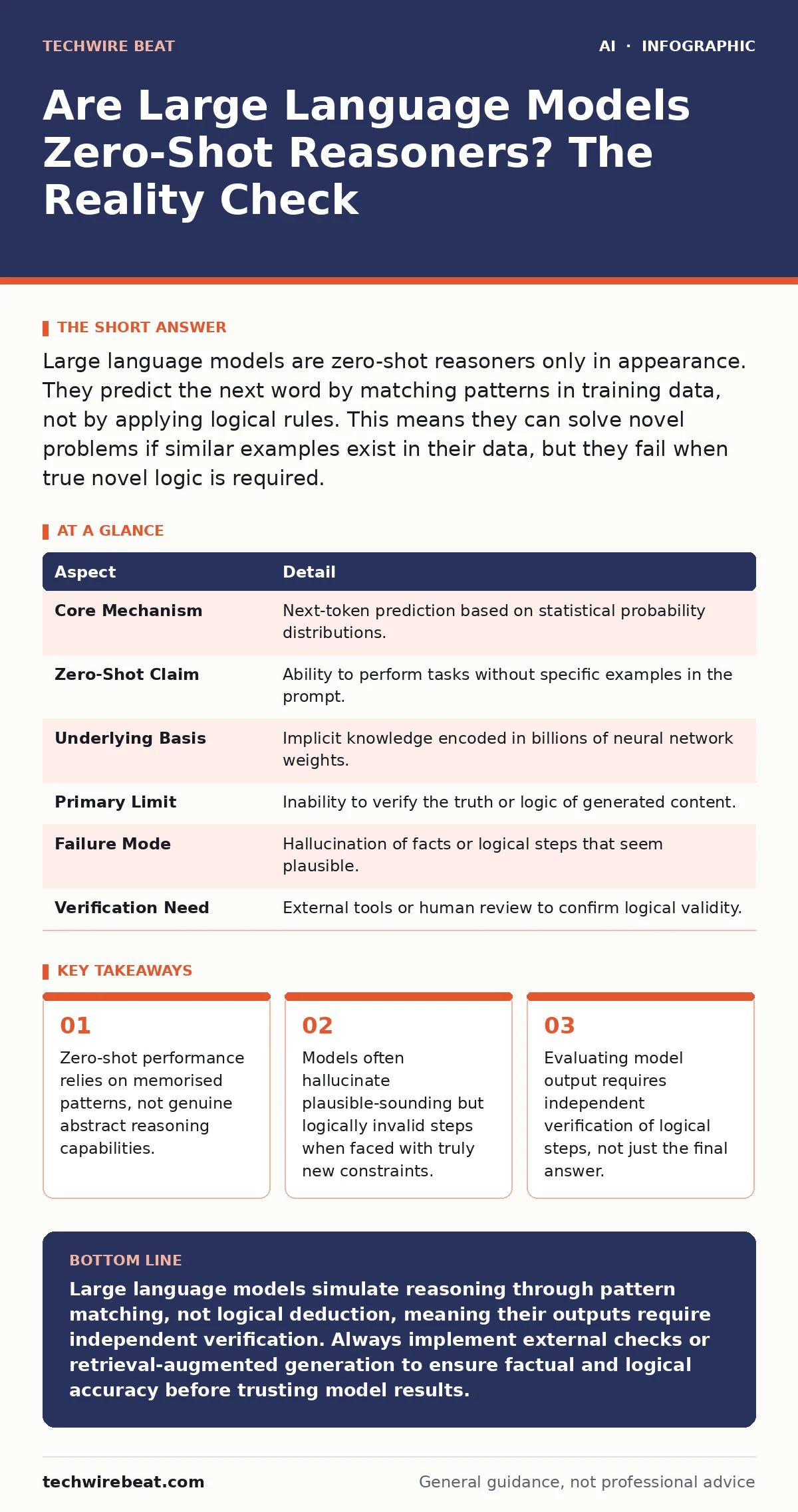
Large language models are zero-shot reasoners only in appearance. They predict the next word by matching patterns in training data, not by applying logical rules. This means they can solve novel problems if similar examples exist in their data, but they fail when true novel logic is required.
The Library Analogy for Pattern Matching
Imagine a librarian who has read every book in a vast library. You ask a question that has never been asked before. The librarian does not think through the logic from scratch. Instead, they recall similar questions from memory and stitch together an answer that sounds correct based on how previous questions were answered. This is how large language models operate. They do not possess a mental model of the world or a engine for logical deduction. They are sophisticated pattern completers that predict the most statistically likely continuation of a text sequence.
At a glance: How the Mechanism Works
| Aspect | Detail |
|---|---|
| Core Mechanism | Next-token prediction based on statistical probability distributions. |
| Zero-Shot Claim | Ability to perform tasks without specific examples in the prompt. |
| Underlying Basis | Implicit knowledge encoded in billions of neural network weights. |
| Primary Limit | Inability to verify the truth or logic of generated content. |
| Failure Mode | Hallucination of facts or logical steps that seem plausible. |
| Verification Need | External tools or human review to confirm logical validity. |
Large Language Models Are Zero-Shot Reasoners
When people type "large language models are zero-shot reasoners" into a search engine, they are often looking for confirmation of a specific capability. The short answer is that this statement is technically misleading. A zero-shot task is one where the model performs a function without being given examples in the immediate prompt. While models can appear to reason, they are actually retrieving and recombining learned associations. If a model solves a complex puzzle it has never seen, it is likely because the puzzle shares structural similarities with problems in its training data. It is not deriving a new logical principle. It is recognising a familiar shape.
This distinction matters because it changes how you trust the output. If you believe the model is reasoning, you might accept its answer as logically sound. If you understand it is pattern-matching, you will look for gaps in the logic. The model provides a draft of reasoning, not a proof.
Who This Capability Affects
Developers building applications on top of these models are the primary group affected by this misunderstanding. They often integrate models into workflows that require strict logical consistency, such as code generation or data analysis. When a model fails, the failure is not random noise. It is a confident, well-structured error that looks like a correct attempt at reasoning. This makes debugging difficult. You cannot simply ask the model to "try again" with more logic. You must change the prompt structure or add external verification steps.
End users are also affected, particularly those who use these tools for decision support. The ease of interaction masks the complexity of the underlying process. A user may assume that a concise, confident answer implies competence. In reality, the model may have taken a shortcut, ignoring nuance to produce a statistically probable response. This creates a risk of automation bias, where the user defers to the machine without critical evaluation.
What People Usually Get Wrong
The most common error is anthropomorphising the model. People attribute intent, understanding, or belief to the system. They think the model "knows" the answer or "understands" the context. In truth, the model has no concept of truth. It only knows which words tend to follow other words. This leads to the mistake of trusting the model’s confidence. A model can state a falsehood with the same grammatical certainty as a fact.
Another misconception is that zero-shot performance scales linearly with model size. Larger models have more parameters and can store more complex patterns, which improves their apparent reasoning. However, they do not gain the ability to perform formal logic. They simply become better at simulating the appearance of logic. This means that while larger models make fewer obvious errors, they can still fail in subtle, hard-to-detect ways.
How to Manage the Risk
To work effectively with these systems, you must treat them as probabilistic engines, not logical ones. One effective strategy is chain-of-thought prompting, where you ask the model to show its work step-by-step. This does not make the model reason better, but it exposes the logical flow, making it easier for you to spot errors. If a step in the chain is nonsensical, the final answer is likely wrong.
You should also implement retrieval-augmented generation. This involves providing the model with specific, verified documents to ground its response. Instead of relying on its internal memory, the model uses the provided text as a reference. This reduces hallucinations because the model is constrained by the source material. It shifts the burden of truth from the model’s weights to your curated data.
Integrating with Security Frameworks
Understanding the limits of zero-shot reasoning is critical for security teams. The OWASP Top 10 for LLM applications highlights risks such as prompt injection and data leakage, which exploit the model’s tendency to follow instructions without understanding context. If a model cannot distinguish between a user’s request and an attacker’s hidden command, it will execute the command. This is not a reasoning failure; it is a design feature of how the model processes text.
Security professionals should also consider malware that targets AI infrastructure. Attackers may craft inputs that cause the model to behave unpredictably or leak sensitive training data. These attacks rely on the model’s lack of true understanding. It processes the malicious input as just another pattern to complete. Defending against this requires robust input validation and monitoring, not just trusting the model’s output.
The Path Forward for Users
You can improve reliability by combining model outputs with deterministic checks. For example, if the model generates code, run it through a compiler or a static analysis tool. If it generates a summary, compare it against the source text. This hybrid approach leverages the model’s speed and fluency while relying on traditional tools for accuracy.
It is also worth exploring AI agents that are designed to use tools. These agents can call external APIs or search engines to verify facts. They do not just generate text; they perform actions. This moves the system closer to true reasoning by grounding the output in real-world data. However, even these agents require careful oversight. The agent’s planning logic can still be flawed.
Conclusion on Model Capabilities
Large language models are powerful tools for generating text, but they are not reasoners in the human sense. They simulate reasoning through statistical approximation. Recognising this limit allows you to use them effectively. You can offload drafting, summarisation, and creative tasks to the model, but you must retain control over verification and logical validation.
The future of these systems lies in hybrid architectures that combine neural networks with symbolic logic engines. Until then, you must treat every output as a hypothesis, not a fact. By understanding the mechanism behind zero-shot performance, you can avoid the pitfalls of over-trust and build more reliable applications. This approach aligns with responsible AI practices that emphasise transparency and human oversight. It also complements broader discussions on AI governance, which seek to establish standards for the safe deployment of these technologies.
Key takeaways
- Zero-shot performance relies on memorised patterns, not genuine abstract reasoning capabilities.
- Models often hallucinate plausible-sounding but logically invalid steps when faced with truly new constraints.
- Evaluating model output requires independent verification of logical steps, not just the final answer.
Large language models simulate reasoning through pattern matching, not logical deduction, meaning their outputs require independent verification. Always implement external checks or retrieval-augmented generation to ensure factual and logical accuracy before trusting model results.
Frequently asked questions
Can a large language model solve a math problem it has never seen?
It can often solve it if the structure resembles problems in its training data, but it may fail on truly novel logical structures because it lacks formal arithmetic reasoning.
Does zero-shot learning mean the model is intelligent?
No, zero-shot learning means the model can apply learned patterns to new contexts, but it does not imply general intelligence or true understanding of the subject matter.
How do I prevent the model from hallucinating facts?
Use retrieval-augmented generation to ground responses in verified documents and implement post-generation checks to compare outputs against known truths.
Are larger models better at reasoning?
Larger models are better at simulating reasoning and handling complex patterns, but they still rely on statistical prediction rather than logical deduction, so they can still make logical errors.
How this guide was produced: written by the TechWire Beat editorial team with AI assistance, checked against the public references listed below, and reviewed when the facts change. See our editorial policy or report an error.