Large language models: five common misunderstandings and how to read them
Large language models function as probabilistic pattern matchers rather than logical reasoning engines or factual databases.

Large language models process text by predicting the next likely token based on statistical patterns learned from vast training corpora. Treating them as deterministic calculators or truth-seeking databases creates operational risks. You must evaluate their outputs as probabilistic suggestions rather than verified facts.
Misreading: They possess an internal world model
Correct reading: Large language models maintain no semantic comprehension of the physical world, relying instead on statistical associations between linguistic tokens. Tokens are sub-word fragments processed by the neural network during computation.
Text generation proceeds by calculating the mathematical probability of subsequent tokens based on preceding context. Semantic coherence emerges from statistical regularities in human writing rather than conscious thought. Believing a system understands physical reality invites severe errors when evaluating outputs about mechanics, spatial reasoning, or physical safety.
Calculated probabilities dictate every output word, meaning plausible falsehoods receive the same structural validation as verified truths. Mathematical fluency replaces genuine reasoning, which causes systems to fail abruptly when presented with novel logic puzzles that deviate from training distributions. Recognising this limitation helps integrate structural safeguards into programs that rely on OWASP Top 10 for LLM applications.
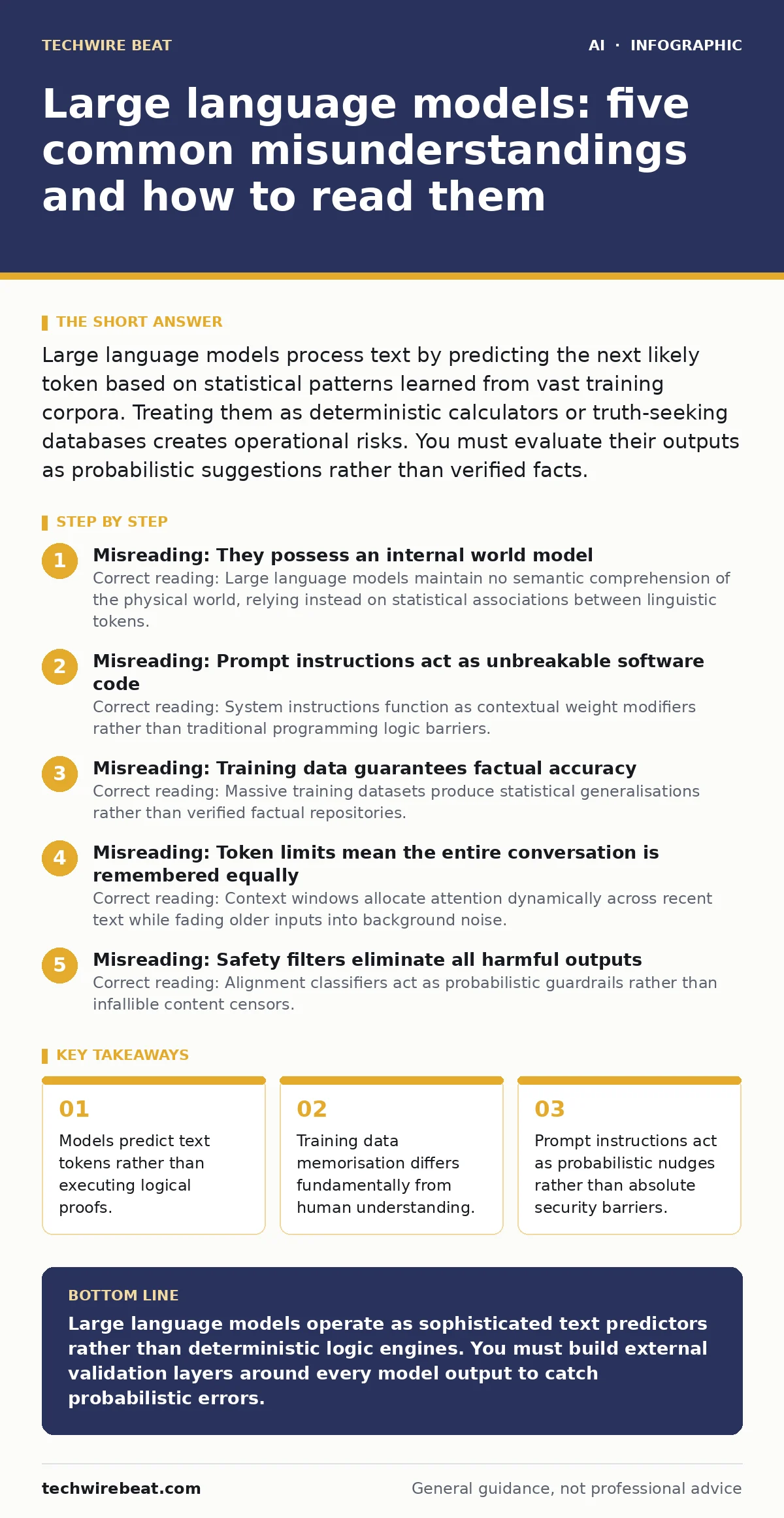
Misreading: Prompt instructions act as unbreakable software code
Correct reading: System instructions function as contextual weight modifiers rather than traditional programming logic barriers. Prompt injection describes the technique where malicious user input overrides original system directives by exploiting the fluid boundary between instructions and data.
Natural language instructions compete with user input within the same continuous token stream processed by the model layers. Stronger semantic framing or repeated instructions can dilute previous constraints, allowing users to bypass intended operational boundaries. Relying on conversational instructions alone to secure backend functions fails because the underlying architecture lacks a clear demarcation between code and data.
Operational security requires separating control channels from data channels through external software wrappers. System boundaries must be enforced outside the neural network using conventional code validation. Effective risk management frameworks address these architectural vulnerabilities through comprehensive validation layers rather than relying on polite instructions.
Misreading: Training data guarantees factual accuracy
Correct reading: Massive training datasets produce statistical generalisations rather than verified factual repositories. Memorisation occurs when a model stores exact sequences from its training corpus, but retrieval remains probabilistic rather than indexed.
Factual errors often stem from high-probability completions that sound authoritative despite containing false information. Statistical models prioritise fluency and style over empirical correctness, making confident fabrications indistinguishable from genuine facts without external verification. Treating generated responses as reliable reference material introduces subtle inaccuracies into research and operational workflows.
External retrieval systems must cross-reference generated claims against trusted databases to maintain factual reliability. Verification pipelines check outputs before presenting them to end users, reducing the frequency of confident errors. Organisations often align these verification workflows with standards found in the NIST AI Risk Management Framework to ensure consistent accuracy.
Misreading: Token limits mean the entire conversation is remembered equally
Correct reading: Context windows allocate attention dynamically across recent text while fading older inputs into background noise. Attention mechanisms calculate mathematical weights connecting different tokens across the input sequence, decaying older associations as new tokens enter the processing queue.
Long conversations experience attention dilution, where early instructions or specific constraints lose influence over the generated output. Critical details provided at the beginning of a long prompt session can be effectively ignored by the model as token counts grow. Designing workflows requires repeating essential parameters or summarising past interactions to maintain consistent behavioural guidelines.
Memory management demands external storage systems to retain crucial state information outside the active context window. Storing conversation histories in traditional databases prevents the gradual loss of context inherent in fixed-window architectures. Developers address these architectural constraints by building specialized AI agents that manage state externally rather than relying on internal memory persistence.
Misreading: Safety filters eliminate all harmful outputs
Correct reading: Alignment classifiers act as probabilistic guardrails rather than infallible content censors. Alignment refers to the training processes intended to steer model behaviour toward safe and helpful responses.
Adversarial prompts can disguise prohibited requests using metaphors, fictional framing, or encoded languages that bypass classification thresholds. Safety filters evaluate text patterns against known malicious templates, missing novel variants that achieve identical harmful outcomes through different linguistic paths. Assuming complete protection from content filters exposes platforms to policy violations and unintended toxic generation.
Layered moderation strategies combine input sanitisation, output classification, and human oversight to catch anomalies missed by automated filters. Continuous testing against adversarial examples identifies blind spots in current alignment training before malicious actors exploit them in production environments.
Key takeaways
- Models predict text tokens rather than executing logical proofs.
- Training data memorisation differs fundamentally from human understanding.
- Prompt instructions act as probabilistic nudges rather than absolute security barriers.
Large language models operate as sophisticated text predictors rather than deterministic logic engines. You must build external validation layers around every model output to catch probabilistic errors.
Frequently asked questions
Can a large language model learn new facts during a normal conversation?
Standard inference does not update permanent model weights, meaning temporary context disappears when the session ends.
Why do models occasionally invent citations or academic papers?
Statistical generation prioritises plausible linguistic patterns over real-world existence, fabricating realistic-sounding references when exact matches are missing from memory.
How does fine-tuning differ from training a model from scratch?
Fine-tuning adjusts existing neural weights using a smaller, targeted dataset to modify style or domain focus rather than teaching foundational language structures.
What causes repetitive loops during long text generation?
High probability loops occur when a specific token sequence reinforces its own likelihood, trapping the generation process in an infinite cycle.
How this guide was produced: written by the TechWire Beat editorial team with AI assistance, checked against the public references listed below, and reviewed when the facts change. See our editorial policy or report an error.