AI Agents vs Agentic AI: The Distinction That Matters
Agentic AI provides the autonomy layer that allows AI agents to execute multi-step tasks without constant human intervention or rigid scripting.

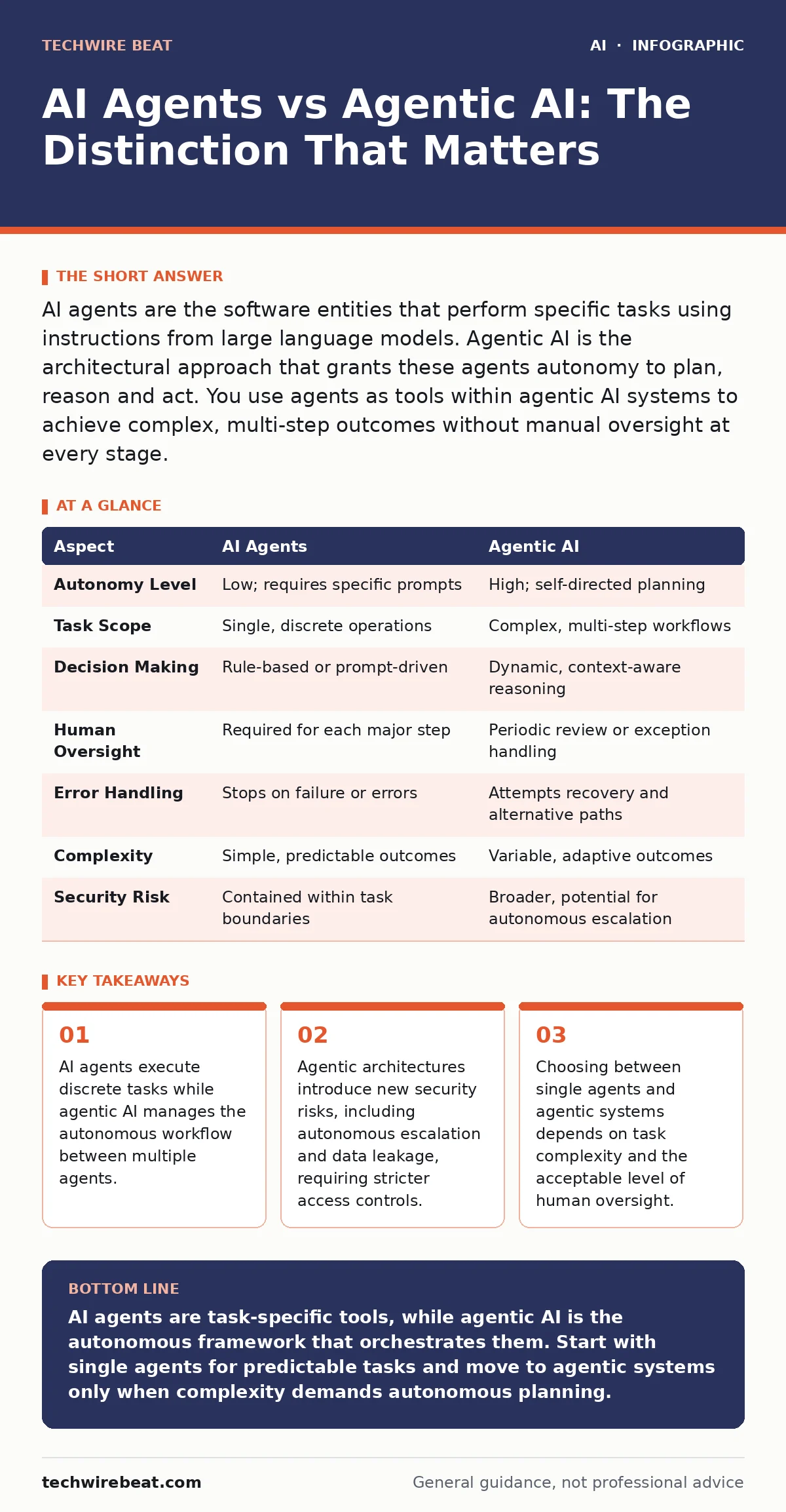
AI agents are the software entities that perform specific tasks using instructions from large language models. Agentic AI is the architectural approach that grants these agents autonomy to plan, reason and act. You use agents as tools within agentic AI systems to achieve complex, multi-step outcomes without manual oversight at every stage.
The Difference Between AI Agents and Agentic AI
The distinction between AI agents and agentic AI lies in autonomy and scope. An AI agent is a single entity designed to perceive its environment and take actions to achieve a specific goal, often driven by a large language model. Agentic AI refers to the broader system architecture that enables these agents to operate autonomously, plan multi-step workflows and collaborate with other agents. While an agent performs a task, agentic AI orchestrates the entire process, allowing for dynamic decision-making without human intervention at each step. This separation clarifies that agents are components, while agentic AI is the operational framework.
What Is an AI Agent?
An AI agent is a software program that uses artificial intelligence to interact with its environment. It perceives inputs, processes them through a reasoning engine, and outputs actions. These agents are typically task-specific, such as summarising documents, querying databases or scheduling meetings. They rely on pre-defined boundaries and often require human triggers to begin or continue their work. The agent does not decide what to do next beyond its immediate instruction; it executes the command with intelligence but limited scope. This design keeps the behaviour predictable and contained within a narrow function.
What Is Agentic AI?
Agentic AI is a system design where AI components have the authority to plan and execute sequences of actions. Instead of waiting for a user to prompt each step, the system breaks down complex objectives into sub-tasks, assigns them to appropriate agents and monitors progress. If an agent fails, the agentic system can reroute the task or attempt an alternative strategy. This architecture mimics human problem-solving by allowing for iteration and adaptation. The system maintains state memory, enabling it to remember previous steps and adjust future actions accordingly, creating a continuous loop of perception, planning and execution.
AI Agents vs Agentic AI: A Point-by-Point Comparison
| Aspect | AI Agents | Agentic AI |
|---|---|---|
| Autonomy Level | Low; requires specific prompts | High; self-directed planning |
| Task Scope | Single, discrete operations | Complex, multi-step workflows |
| Decision Making | Rule-based or prompt-driven | Dynamic, context-aware reasoning |
| Human Oversight | Required for each major step | Periodic review or exception handling |
| Error Handling | Stops on failure or errors | Attempts recovery and alternative paths |
| Complexity | Simple, predictable outcomes | Variable, adaptive outcomes |
| Security Risk | Contained within task boundaries | Broader, potential for autonomous escalation |
When to Choose AI Agents
Choose an AI agent when the task is well-defined and repetitive. These systems excel at automating straightforward processes where the input and desired output are consistent. For example, an agent can extract data from invoices or categorise customer support tickets. The benefit here is predictability and ease of integration. You do not need complex orchestration logic because the agent follows a clear path. This approach minimises the risk of unexpected behaviour, making it suitable for environments where compliance and audit trails are strict. It also reduces the computational overhead associated with maintaining long-term state memory across multiple interactions.
Choose an AI agent when human oversight is required at every stage. If your workflow demands immediate correction of errors, an agent provides the necessary transparency. You can review each output before it proceeds to the next step. This is particularly useful in high-stakes environments where a single mistake could have significant consequences. The agent acts as a powerful assistant rather than an independent worker, ensuring that human judgment remains the primary control mechanism. This preserves accountability and simplifies debugging, as the failure point is always within the visible scope of the current operation.
When to Choose Agentic AI
Choose agentic AI when the problem is complex and lacks a predefined solution path. These systems are ideal for research tasks, software development or strategic planning, where the steps to success are not known in advance. The agentic system can explore different avenues, test hypotheses and refine its approach based on feedback. This flexibility allows it to handle ambiguity and adapt to changing conditions. However, this autonomy comes with a hidden cost: the difficulty of auditing the decision-making process. You must trust the system’s internal logic, which requires robust monitoring and clear boundary conditions to prevent drift.
Choose agentic AI when efficiency gains from automation outweigh the risks of autonomous action. If manual oversight of every step is impractical due to volume or speed, an agentic system can manage the workflow independently. It can coordinate multiple agents to work in parallel, significantly reducing the time required to complete large projects. This is useful for scenarios where the cost of minor errors is low, but the benefit of rapid completion is high. The system learns from its interactions, improving its performance over time without requiring explicit reprogramming for each new variation of the task.
Where They Overlap and Intersect
The overlap occurs in hybrid systems where agents operate within an agentic framework. Here, individual agents handle specific technical tasks, while the agentic layer manages the overall strategy. This combination leverages the precision of agents with the flexibility of agentic orchestration.
For instance, an agentic system might plan a marketing campaign, while individual agents generate content, schedule posts and analyse engagement metrics. The key is to define clear interfaces between the planning layer and the execution layer. This ensures that the autonomous decisions do not bypass necessary security checks or compliance requirements. Understanding this intersection helps in designing systems that are both powerful and safe.
Security and Risk Considerations
Implementing these technologies requires careful attention to security. Agentic AI introduces unique risks, such as autonomous actions that may bypass traditional safeguards. You must implement strict access controls for AI agents to limit their ability to interact with sensitive systems. Additionally, consider the potential for training data leakage when agents process confidential information.
Refer to the OWASP Top 10 for LLM applications to understand common vulnerabilities. Regular AI vendor assessments can help identify weaknesses in third-party components. The NIST AI Risk Management Framework provides a structured approach to managing these risks, ensuring that your implementation remains secure and compliant. Machine learning in cybersecurity can also help detect anomalous behaviour in autonomous systems.
Key takeaways
- AI agents execute discrete tasks while agentic AI manages the autonomous workflow between multiple agents.
- Agentic architectures introduce new security risks, including autonomous escalation and data leakage, requiring stricter access controls.
- Choosing between single agents and agentic systems depends on task complexity and the acceptable level of human oversight.
AI agents are task-specific tools, while agentic AI is the autonomous framework that orchestrates them. Start with single agents for predictable tasks and move to agentic systems only when complexity demands autonomous planning.
Frequently asked questions
Can an AI agent become agentic AI?
Yes, by adding memory, planning capabilities and tool-use permissions, an agent can evolve into part of an agentic system.
Is agentic AI more expensive to run?
Agentic systems typically consume more computational resources due to their complex reasoning and state management requirements.
Do I need machine learning in cybersecurity for agentic AI?
Yes, autonomous systems require advanced monitoring to detect and respond to anomalous behaviour or security threats.
How do I prevent AI bias in agentic systems?
Implement rigorous testing and validation processes, and ensure diverse training data to mitigate bias in decision-making.
How this guide was produced: written by the TechWire Beat editorial team with AI assistance, checked against the public references listed below, and reviewed when the facts change. See our editorial policy or report an error.