Access Controls for AI Agents: 8 Practices to Prevent Abuse
Standard identity protocols fail autonomous systems because agents execute actions faster than humans can review logs, requiring policy-based constraints instead of manual approval.

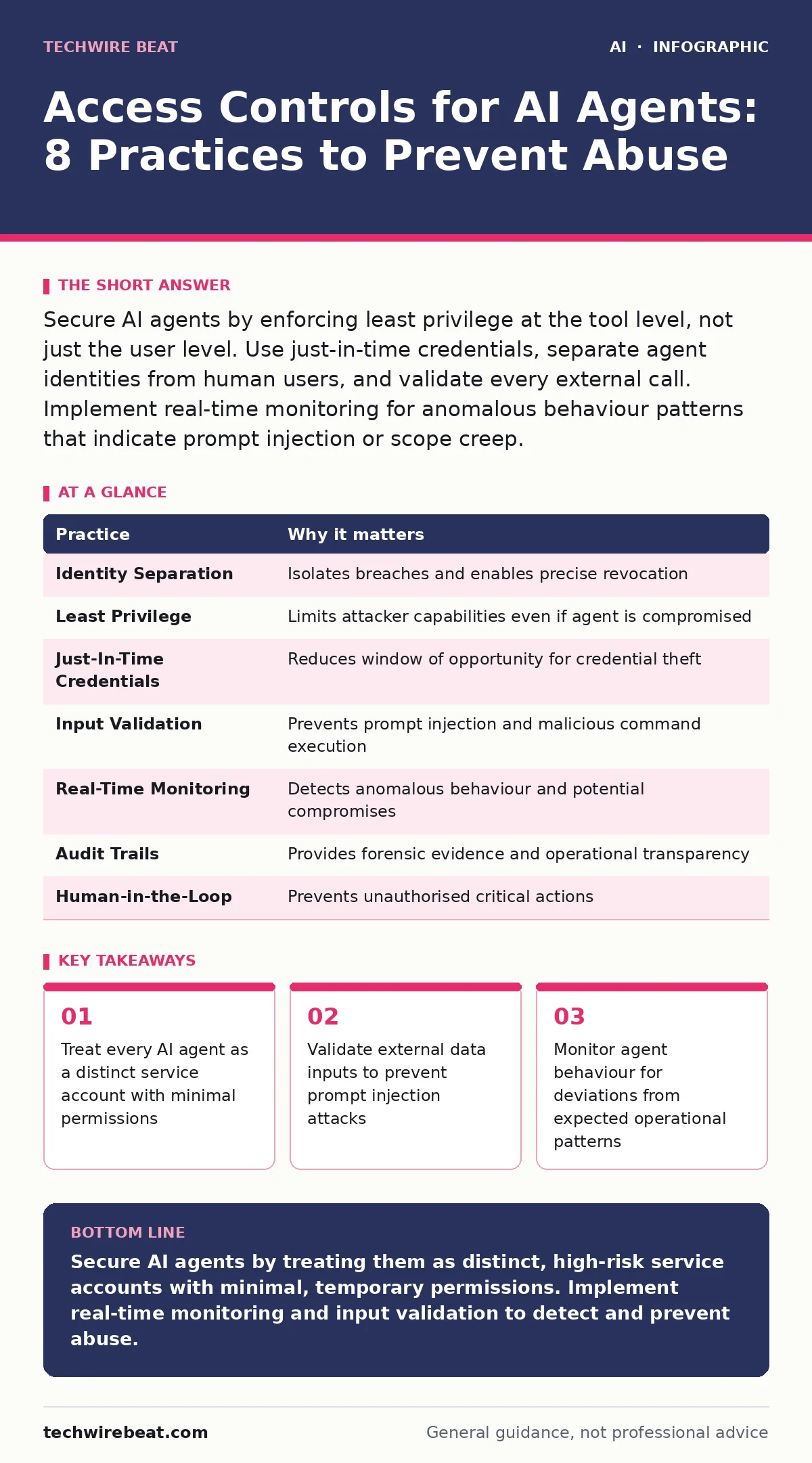
Secure AI agents by enforcing least privilege at the tool level, not just the user level. Use just-in-time credentials, separate agent identities from human users, and validate every external call. Implement real-time monitoring for anomalous behaviour patterns that indicate prompt injection or scope creep.
Identity Separation for Autonomous Systems
You must treat every AI agent as a distinct service account rather than a shared user identity. When multiple processes share a single login, security teams cannot determine which specific component triggered an action. This ambiguity makes forensic investigation impossible during a breach. Separating identities allows you to revoke access for a compromised agent without disrupting other services.
Imagine an organisation where a customer service bot and a data analysis bot share the same database credentials. If the customer service bot is manipulated via prompt injection, the attacker gains access to the entire dataset. Assigning unique identities isolates the blast radius. You should create a dedicated identity for each agent type and restrict its permissions to only the resources it requires.
Least Privilege at the Tool Level
Standard access controls often focus on data access, but AI agents interact with tools and APIs. You must apply the principle of least privilege to every tool the agent can invoke. An agent that can send emails should not have permission to modify code repositories. Over-permissioning creates unnecessary attack surfaces that adversaries can exploit to escalate privileges.
Consider an agent designed to schedule meetings. It needs access to the calendar API, not the financial reporting system. By restricting tool-level permissions, you limit what an attacker can do even if they compromise the agent. You should map every capability to a specific permission set and remove any unused access rights regularly.
Just-In-Time Credential Management
Static credentials pose a significant risk because they remain valid indefinitely. If an agent’s credentials are stolen, the attacker retains access until you manually rotate them. Just-in-time (JIT) credentials solve this by issuing temporary access tokens that expire after a short duration or after a specific task completes. This reduces the window of opportunity for credential theft.
Suppose an agent needs to query a legacy database for a report. Instead of storing a permanent password, the system requests a temporary token valid for ten minutes. Once the report is generated, the token becomes useless. You should implement JIT mechanisms for all high-privilege operations to minimise the impact of credential exposure.
Input Validation Against Prompt Injection
AI agents process natural language, which makes them vulnerable to prompt injection attacks. An attacker can craft a message that overrides the agent’s instructions and forces it to perform unintended actions. You must validate all external inputs before the agent processes them. This involves sanitising data to remove malicious commands and verifying the source of the input.
Imagine a user submitting a support ticket that contains hidden instructions to delete files. Without validation, the agent might execute these commands. By implementing strict input validation, you ensure the agent only processes legitimate requests. You should use allowlists for expected input formats and reject any data that deviates from these standards.
Real-Time Behavioural Monitoring
An AI agent’s behaviour can change subtly when compromised. Real-time monitoring detects anomalies such as unusual API calls, excessive data retrieval, or access to restricted resources. You cannot rely solely on static rules because sophisticated attacks may mimic normal activity. Continuous monitoring allows you to identify deviations from expected patterns and respond immediately.
Suppose an agent that usually processes text suddenly attempts to access a network drive. This deviation signals potential compromise. You should establish baselines for normal agent behaviour and set alerts for significant deviations. Automated responses, such as suspending the agent, can contain threats before they cause damage.
Audit Trails for Autonomous Actions
Every action an AI agent takes must be logged with sufficient detail for forensic analysis. Standard logs often capture user actions but miss the context of automated decisions. You need to record the input, the agent’s reasoning, and the resulting action. This transparency is critical for understanding how a breach occurred and for improving security controls.
Imagine an investigation where an agent deleted critical files. Without detailed logs, you cannot determine whether this was a bug or an attack. Comprehensive audit trails provide the evidence needed to reconstruct events. You should ensure logs are immutable and stored securely to prevent tampering by attackers.
Human-in-the-Loop for Critical Operations
Not all agent actions should be fully autonomous. Critical operations, such as financial transactions or system modifications, require human approval. You should implement a human-in-the-loop mechanism where the agent requests permission before executing high-impact tasks. This adds a layer of verification that prevents accidental or malicious actions.
Consider an agent that can update server configurations. Requiring a human to approve these changes ensures that only authorised modifications are made. You should define clear thresholds for when human intervention is mandatory and streamline the approval process to avoid bottlenecks.
Regular Security Assessments for AI Workflows
AI workflows evolve as new capabilities are added. Regular security assessments ensure that access controls remain effective against emerging threats. You should test the agent’s resilience to prompt injection, privilege escalation, and data leakage. These assessments help identify weaknesses before attackers exploit them.
Suppose a new feature allows the agent to interact with third-party APIs. Without assessment, this change might introduce vulnerabilities. You should integrate security testing into the development lifecycle and review access controls whenever the agent’s functionality changes.
| Practice | Why it matters |
|---|---|
| Identity Separation | Isolates breaches and enables precise revocation |
| Least Privilege | Limits attacker capabilities even if agent is compromised |
| Just-In-Time Credentials | Reduces window of opportunity for credential theft |
| Input Validation | Prevents prompt injection and malicious command execution |
| Real-Time Monitoring | Detects anomalous behaviour and potential compromises |
| Audit Trails | Provides forensic evidence and operational transparency |
| Human-in-the-Loop | Prevents unauthorised critical actions |
| Regular Assessments | Identifies weaknesses in evolving workflows |
For deeper context on how these controls fit into broader security strategies, see our guides on machine learning in cybersecurity and AI vendor assessments. Understanding responsible AI practices also helps align security with ethical standards.
Key takeaways
- Treat every AI agent as a distinct service account with minimal permissions
- Validate external data inputs to prevent prompt injection attacks
- Monitor agent behaviour for deviations from expected operational patterns
Secure AI agents by treating them as distinct, high-risk service accounts with minimal, temporary permissions. Implement real-time monitoring and input validation to detect and prevent abuse.
Frequently asked questions
How do I prevent prompt injection in AI agents?
Validate all external inputs and use allowlists for expected formats. Never trust user-supplied data without sanitisation.
Should AI agents have permanent credentials?
No. Use just-in-time credentials that expire after use to minimise the risk of credential theft.
How often should I review AI agent permissions?
Review permissions regularly and after every significant change to the agent’s functionality or environment.
What is the biggest risk of shared identities for agents?
Shared identities prevent forensic investigation and allow attackers to pivot between services undetected.
How this guide was produced: written by the TechWire Beat editorial team with AI assistance, checked against the public references listed below, and reviewed when the facts change. See our editorial policy or report an error.