Detect Privilege Escalation: Signals, Tools and Blind Spots
Privilege escalation often hides in routine administrative tasks, making standard log monitoring insufficient for catching lateral movement and role manipulation.

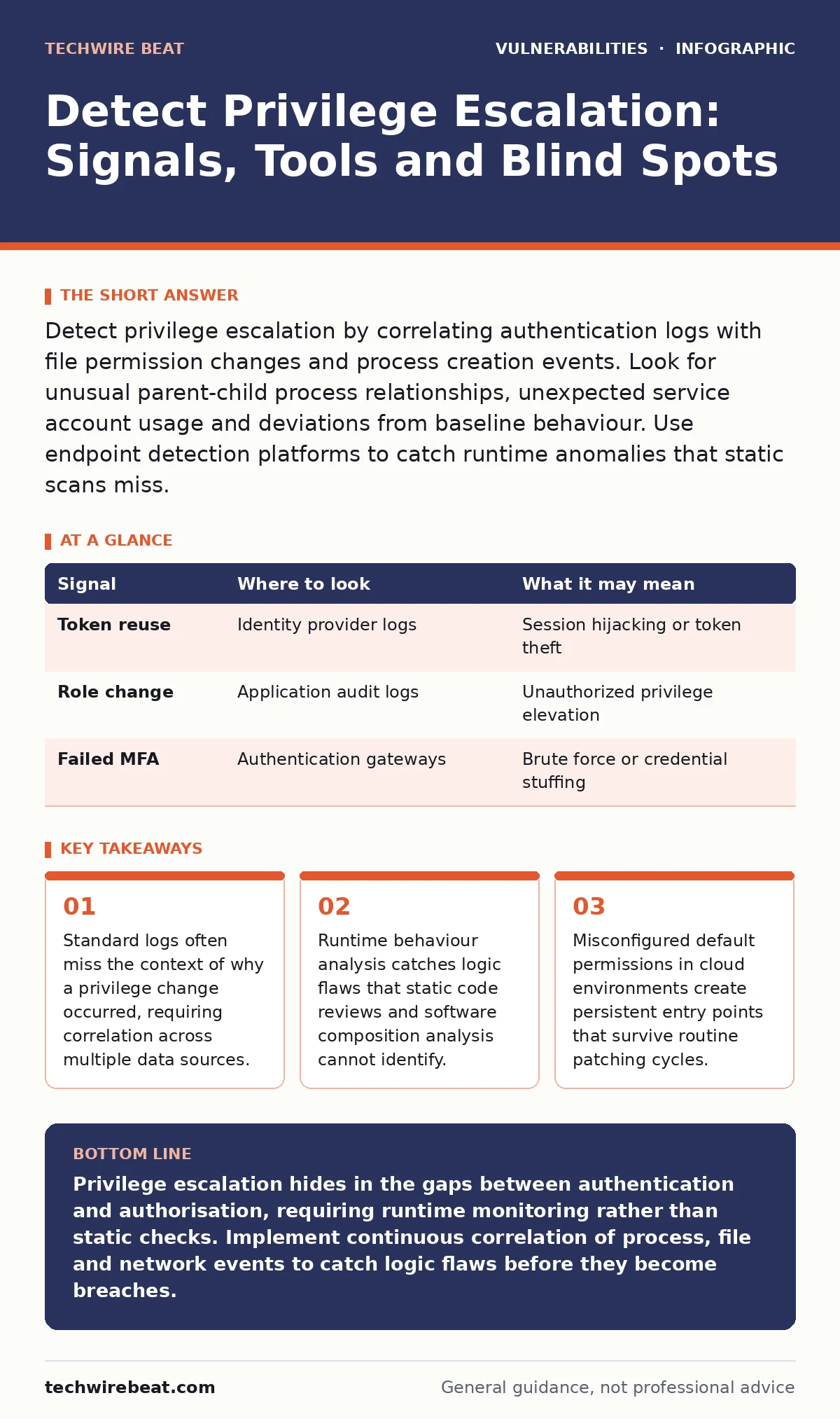
Detect privilege escalation by correlating authentication logs with file permission changes and process creation events. Look for unusual parent-child process relationships, unexpected service account usage and deviations from baseline behaviour. Use endpoint detection platforms to catch runtime anomalies that static scans miss.
Authentication and Session Anomalies
Privilege escalation frequently begins with a subtle shift in how a user or service authenticates. You must look for sessions that inherit rights from a higher-privileged context without explicit re-authentication. This often appears as a service account performing actions outside its defined scope. Check for tokens that grant broader access than the original request required.
Imagine a web application that allows a standard user to edit their profile. If the backend fails to verify that the user ID in the request matches the authenticated session, an attacker can modify another user’s data. This is a classic case of insecure direct object references. It is not always a code bug; sometimes it is a configuration error in the identity provider.
| Signal | Where to look | What it may mean |
|---|---|---|
| Token reuse | Identity provider logs | Session hijacking or token theft |
| Role change | Application audit logs | Unauthorized privilege elevation |
| Failed MFA | Authentication gateways | Brute force or credential stuffing |
File System and Permission Shifts
File permissions are the boundary between normal operation and system compromise. Look for changes to executable files in system directories. An attacker often replaces a legitimate binary with a malicious one that runs with elevated privileges. This is known as a binary substitution attack. It bypasses application-level controls because the operating system trusts the file location.
You should monitor for modifications to critical configuration files. These files often dictate who can run what. A change to a sudoers file or a local security policy is a clear indicator of attempted persistence. The challenge is distinguishing between an administrator performing routine maintenance and an attacker establishing a foothold. Context is the only differentiator.
Process Execution Chains
Processes do not run in isolation. They spawn other processes, creating a family tree. Privilege escalation often involves a low-privileged process spawning a high-privileged one. This is visible in process creation logs. Look for a web server process spawning a command shell. This is never legitimate in a production environment.
The parent-child relationship reveals the attack path. If a database service spawns a network connection tool, the attacker has likely exploited a flaw in the database or its configuration. This technique is common in containerised environments where escape is difficult. Attackers pivot through allowed processes to reach the host operating system.
Monitor for processes running under unexpected user accounts. A background service running as root when it should run as a dedicated service account is a red flag. This misconfiguration allows an attacker to take full control of the system if they compromise the service. It is a silent vulnerability that persists until someone audits the startup scripts.
Network and API Behaviour
Network traffic often reveals privilege escalation attempts that logs miss. Look for unusual outbound connections from internal services. An attacker might use a compromised service to query internal APIs for administrative endpoints. This is a form of reconnaissance. The traffic looks like normal application behaviour but targets sensitive resources.
Server-side request forgery (SSRF) is a common vector for this. An application fetches resources from a user-specified URL. If the application uses its own credentials to fetch the resource, an attacker can request internal metadata services. This grants access to cloud credentials and administrative tokens. The application logs show a successful request, not an attack.
Common Blind Spots in Detection
Most detection frameworks focus on known exploits. They miss logic flaws that do not trigger signature-based alerts. One major blind spot is the assumption that authentication equals authorisation. Just because a user is logged in does not mean they should have access to a specific resource. This gap allows for horizontal and vertical privilege escalation.
Another blind spot is the reliance on static analysis. Static tools cannot see how a program behaves at runtime. They miss dynamic code loading and reflection-based attacks. These techniques bypass traditional controls because the malicious code is not present in the binary at rest. It is injected or loaded during execution.
Virtual patching helps mitigate these risks by blocking exploit attempts at the network layer. It does not fix the underlying code issue but buys time for a proper remediation. This is particularly useful for zero-day vulnerabilities where no patch is available. It adds a layer of defence without changing the application code.
Tooling and Correlation Strategies
No single tool catches all privilege escalation attempts. You need a combination of endpoint detection, network monitoring and application logging. Endpoint detection and response platforms provide deep visibility into process behaviour. They can stop a malicious process before it executes. Network monitoring tools detect unusual traffic patterns and data exfiltration attempts.
The key is correlation. A single event might be benign. A sequence of events is rarely accidental. Connect authentication logs with file access logs and network traffic. If a user logs in, changes a file and then connects to an external server, that is a suspicious pattern. Automated systems must be configured to link these disparate data points.
Software composition analysis helps identify known vulnerabilities in third-party libraries. It does not detect custom logic flaws. Use it as part of a broader strategy that includes runtime monitoring and regular penetration testing. This layered approach ensures that you catch both known exploits and novel attack techniques.
Validating Detection Effectiveness
Detection is only useful if it leads to action. You must validate your alerts regularly. Simulate privilege escalation attempts in a test environment. This is not a penetration test. It is a verification exercise to ensure your monitoring tools catch the specific techniques you care about. Adjust your rules based on the results.
False positives are the enemy of security operations. If your system alerts on every normal administrative action, operators will ignore it. Tune your detection rules to reduce noise. Focus on high-fidelity signals that indicate a genuine threat. This requires ongoing refinement and a deep understanding of your environment’s normal behaviour.
Key takeaways
- Standard logs often miss the context of why a privilege change occurred, requiring correlation across multiple data sources.
- Runtime behaviour analysis catches logic flaws that static code reviews and software composition analysis cannot identify.
- Misconfigured default permissions in cloud environments create persistent entry points that survive routine patching cycles.
Privilege escalation hides in the gaps between authentication and authorisation, requiring runtime monitoring rather than static checks. Implement continuous correlation of process, file and network events to catch logic flaws before they become breaches.
Frequently asked questions
How do I distinguish between an admin and an attacker?
Look for deviations from baseline behaviour. Admins follow predictable patterns. Attackers often trigger multiple unusual events in rapid succession, such as changing permissions and then accessing sensitive files.
Can privilege escalation happen in cloud environments?
Yes, cloud environments have unique risks like misconfigured IAM roles. Attackers exploit these to gain access to other services. Monitor for unusual API calls and role assumption events.
Is static analysis enough to find these vulnerabilities?
No, static analysis misses runtime logic flaws. You need dynamic testing and runtime monitoring to catch issues that only appear when the code is executing.
What is the first step in improving detection?
Establish a baseline of normal behaviour. You cannot detect anomalies if you do not know what normal looks like. Start with critical systems and expand from there.
How this guide was produced: written by the TechWire Beat editorial team with AI assistance, checked against the public references listed below, and reviewed when the facts change. See our editorial policy or report an error.