Software Composition Analysis: How It Works and Why It Matters
Software composition analysis reveals hidden supply chain risks by mapping every third-party component within your codebase to known vulnerabilities.

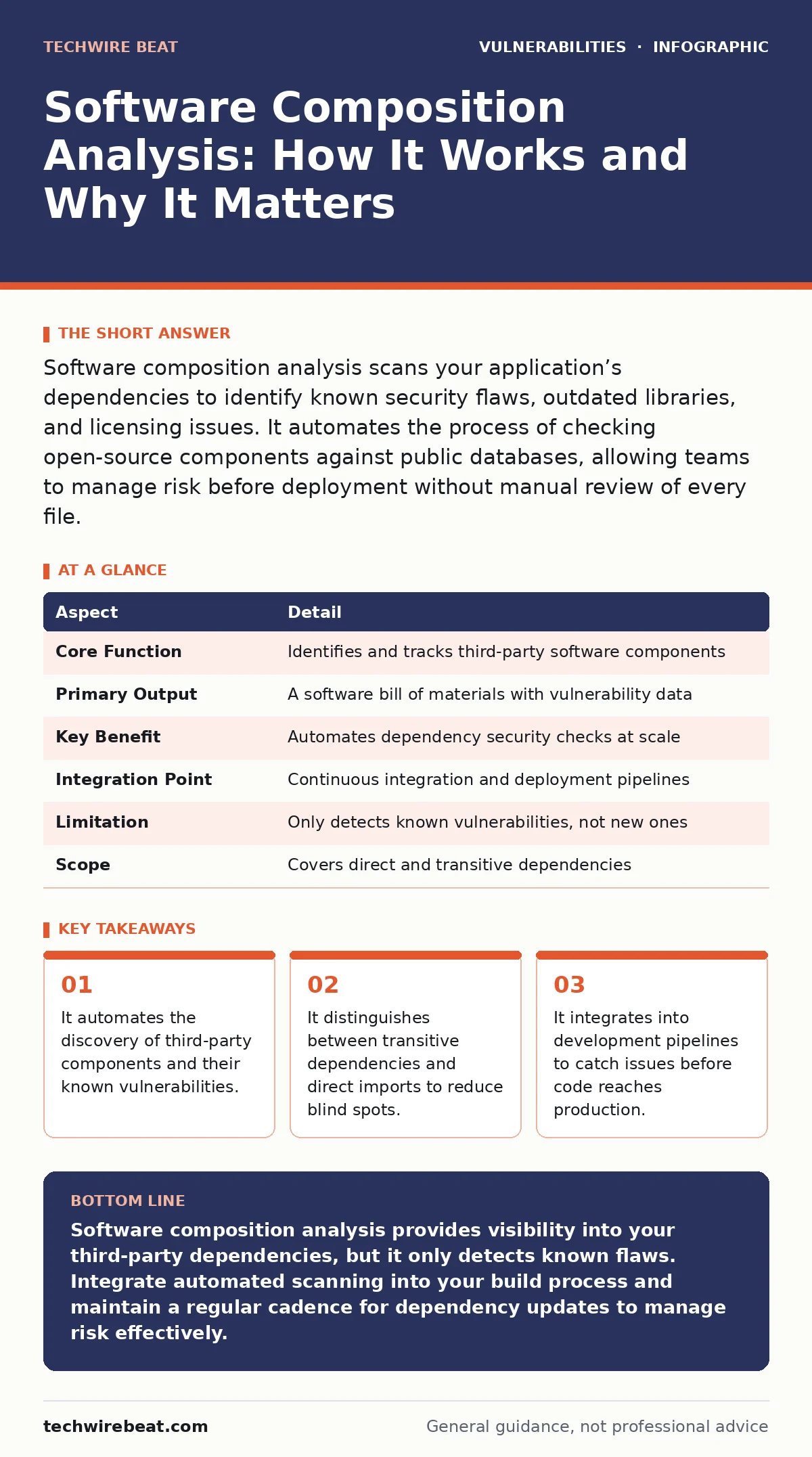
Software composition analysis scans your application’s dependencies to identify known security flaws, outdated libraries, and licensing issues. It automates the process of checking open-source components against public databases, allowing teams to manage risk before deployment without manual review of every file.
The Library Analogy
Imagine you are building a house. You construct the walls yourself, but you buy windows, doors, and electrical wiring from various suppliers. If a specific brand of wiring has a design flaw that causes fires, your house is unsafe, even if your brickwork is perfect. You did not make the faulty wiring, but you are responsible for installing it.
Software development works the same way. You write original code, but you also include libraries and frameworks created by others. These third-party pieces are called dependencies. Software composition analysis is the process of cataloguing every component you use and checking whether any of them have known weaknesses.
What Is Software Composition Analysis?
Software composition analysis is a security practice that identifies and manages the open-source and third-party components within an application. It creates a software bill of materials, which is a structured list of every library, module, and package in your project.
This tool scans your codebase and compares the identified components against databases of known vulnerabilities. It tells you which parts of your application are exposed to public threats. It also checks for licensing compliance, ensuring you do not accidentally include code with restrictive legal terms.
The primary purpose is to reduce the attack surface. Attackers often target known flaws in popular libraries because they affect many systems at once. By identifying these flaws early, you can patch or replace them before an attacker exploits them.
| Aspect | Detail |
|---|---|
| Core Function | Identifies and tracks third-party software components |
| Primary Output | A software bill of materials with vulnerability data |
| Key Benefit | Automates dependency security checks at scale |
| Integration Point | Continuous integration and deployment pipelines |
| Limitation | Only detects known vulnerabilities, not new ones |
| Scope | Covers direct and transitive dependencies |
The Hidden Cost of Free Code
Open-source software accelerates development. It allows teams to reuse code rather than building everything from scratch. However, this convenience introduces supply chain risk. When you include a library, you inherit its security posture.
Many developers assume that if a library is popular, it is safe. This is a dangerous assumption. Popular libraries attract more attention from attackers, who study them for weaknesses. A single flawed dependency can compromise an entire application, regardless of how secure your original code is.
Software composition analysis addresses this by providing visibility. It reveals not just the libraries you explicitly import, but also the libraries those libraries depend on. These are called transitive dependencies. You might use a small utility, which uses a larger framework, which uses a database connector. If the database connector has a flaw, your utility is affected. The analysis tool maps this entire chain.
How It Fits With Other Defences
Software composition analysis is one layer of a broader security strategy. It does not replace other practices but complements them. For instance, threat modeling helps you identify what assets need protection and how data flows through your system. Software composition analysis provides the data on what components are in that flow.
You might also use fuzz testing, which involves feeding random or malformed data to your application to find crashes. This tests your code’s runtime behaviour. Software composition analysis, by contrast, tests the static composition of your code. It checks the ingredients, not just the final dish.
Another related concept is risk-based vulnerability management. This approach prioritises fixing vulnerabilities based on their likelihood and impact. Software composition analysis feeds into this by providing the raw data on which vulnerabilities exist. You can then apply an EPSS score, which estimates the probability that a vulnerability will be exploited in the wild, to decide which fixes to tackle first.
What People Usually Get Wrong
A common misconception is that software composition analysis provides complete protection. It only identifies known vulnerabilities. If a flaw is new and has not been published in a database, the tool will not detect it. This is known as a zero-day vulnerability. You still need other measures, such as runtime protection and input validation, to mitigate these unknown threats.
Another mistake is treating the initial scan as a one-time event. Dependencies change. New vulnerabilities are discovered daily. If you do not update your software bill of materials regularly, your data becomes stale. You might believe you are secure because you scanned last month, but a new flaw could have emerged since then.
Some teams also ignore transitive dependencies. They focus only on the libraries they directly import. This leaves a blind spot. The majority of dependencies in a modern application are transitive. Ignoring them means ignoring the bulk of your third-party risk.
The Dependency Update Challenge
Identifying a vulnerability is only half the battle. Fixing it often requires updating the affected library. This is not always straightforward. A new version of a library might change its interface, breaking your code. This is called a breaking change.
Teams often delay updates to avoid this risk. They prefer stability over security. However, delaying updates increases the window of exposure. Attackers actively scan for systems running outdated versions of popular libraries.
Software composition analysis helps here by providing context. It can show you which parts of your code are affected by an update. Some tools integrate with dependency updates processes, suggesting safe paths to patch. You can test the update in a staging environment before applying it to production. This reduces the fear of breaking changes.
Integrating Into Your Workflow
To be effective, software composition analysis must be integrated into your development workflow. Running it manually once a year is insufficient. It should run automatically whenever code is committed or built. This is known as shift-left security.
By catching issues early, you reduce the cost of remediation. Fixing a vulnerability in development is cheaper and faster than fixing it in production. It also prevents insecure code from reaching users.
You should configure the tool to block builds if critical vulnerabilities are found. This enforces security standards without slowing down development significantly. Developers can address issues while the context is fresh, rather than dealing with a backlog of technical debt.
Beyond Vulnerabilities: Licensing and Policy
Security is not the only concern with third-party code. Licensing compliance is equally important. Different open-source licenses have different requirements. Some require you to share your source code if you distribute the software. Others prohibit commercial use.
Software composition analysis tools often include licensing checks. They identify the license of each component and flag any that conflict with your organisation’s policy. This prevents legal disputes and ensures you are using code correctly.
You can define policies within the tool. For example, you might block all libraries with copyleft licenses if you are building proprietary software. The tool will alert you if a developer attempts to include such a library. This automates compliance and reduces legal risk.
The Lifecycle of a Vulnerability
Understanding the vulnerability lifecycle helps you appreciate the role of software composition analysis. A vulnerability is discovered, reported, assigned an identifier, and then patched. During the time between discovery and patching, the vulnerability is public.
Attackers monitor these disclosures closely. They develop exploits for high-profile flaws. Software composition analysis connects your components to these disclosures. It tells you when a component you use has a new vulnerability.
This is where concepts like LDAP injection or other specific attack vectors become relevant. If a library you use handles directory services, it might be vulnerable to LDAP injection. The analysis tool identifies the library and the specific flaw, allowing you to mitigate the risk. You do not need to know the technical details of the injection to know that you need to update the library.
Key takeaways
- It automates the discovery of third-party components and their known vulnerabilities.
- It distinguishes between transitive dependencies and direct imports to reduce blind spots.
- It integrates into development pipelines to catch issues before code reaches production.
- It requires regular updates to remain effective against newly discovered flaws.
Software composition analysis provides visibility into your third-party dependencies, but it only detects known flaws. Integrate automated scanning into your build process and maintain a regular cadence for dependency updates to manage risk effectively.
Frequently asked questions
Does software composition analysis find bugs in my own code?
No, it only identifies issues in third-party libraries and open-source components. You need static application security testing to find bugs in your original code.
How often should I run software composition analysis?
You should run it every time you build your application. This ensures that any new dependencies or updated components are checked immediately.
Can software composition analysis prevent all attacks?
No, it only addresses known vulnerabilities in dependencies. It does not protect against zero-day flaws, misconfigurations, or bugs in your own code.
Is software composition analysis expensive?
There are many free and open-source tools available. Commercial tools offer more features and support, but the basic functionality is accessible to most teams.
How this guide was produced: written by the TechWire Beat editorial team with AI assistance, checked against the public references listed below, and reviewed when the facts change. See our editorial policy or report an error.