EPSS Score Misconceptions: How to Read Exploit Prediction Correctly
The EPSS score predicts the likelihood of exploit activity in the wild, not the severity of damage if an attacker succeeds, requiring a distinct risk calculation.

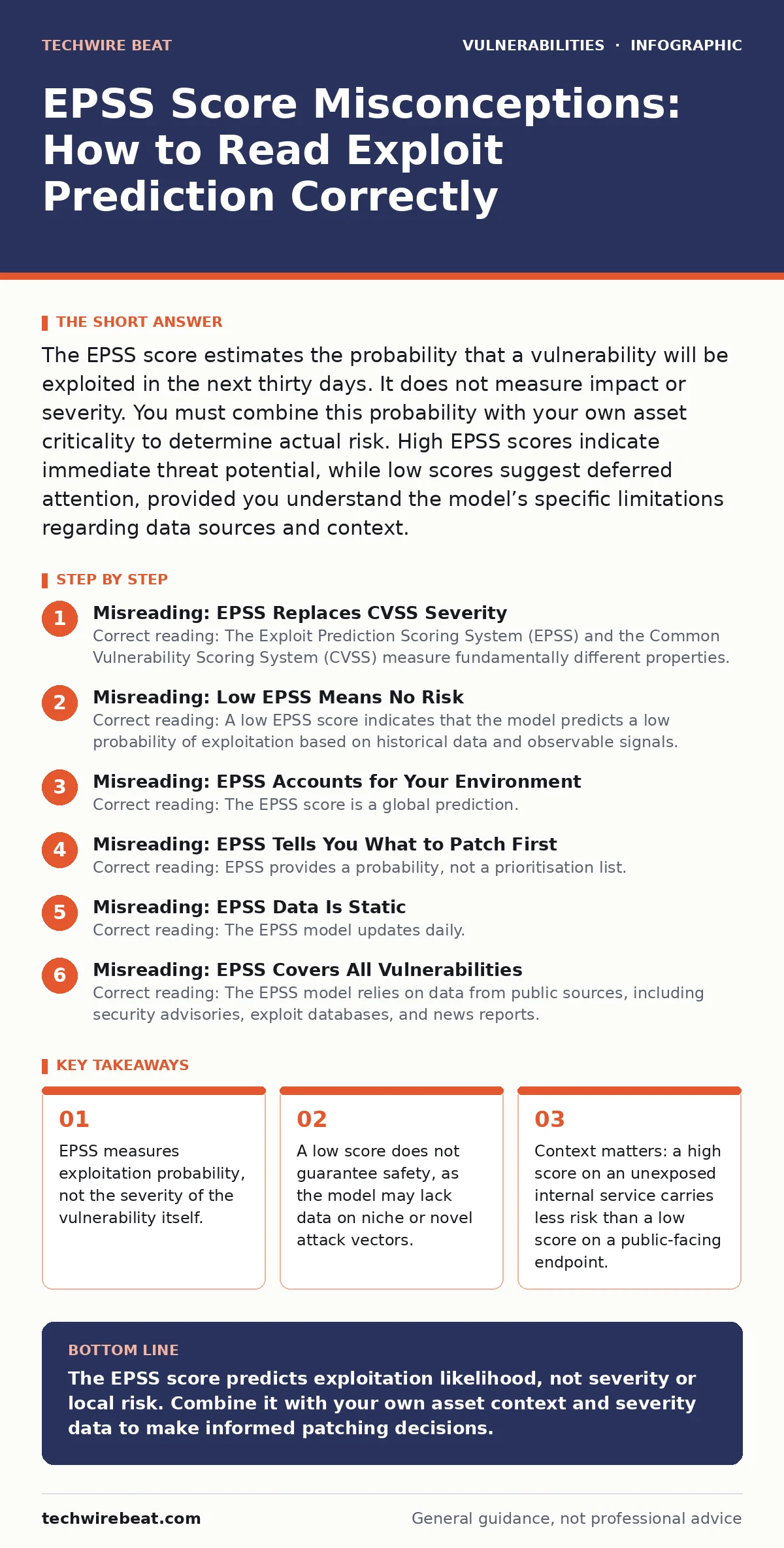
The EPSS score estimates the probability that a vulnerability will be exploited in the next thirty days. It does not measure impact or severity. You must combine this probability with your own asset criticality to determine actual risk. High EPSS scores indicate immediate threat potential, while low scores suggest deferred attention, provided you understand the model’s specific limitations regarding data sources and context.
Misreading: EPSS Replaces CVSS Severity
Correct reading: The Exploit Prediction Scoring System (EPSS) and the Common Vulnerability Scoring System (CVSS) measure fundamentally different properties. CVSS estimates the intrinsic severity of a flaw, such as whether it allows remote code execution or requires physical access. EPSS predicts the likelihood that someone will actually use that flaw in a real-world attack within thirty days.
You cannot substitute one for the other. A vulnerability might have a critical CVSS score because it allows total system compromise, but if no exploit code exists and no attacker group is targeting it, the EPSS score will remain low. Conversely, a low-severity flaw might have a high EPSS score if it is easy to automate and widely targeted.
Imagine you manage a web server with a known configuration error. The CVSS score is moderate, but the EPSS score is high. If you ignore the EPSS score because the CVSS is "only" moderate, you leave the door open to automated scanners. You must treat EPSS as a likelihood multiplier for your existing severity assessments.
Misreading: Low EPSS Means No Risk
Correct reading: A low EPSS score indicates that the model predicts a low probability of exploitation based on historical data and observable signals. It does not mean the vulnerability is safe or that no attacker is interested. The model relies on patterns of past behaviour, public exploit availability, and media attention.
If a vulnerability is new, highly specific to your industry, or part of a targeted campaign that leaves few public traces, the EPSS score may not reflect the true threat. Attackers often exploit zero-day vulnerabilities or private exploits before they appear in public datasets. In these cases, the EPSS score will be near zero, yet the risk remains significant.
This is where threat modeling becomes necessary. You must assess whether an attacker has a motive to target your specific environment, regardless of the general exploitation probability. A low EPSS score should prompt you to verify if the asset is exposed to untrusted networks, rather than allowing you to dismiss the flaw entirely.
Misreading: EPSS Accounts for Your Environment
Correct reading: The EPSS score is a global prediction. It does not know whether your vulnerable application is behind a firewall, in an air-gapped network, or exposed directly to the internet. It calculates the probability of exploitation anywhere in the world.
You must apply this global probability to your local context. If a vulnerability has a high EPSS score, but the affected software is only accessible to a small group of trusted internal users, your actual risk is lower than the score suggests. However, if that same software is part of a public-facing API, the high EPSS score indicates a very high likelihood of an immediate attempt.
Consider a database server with a known flaw. If it is only accessible from a specific application server, the attack surface is small. If that application server is compromised, the database becomes a target. You must map the EPSS score to your network topology to understand the true exposure. This process helps you prioritise patches for internet-facing assets over internal ones when resources are limited.
Misreading: EPSS Tells You What to Patch First
Correct reading: EPSS provides a probability, not a prioritisation list. It tells you which vulnerabilities are likely to be exploited, but it does not tell you which ones will cause the most damage to your organisation. Patching decisions must balance likelihood (EPSS) with impact (business criticality and CVSS).
If you patch only high-EPSS vulnerabilities, you might ignore a low-EPSS flaw that compromises your most sensitive customer data. Conversely, patching only high-CVSS flaws might leave you vulnerable to widespread, automated attacks on less critical systems. The optimal strategy combines both metrics.
For example, a low-impact vulnerability with a high EPSS score might be a nuisance but not a disaster. A high-impact vulnerability with a low EPSS score might be worth monitoring but not immediately patching if resources are scarce. You need a risk formula that weights both probability and consequence. This approach ensures you are not just reacting to the loudest threats, but protecting your most valuable assets.
Misreading: EPSS Data Is Static
Correct reading: The EPSS model updates daily. The probability of exploitation changes as new information becomes available. A vulnerability that was previously considered obscure might suddenly see a spike in EPSS score if exploit code is released or if a major news outlet reports on it.
Relying on a snapshot of the score from weeks ago can lead to false security. An attacker might have been quietly developing an exploit, and the public release of that exploit will immediately shift the EPSS prediction. You must integrate real-time or near-real-time EPSS data into your vulnerability management process.
This dynamism means that your patching queue should be dynamic as well. A vulnerability that was low priority last week might become high priority today. Automated tools can help monitor these changes, but you must understand that the score is a moving target. Static spreadsheets will quickly become misleading.
Misreading: EPSS Covers All Vulnerabilities
Correct reading: The EPSS model relies on data from public sources, including security advisories, exploit databases, and news reports. If a vulnerability is not well-documented in these sources, the model may not have enough data to generate an accurate prediction.
This is particularly relevant for proprietary software or custom applications. If a flaw is discovered in your internal code and never published, the EPSS score will not reflect it. Similarly, vulnerabilities in older, unsupported software may have less data, leading to less reliable predictions.
In these cases, you must rely on other methods to assess risk. Software composition analysis can help identify known vulnerabilities in open-source components, but it cannot predict the likelihood of exploitation for custom code. You must use your own knowledge of the codebase and the threat environment to fill in the gaps left by the EPSS model.
Key takeaways
- EPSS measures exploitation probability, not the severity of the vulnerability itself.
- A low score does not guarantee safety, as the model may lack data on niche or novel attack vectors.
- Context matters: a high score on an unexposed internal service carries less risk than a low score on a public-facing endpoint.
- The score updates daily, reflecting new intelligence, so static assessments quickly become outdated.
The EPSS score predicts exploitation likelihood, not severity or local risk. Combine it with your own asset context and severity data to make informed patching decisions.
Frequently asked questions
How often does the EPSS score change?
The EPSS score is updated daily to reflect new data on exploit availability and media attention.
Can I use EPSS for internal-only systems?
Yes, but you must adjust for the reduced attack surface. A high EPSS score on an isolated system carries less risk than on a public one.
Does EPSS replace the need for penetration testing?
No. EPSS predicts general likelihood, while penetration testing reveals specific weaknesses in your unique configuration.
What if a vulnerability has no EPSS score?
This usually means there is insufficient public data. You must rely on CVSS severity and your own risk assessment for such flaws.
How this guide was produced: written by the TechWire Beat editorial team with AI assistance, checked against the public references listed below, and reviewed when the facts change. See our editorial policy or report an error.