Vulnerability Lifecycle Management: Decisions, Risks and Team Workflow
Treating flaws as living processes prevents teams from wasting resources on low-risk issues while missing critical threats that bypass standard scans.
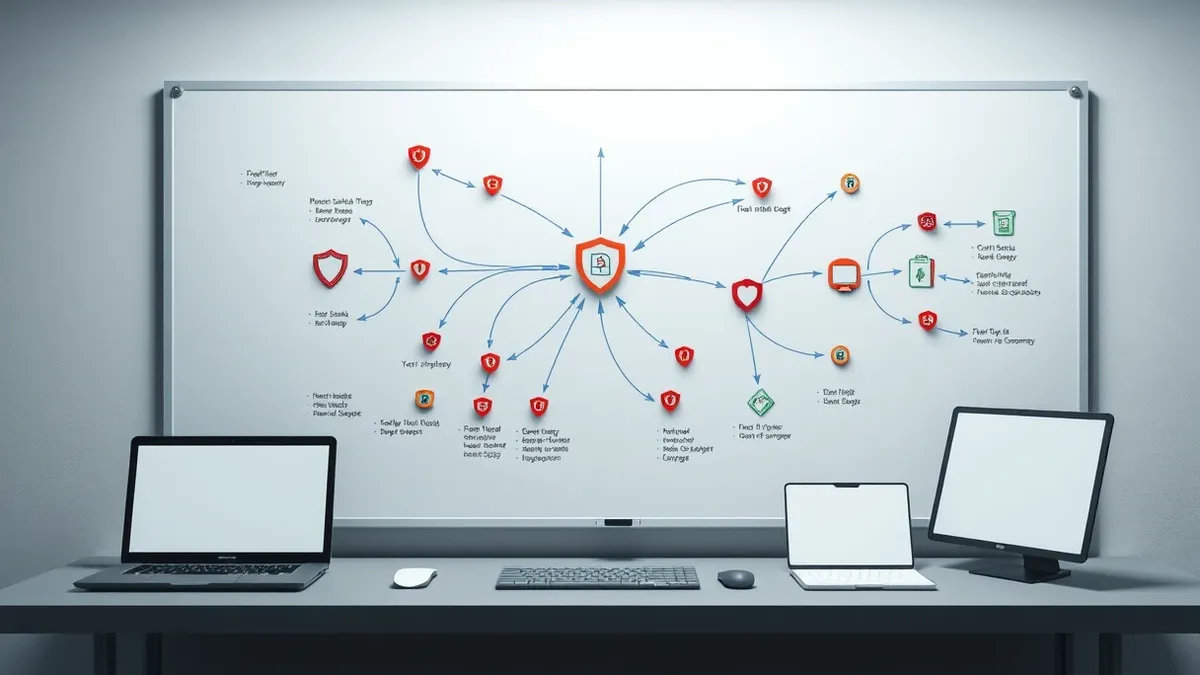
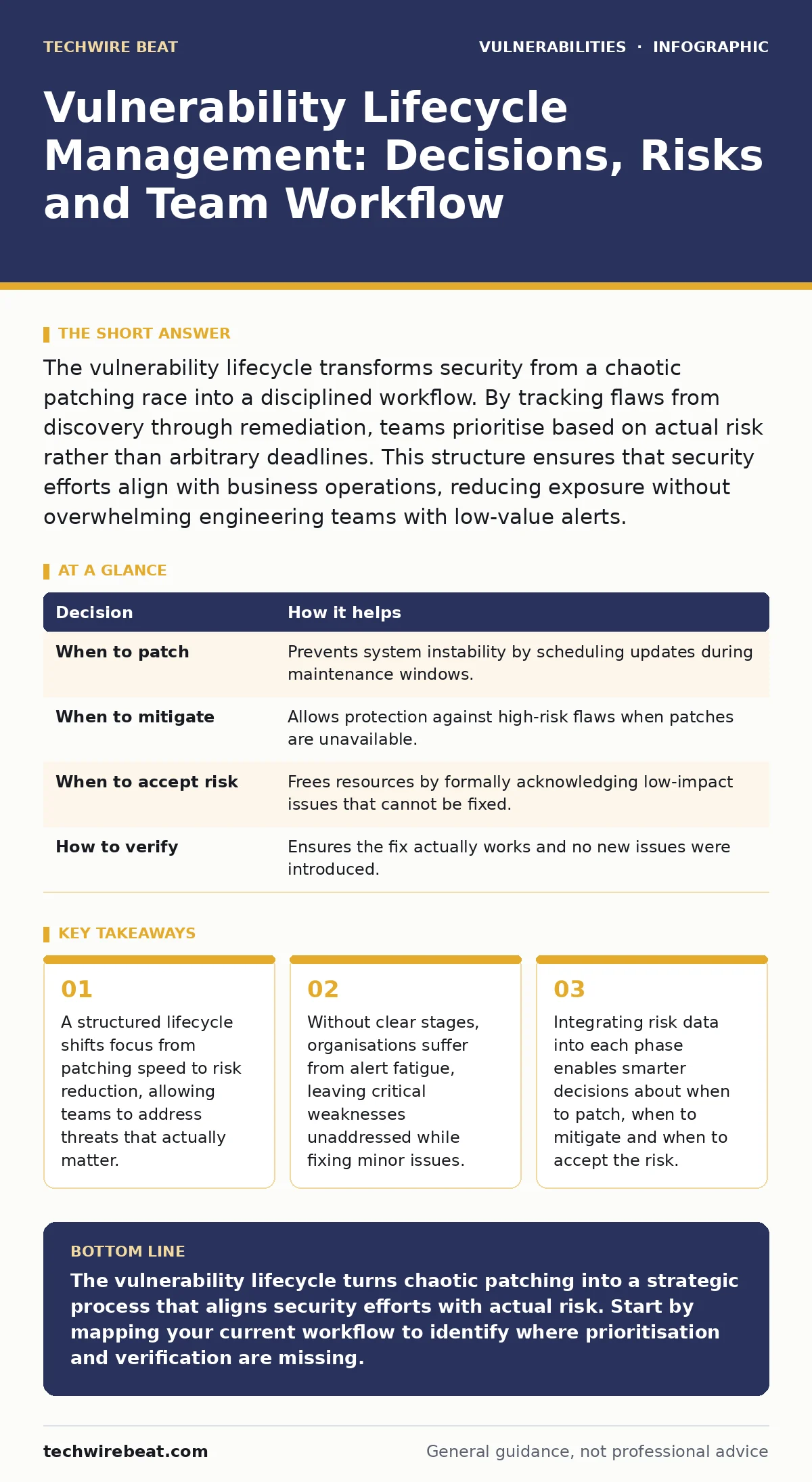
The vulnerability lifecycle transforms security from a chaotic patching race into a disciplined workflow. By tracking flaws from discovery through remediation, teams prioritise based on actual risk rather than arbitrary deadlines. This structure ensures that security efforts align with business operations, reducing exposure without overwhelming engineering teams with low-value alerts.
From Discovery to Closure
A vulnerability is a weakness in a system that can be exploited by an attacker. The lifecycle of this weakness begins the moment it is discovered and ends only when the risk is fully mitigated or accepted. This process is not a single event but a continuous loop involving detection, analysis, prioritisation, remediation and verification.
Many teams treat patching as a one-off task. They apply updates when vendors release them and assume the problem is solved. This approach ignores the reality that vulnerabilities have different levels of danger. Some require immediate attention, while others pose negligible risk in your specific environment. Understanding the full lifecycle allows you to apply the right level of effort to each issue.
The Cost of Ignoring Structure
Imagine a security team that receives hundreds of alerts weekly. Without a lifecycle framework, they attempt to fix every issue immediately. This leads to burnout and missed deadlines. Critical flaws remain open because the team is distracted by low-severity notifications that have no realistic attack path.
Suppose another team uses a structured approach. They triage alerts based on context. They focus on vulnerabilities that affect exposed services and ignore those in isolated test environments. This team spends less time on trivial fixes and more time on genuine threats. The difference is not technology but process.
Prioritisation Beyond Severity Scores
Severity scores provide a baseline for understanding potential impact. However, they do not account for your specific environment. A high-severity flaw in an unused application is less dangerous than a low-severity flaw in a public-facing database.
This is where risk-based vulnerability management becomes useful. It combines severity with context. You consider factors such as asset criticality, exploitability and current threat activity. By adding an EPSS score to your analysis, you gain insight into the likelihood of exploitation. This data helps you decide which vulnerabilities require immediate action.
Prioritisation is not just about speed. It is about efficiency. Fixing the wrong vulnerabilities first wastes resources and leaves real gaps open. A lifecycle approach ensures that prioritisation happens at a specific stage, not as an afterthought.
Remediation Strategies
Remediation is not always about applying a patch. Sometimes, patches introduce new issues or are incompatible with legacy systems. In these cases, you must consider alternative controls.
Virtual patching involves placing a security device or rule between the attacker and the vulnerable system. This blocks exploitation without changing the underlying code. It is a temporary measure but can buy time for a proper fix. For issues in third-party libraries, dependency updates may be the only path forward. However, updating dependencies requires testing to ensure no new bugs are introduced.
Each remediation strategy has a cost. Patches require testing and deployment. Virtual patching requires configuration and monitoring. Dependency updates require code review. Your lifecycle process must account for these trade-offs. Choosing the right strategy depends on the risk level and operational constraints.
Verification and Feedback
Applying a fix does not guarantee the vulnerability is closed. Configuration errors or partial deployments can leave the weakness active. Verification is the final stage of the lifecycle. It confirms that the remediation was successful.
Automated scanners can verify technical fixes. However, they may not detect logical flaws or misconfigurations. Manual testing is often required for complex issues. Once verified, the vulnerability is closed. But the process does not end there. You should analyse why the vulnerability existed in the first place.
Did a lack of threat modeling during development allow the flaw to emerge? Were security requirements unclear? This feedback loop improves your development practices. It shifts security left, preventing similar issues in future releases. Without this step, you are merely treating symptoms, not the disease.
| Decision | How it helps |
|---|---|
| When to patch | Prevents system instability by scheduling updates during maintenance windows. |
| When to mitigate | Allows protection against high-risk flaws when patches are unavailable. |
| When to accept risk | Frees resources by formally acknowledging low-impact issues that cannot be fixed. |
| How to verify | Ensures the fix actually works and no new issues were introduced. |
Integrating with Development
The vulnerability lifecycle should not exist in isolation. It must integrate with your development and operations workflows. When developers see vulnerabilities as part of the product lifecycle, they are more likely to address them early.
Shift-left security practices embed checks into the development process. This includes static analysis and dependency scanning. By catching issues early, you reduce the cost of remediation. It is cheaper to fix a flaw in code than in production.
However, integration requires balance. Too many checks can slow down development. You must configure tools to report only significant issues. Use the same prioritisation logic in development as in operations. This consistency ensures that the team focuses on what matters throughout the entire product lifecycle.
Managing External Dependencies
Modern applications rely on numerous third-party components. These components introduce their own vulnerabilities. Managing these risks requires a different approach than managing internal code.
You cannot control when vendors release fixes for external libraries. You must monitor their security status. Tools that track dependency updates can alert you to new risks. However, you must also verify compatibility. Updating a library may break your application if it changes behaviour.
This creates a tension between security and stability. The lifecycle process helps manage this tension. By prioritising based on risk, you can update high-risk dependencies quickly. Lower-risk updates can be batched with other maintenance tasks. This approach keeps your supply chain secure without disrupting operations.
The Human Element
Tools can scan and report, but humans must decide. The vulnerability lifecycle is ultimately a human process. It requires communication between security, development and operations teams.
Security teams must explain the risk clearly. They should avoid technical jargon that confuses developers. Instead, focus on the business impact. What can an attacker do? What data is at risk? This context helps other teams understand the urgency.
Development teams need support, not just directives. Provide clear guidance on remediation. Offer templates for fixes. Make it easy for them to do the right thing. When teams collaborate, the lifecycle becomes smoother. Vulnerabilities are resolved faster and with less friction.
Key takeaways
- A structured lifecycle shifts focus from patching speed to risk reduction, allowing teams to address threats that actually matter.
- Without clear stages, organisations suffer from alert fatigue, leaving critical weaknesses unaddressed while fixing minor issues.
- Integrating risk data into each phase enables smarter decisions about when to patch, when to mitigate and when to accept the risk.
The vulnerability lifecycle turns chaotic patching into a strategic process that aligns security efforts with actual risk. Start by mapping your current workflow to identify where prioritisation and verification are missing.
Frequently asked questions
How does the vulnerability lifecycle differ from traditional patch management?
Traditional patch management focuses on applying updates as they are released, often regardless of risk. The vulnerability lifecycle emphasises risk-based prioritisation and includes stages for mitigation, verification and feedback, not just patching.
Can small teams implement a full vulnerability lifecycle?
Yes, but they should simplify the stages. Focus on discovery, risk-based prioritisation and remediation. Verification can be automated where possible. The key is consistency, not complexity.
What is the role of automation in the vulnerability lifecycle?
Automation handles repetitive tasks like scanning and alerting. It frees humans to focus on analysis, decision-making and complex remediation. However, automation cannot replace human judgment in risk assessment.
How often should the vulnerability lifecycle process be reviewed?
Review the process regularly, especially after major incidents or changes in technology. Ensure that prioritisation criteria remain relevant. Adjust workflows based on feedback from development and operations teams.
How this guide was produced: written by the TechWire Beat editorial team with AI assistance, checked against the public references listed below, and reviewed when the facts change. See our editorial policy or report an error.