Secure Software Development Lifecycle: 8 Questions Answered
Integrating security into every development phase reduces remediation costs and prevents vulnerabilities from reaching production environments.
The secure software development lifecycle embeds security practices into each phase of software creation, from design to deployment. This approach identifies risks early, reduces technical debt, and ensures that applications meet compliance standards without delaying release schedules.
What is the secure software development lifecycle?
The secure software development lifecycle (SSDLC) is a structured process that integrates security activities into every stage of software creation. It moves beyond treating security as a final checklist item. Instead, it embeds threat modelling, code analysis, and configuration checks into the daily workflow of development teams. This integration ensures that security requirements are defined alongside functional requirements.
How does threat modelling prevent design flaws?
Threat modelling identifies potential attack vectors before any code is written. You map out data flows and trust boundaries to spot weaknesses in the architecture. This proactive step prevents expensive rewrites later. For instance, identifying that an API endpoint lacks authentication during design is cheaper than fixing it after launch. Threat modelling forces teams to consider how an adversary might misuse the system’s logic.
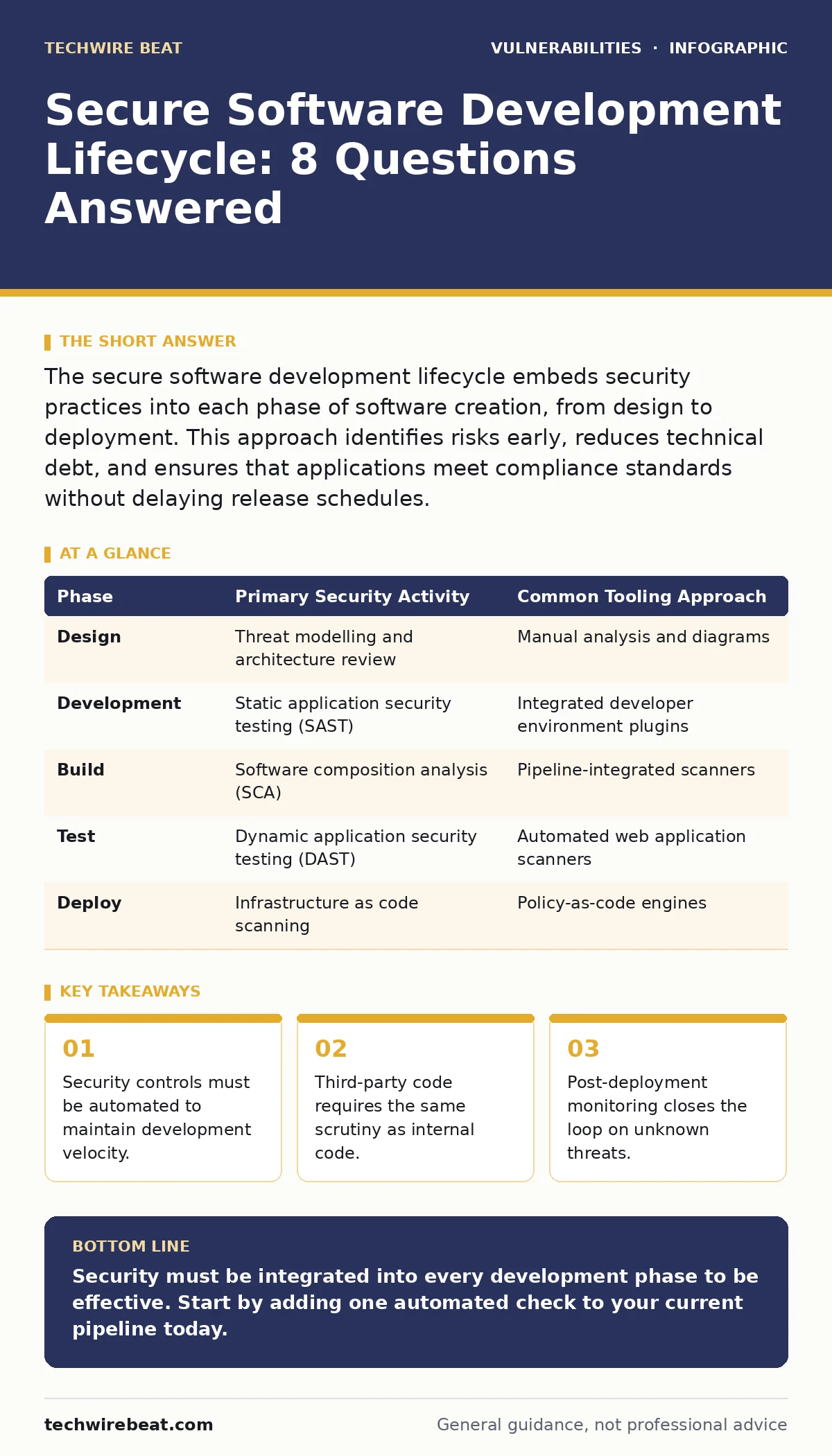
| Phase | Primary Security Activity | Common Tooling Approach |
|---|---|---|
| Design | Threat modelling and architecture review | Manual analysis and diagrams |
| Development | Static application security testing (SAST) | Integrated developer environment plugins |
| Build | Software composition analysis (SCA) | Pipeline-integrated scanners |
| Test | Dynamic application security testing (DAST) | Automated web application scanners |
| Deploy | Infrastructure as code scanning | Policy-as-code engines |
Why do static code scans miss critical bugs?
Static application security testing (SAST) analyses source code without executing it. It looks for known patterns like unescaped input or hardcoded secrets. However, it cannot detect logical flaws or runtime behaviours. A function might look safe in isolation but fail when combined with other modules. SAST also generates false positives, which can lead to alert fatigue. Teams often ignore warnings when the signal-to-noise ratio is poor.
How does software composition analysis manage third-party risk?
Software composition analysis (SCA) scans your project for open-source libraries and their known vulnerabilities. Modern applications rely heavily on external dependencies. If a library contains a bug, your application inherits it. SCA tools check these components against public databases. This process is vital for managing the supply chain risk. You must also monitor for dependency updates to patch these components quickly.
What role does dynamic testing play in finding runtime issues?
Dynamic application security testing (DAST) evaluates the running application. It simulates attacks against the live service to find vulnerabilities like cross-site scripting (XSS) or injection flaws. Unlike SAST, DAST sees the application as an attacker does. It detects issues that only appear in specific runtime conditions. However, DAST requires a working environment and can be slow to execute. It complements static analysis by catching what static tools cannot see.
How do you secure the build and deployment pipeline?
The build pipeline must be treated as a critical security boundary. You should enforce integrity checks on all artifacts. This includes signing builds and verifying hashes before deployment. Infrastructure as code (IaC) scanning ensures that cloud configurations match security policies. Misconfigured storage buckets or open database ports are common deployment errors. Automating these checks prevents human error from exposing sensitive data.
Why is post-deployment monitoring necessary for security?
Deployment is not the end of security efforts. Runtime application self-protection (RASP) and web application firewalls (WAF) provide active defence. They detect and block attacks that bypass earlier controls. Monitoring logs helps identify anomalous behaviour. This data feeds back into the development cycle for future improvements. You must also consider virtual patching techniques to mitigate zero-day vulnerabilities before code fixes are available.
How do metrics influence security maturity?
Measuring security effectiveness requires clear metrics. Track the time to detect and time to remediate vulnerabilities. Use EPSS score data to prioritise which vulnerabilities to fix first. High-risk items should be addressed immediately. Low-risk items can be scheduled. Metrics help justify security investments and show progress over time. They turn abstract security goals into tangible outcomes.
Key takeaways
- Security controls must be automated to maintain development velocity.
- Third-party code requires the same scrutiny as internal code.
- Post-deployment monitoring closes the loop on unknown threats.
Security must be integrated into every development phase to be effective. Start by adding one automated check to your current pipeline today.
Frequently asked questions
Is SSDLC only for large enterprises?
No, small teams benefit greatly from automated checks. Start with basic static analysis and dependency scanning. These tools scale with your team size and budget.
How does SSDLC relate to DevSecOps?
SSDLC provides the process framework. DevSecOps is the cultural and technical implementation that automates these processes. They work together to embed security into rapid delivery cycles.
Can automated tools replace security experts?
No, tools automate repetitive checks. Experts interpret results, design architecture, and handle complex threat modelling. Automation frees experts to focus on high-value tasks.
What is the impact of server-side request forgery (SSRF) in SSDLC?
SSRF vulnerabilities often arise from improper input validation. SSDLC catches these during design and testing phases. Early detection prevents attackers from accessing internal services.
How this guide was produced: written by the TechWire Beat editorial team with AI assistance, checked against the public references listed below, and reviewed when the facts change. See our editorial policy or report an error.