How SQL Injection Works: The Step-by-Step Attack Lifecycle
SQL injection succeeds because application code treats user input as executable instructions rather than inert data, allowing attackers to bypass authentication or extract hidden database records.

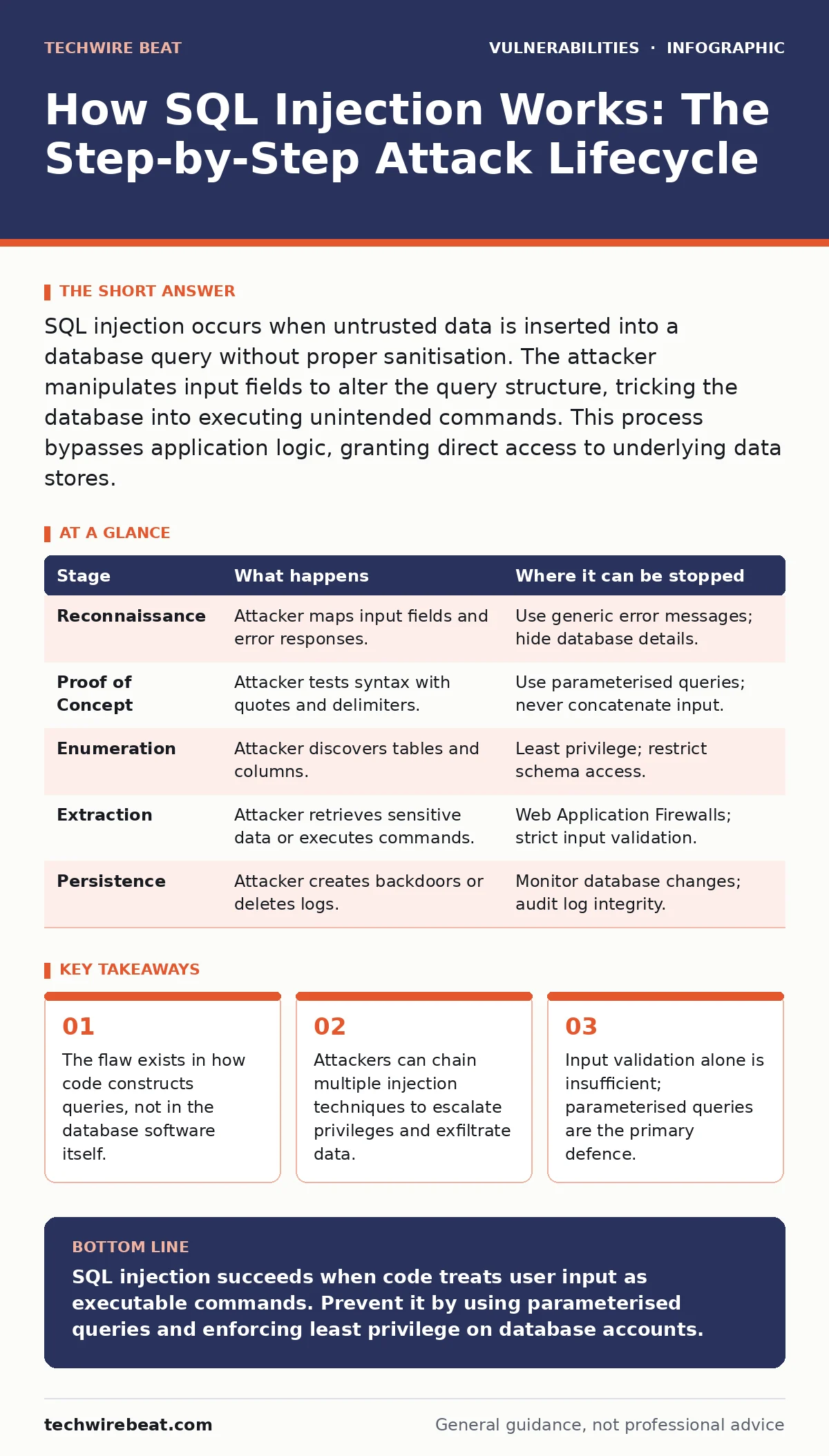
SQL injection occurs when untrusted data is inserted into a database query without proper sanitisation. The attacker manipulates input fields to alter the query structure, tricking the database into executing unintended commands. This process bypasses application logic, granting direct access to underlying data stores.
The Anatomy of a Broken Query
SQL injection exploits a fundamental misunderstanding of data boundaries. When an application accepts user input, it must distinguish between data that should be stored and commands that should be executed. If this distinction fails, the database interprets user-supplied text as part of the SQL syntax. This allows an attacker to inject malicious commands that the database will happily execute.
The vulnerability does not reside in the database engine. It lives in the application code that builds the query string. Developers often concatenate user input directly into SQL statements. This practice creates a bridge between the user interface and the database backend. Once that bridge is open, the attacker can walk across it.
### Stage 1: Reconnaissance and Input Mapping
Before injecting any code, the attacker identifies where the application accepts input. They look for search bars, login forms, URL parameters, and hidden form fields. Each entry point is a potential vector for injection. The attacker tests these fields by entering simple characters like quotes or semicolons.
This stage relies on the application providing feedback. If the application returns a generic error message, the attacker must guess. If it returns detailed database errors, the attacker gains immediate insight into the database type and structure. Detailed errors are a gift to the attacker. They reveal the schema, table names, and column types.
### Stage 2: Proof of Concept and Syntax Validation
The attacker now attempts to break the query syntax. They insert a single quote character into an input field. If the application crashes or returns a database error, the input is likely being concatenated directly into a SQL statement. This confirms the presence of a vulnerability.
The attacker then tries to balance the syntax. They might add a comment delimiter, such as two hyphens, to ignore the rest of the original query. If the application returns a normal page or a different error, the injection is syntactically valid. The attacker has established a channel for communication with the database.
This step is often automated. Scripts can cycle through hundreds of payloads rapidly. The goal is to find a payload that changes the application’s behaviour without crashing it. A successful proof of concept proves the attacker can influence the query logic.
### Stage 3: Enumeration and Schema Discovery
With a working injection point, the attacker begins to explore the database. They use conditional statements to ask true-or-false questions. For example, they might inject a condition that checks if a specific table exists. If the page loads normally, the table exists. If it fails, it does not.
This technique, known as blind injection, allows extraction of data one bit at a time. The attacker can enumerate table names, column names, and data types. They build a mental map of the database schema. This map reveals where sensitive information is stored.
The attacker might also check for database version information. Different versions have different features and vulnerabilities. Knowing the version helps the attacker choose the right extraction techniques. Some databases allow out-of-band data exfiltration, which is faster than blind injection.
### Stage 4: Data Extraction and Privilege Escalation
Now the attacker extracts the actual data. They use union-based injection to append their own query to the original one. This allows them to retrieve rows from other tables. They can pull usernames, passwords, credit card numbers, or personal details.
If the database user has elevated privileges, the attacker might attempt to execute system commands. Some databases allow the execution of operating system commands. This turns a data breach into a full system compromise. The attacker can install malware or create backdoor accounts.
This stage highlights the danger of over-privileged database accounts. Applications should use the principle of least privilege. The database account used by the web application should only have permission to read or write specific tables. It should not have administrative rights.
### Stage 5: Persistence and Covering Tracks
After extracting data, the attacker may try to maintain access. They could insert a new administrator account into the users table. This account persists even if the vulnerability is patched. The attacker can then log in legitimately using this new account.
Alternatively, the attacker might modify application data to disrupt services. They could delete records or alter prices. This causes immediate business impact. It may also distract the security team from noticing the initial breach.
To cover their tracks, the attacker might delete log entries. If they have sufficient privileges, they can remove evidence of their queries. This makes forensic analysis difficult. The organisation may never know the full extent of the breach.
Interrupting the Attack Lifecycle
SQL injection can be stopped at multiple points. The most effective defence is parameterised queries. This technique separates code from data. The database treats user input strictly as data, never as code. This breaks the injection chain at Stage 2.
Input validation is a secondary defence. It rejects obviously malicious characters. However, it is not foolproof. Attackers can encode payloads to bypass simple filters. Validation should be used alongside parameterisation, not instead of it.
| Stage | What happens | Where it can be stopped |
|---|---|---|
| Reconnaissance | Attacker maps input fields and error responses. | Use generic error messages; hide database details. |
| Proof of Concept | Attacker tests syntax with quotes and delimiters. | Use parameterised queries; never concatenate input. |
| Enumeration | Attacker discovers tables and columns. | Least privilege; restrict schema access. |
| Extraction | Attacker retrieves sensitive data or executes commands. | Web Application Firewalls; strict input validation. |
| Persistence | Attacker creates backdoors or deletes logs. | Monitor database changes; audit log integrity. |
Beyond Basic Prevention
Relying solely on developer discipline is risky. Human error is inevitable. Automated tools can help catch vulnerabilities before they reach production. Fuzz testing sends randomised inputs to the application to find unexpected crashes. This can reveal injection points that manual testing missed.
Software composition analysis scans third-party libraries for known vulnerabilities. Many injection flaws come from outdated dependencies. Regular dependency updates ensure you are not running vulnerable code. This reduces the attack surface significantly.
Virtual patching offers a temporary fix. A Web Application Firewall can block known injection patterns at the network edge. This buys time while developers implement a permanent code fix. It does not eliminate the flaw but mitigates the risk.
Understanding the vulnerability lifecycle helps prioritise fixes. Not all injection points are equally dangerous. Those with administrative access or sensitive data should be patched first. This approach maximises security impact with limited resources.
Final Considerations
SQL injection remains a prevalent threat because it is simple to execute and difficult to detect fully. The attack relies on a single mistake in code construction. Fixing it requires a shift in how developers think about data.
You must assume all user input is hostile. Never trust the client side. Validate on the server. Use parameterised queries for every database interaction. This discipline builds a resilient defence against injection attacks.
Key takeaways
- The flaw exists in how code constructs queries, not in the database software itself.
- Attackers can chain multiple injection techniques to escalate privileges and exfiltrate data.
- Input validation alone is insufficient; parameterised queries are the primary defence.
SQL injection succeeds when code treats user input as executable commands. Prevent it by using parameterised queries and enforcing least privilege on database accounts.
Frequently asked questions
Can a Web Application Firewall stop all SQL injection attacks?
No, WAFs use signature-based detection and can miss novel or encoded attacks. They are a layer of defence, not a complete solution.
Is input validation enough to prevent SQL injection?
No, attackers can bypass filters using encoding or alternative syntax. Parameterised queries are required to separate data from code.
What is the difference between SQL injection and LDAP injection?
SQL injection targets database queries, while LDAP injection targets directory service queries. Both exploit improper handling of user input.
How do I know if my application is vulnerable?
You cannot be certain without testing. Use automated scanning tools and manual penetration testing to identify injection points.
How this guide was produced: written by the TechWire Beat editorial team with AI assistance, checked against the public references listed below, and reviewed when the facts change. See our editorial policy or report an error.