What Is Parameterized Queries: The Mechanics of Safe Database Access
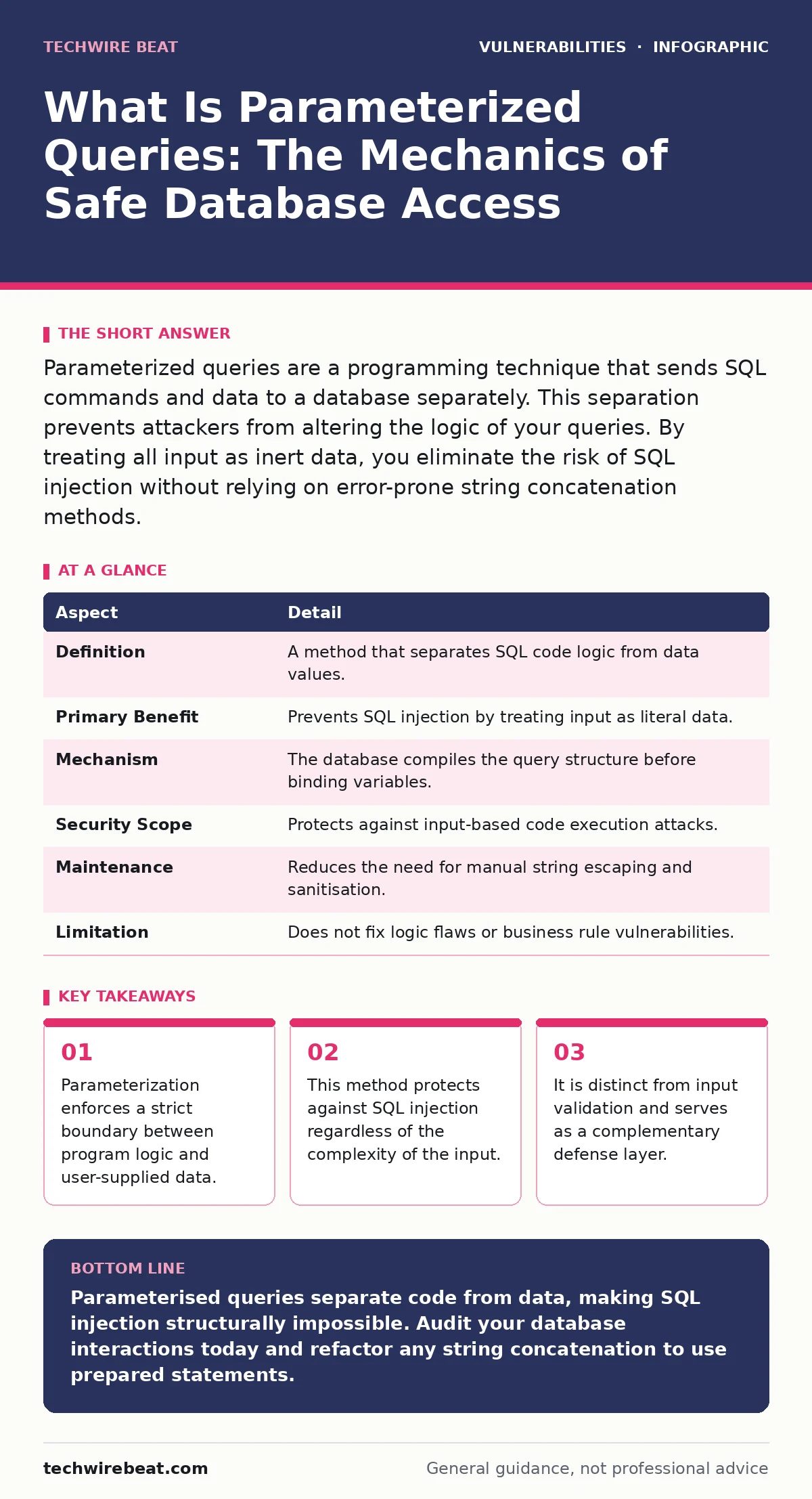
Parameterized queries separate code from data, ensuring that user input is treated as literal values rather than executable commands within database operations.

Parameterized queries are a programming technique that sends SQL commands and data to a database separately. This separation prevents attackers from altering the logic of your queries. By treating all input as inert data, you eliminate the risk of SQL injection without relying on error-prone string concatenation methods.
The Library Analogy for Database Safety
Imagine a librarian who takes book requests on a blank form. You write the title, and the librarian searches the catalogue. If you wrote "Give me all books" on the form, a careless librarian might follow that instruction instead of searching for a title. Parameterized queries act like a strict form where the title field is physically separated from the search action. The system reads your input as a value, never as an instruction.
This separation is the core mechanism of parameterized queries. When you use them, the database engine prepares the SQL statement structure first. It then binds the user data to specific placeholders in that structure. The engine knows exactly where the code ends and the data begins. This knowledge prevents any data value from masquerading as a command.
| Aspect | Detail |
|---|---|
| Definition | A method that separates SQL code logic from data values. |
| Primary Benefit | Prevents SQL injection by treating input as literal data. |
| Mechanism | The database compiles the query structure before binding variables. |
| Security Scope | Protects against input-based code execution attacks. |
| Maintenance | Reduces the need for manual string escaping and sanitisation. |
| Limitation | Does not fix logic flaws or business rule vulnerabilities. |
What Is Parameterized Queries and How It Works
Parameterized queries work by using placeholders, often represented by question marks or named variables, within the SQL statement. When your application sends a request, it sends the SQL template and the data values as two distinct packets. The database engine receives the template and compiles it into an execution plan. This plan is fixed and cannot be altered by the data that follows.
The database then takes the data values and binds them to the placeholders. Because the execution plan is already compiled, the database treats the bound values strictly as data. It does not parse the data for SQL keywords. If a user inputs a single quote or a semicolon, the database sees it as part of the text string, not as a delimiter or command terminator. This process is often called prepared statements in various database APIs.
The mechanism relies on the database driver to handle the separation. The driver ensures that the data is transmitted in a format that the database engine recognises as inert. This removes the burden from the developer to manually escape special characters. Manual escaping is error-prone and often fails when character encodings change. Parameterisation handles these edge cases automatically by design.
Who It Affects and Where It Matters
Any application that interacts with a relational database is affected by this principle. This includes web applications, mobile backends, and desktop software that stores user data. Developers who construct SQL queries by concatenating strings are directly at risk. They build the query by joining variable values into a single string before sending it to the database. This practice leaves the door open for manipulation.
Database administrators also benefit from this approach. Parameterised queries allow the database to cache execution plans. This improves performance because the database does not need to recompile the query logic for every request. It only needs to substitute the new data values. This performance gain is a secondary benefit but a significant one for high-traffic systems.
Security teams must understand that parameterisation is a code-level fix. It requires changes to how the application talks to the database. It is not a configuration setting in the database itself. If your application uses an older codebase that relies on string building, you must refactor the code to use parameterised drivers or an Object-Relational Mapping layer.
Common Mistakes and Misconceptions
Developers often believe that input validation alone stops SQL injection. This is a dangerous misconception. Input validation checks if data matches a expected format, such as an email address or a number. However, attackers can often find ways to bypass these checks or use valid data in unexpected contexts. Parameterised queries provide a structural guarantee that validation cannot offer.
Another common error is using parameterisation for the data but not for the structure. For example, you might parameterise the values in a WHERE clause but dynamically build the column names or table names. Dynamic identifiers cannot be parameterised. If you allow user input to determine which column to sort by, you must use a strict whitelist of allowed column names. You cannot bind a column name as a parameter.
Some developers assume that modern frameworks automatically protect them. While many modern libraries use parameterisation by default, they still allow raw SQL execution. If you drop down to raw SQL for performance or convenience, you lose that protection. You must consciously choose to use parameterised methods every time you interact with the database. Never mix raw string concatenation with parameterised calls in the same query.
The Hidden Costs of Poor Implementation
Refactoring legacy code to use parameterised queries can be costly. You must audit every database interaction to ensure no string concatenation remains. This requires thorough testing to ensure that the new parameterised queries return the same results as the old ones. Logic errors can creep in if you misplace a placeholder or bind a variable in the wrong order.
There is also a cognitive cost for developers who are unfamiliar with the syntax of their specific database driver. Different drivers use different placeholder styles. Some use question marks, others use named parameters like ":id". Mixing these styles within a single application can lead to confusion and bugs. Consistency in coding standards is required to mitigate this risk.
Performance tuning can become more complex. While caching execution plans helps, overly complex parameterised queries can sometimes lead to suboptimal plan selection if the data types vary significantly. If you bind a string where an integer is expected, or vice versa, implicit conversions can prevent the use of indexes. This leads to slower queries. You must ensure that the parameter types match the database schema exactly.
Integrating With Other Security Measures
Parameterised queries are a primary defence against SQL injection. They do not, however, fix all security problems. You should still use input validation to ensure data quality and to prevent other types of attacks. For instance, validation can stop an attacker from inserting excessively long strings that cause buffer overflows. It complements the structural safety of parameterisation.
Understanding the vulnerability lifecycle helps in prioritising these fixes. SQL injection is a common vulnerability type. Addressing it early in the development cycle reduces the cost of remediation. Code reviews should specifically look for string concatenation in database calls. Automated static analysis tools can also flag these patterns before the code reaches production.
If you cannot refactor legacy code immediately, consider virtual patching. This technique uses a web application firewall or a proxy to block suspicious SQL patterns in transit. It provides temporary protection while you work on the code fix. It is not a permanent solution, but it buys time. Similarly, monitoring your EPSS score can help you understand the likelihood of exploitation for known vulnerabilities in your stack.
Practical Steps for Implementation
Start by identifying all database interaction points in your application. Look for functions that execute SQL strings. Check if these functions accept user input or variables derived from user input. If you find string concatenation, mark these functions for refactoring. Prioritise the functions that handle authentication, user data, and financial transactions.
Next, choose the parameterised API provided by your database driver. Most modern drivers offer a method to prepare statements. Learn the syntax for placeholders in your specific environment. Test the new code thoroughly to ensure that the data is bound correctly. Verify that special characters in the input are handled as literal text. Use fuzz testing to generate random inputs and check for errors.
Finally, update your team's coding standards. Document the requirement to use parameterised queries for all database interactions. Provide examples of correct usage in your documentation. Train new developers on this practice from day one. Regular code reviews should enforce this standard. Consistency is key to maintaining a secure application over time.
Key takeaways
- Parameterization enforces a strict boundary between program logic and user-supplied data.
- This method protects against SQL injection regardless of the complexity of the input.
- It is distinct from input validation and serves as a complementary defense layer.
Parameterised queries separate code from data, making SQL injection structurally impossible. Audit your database interactions today and refactor any string concatenation to use prepared statements.
Frequently asked questions
Do parameterised queries protect against all types of injection?
They specifically protect against SQL injection. They do not prevent cross-site scripting or other injection types that occur in different contexts, such as HTML rendering or command-line execution.
Can I use parameterised queries with NoSQL databases?
The concept applies, but the implementation varies. Many NoSQL drivers offer similar separation of code and data. You must check your specific driver's documentation for safe query construction methods.
Is input validation redundant if I use parameterised queries?
No. Input validation ensures data quality and prevents other vulnerabilities. Parameterised queries prevent SQL injection. Both are necessary layers of defence in a secure application architecture.
How do I handle dynamic table names in parameterised queries?
You cannot parameterise table or column names. You must use a whitelist of allowed names and validate the input against this list before constructing the query string.
How this guide was produced: written by the TechWire Beat editorial team with AI assistance, checked against the public references listed below, and reviewed when the facts change. See our editorial policy or report an error.