Open-Source Software: Meaning, Origins and Daily Use
Open-source software allows anyone to inspect the underlying code, creating a model where security relies on collective scrutiny rather than hidden complexity.

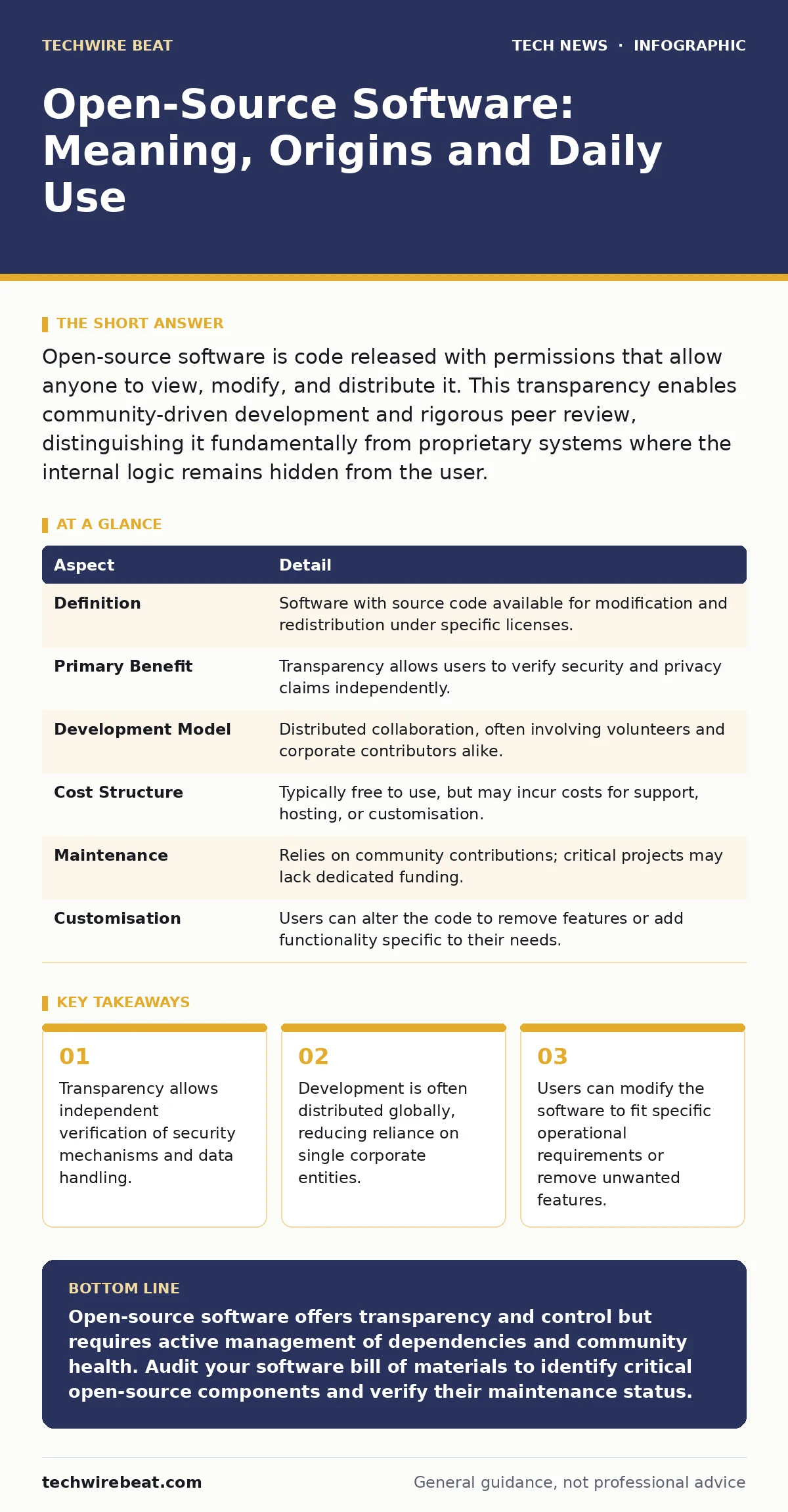
Open-source software is code released with permissions that allow anyone to view, modify, and distribute it. This transparency enables community-driven development and rigorous peer review, distinguishing it fundamentally from proprietary systems where the internal logic remains hidden from the user.
The Blueprint Analogy
Imagine you purchase a complex machine, like a high-end espresso maker. With a proprietary device, you receive the finished product and a manual. If it breaks or behaves strangely, you must trust the manufacturer’s diagnosis and repair. You cannot see inside the gears to verify they are made of safe materials.
Open-source software operates differently. It is as if the manufacturer gave you the machine along with the complete engineering blueprints. You can inspect every gear, valve, and wire. If you suspect a component is faulty, you can open the casing, examine the part, and even replace it with a safer alternative.
This distinction changes the relationship between the user and the tool. You are no longer a passive consumer relying on a brand’s reputation. You become an active participant in verifying the integrity of the system you depend on.
Defining the Mechanism
Open-source software is defined by its licensing terms, not merely by the fact that code is available. The license grants specific legal permissions to copy, study, change, and improve the software. Without these explicit rights, seeing the code is not enough; you cannot legally alter or redistribute your modifications.
The most common licenses, such as the MIT License or the GNU General Public License, dictate how derivatives must be shared. Some require that any changes made to the code must also be released as open source. Others are more permissive, allowing companies to incorporate the code into proprietary products without sharing their own additions.
This legal framework is the foundation of the ecosystem. It ensures that the software remains free to use and adapt, preventing any single entity from locking the community out of improvements. It transforms software from a static product into a living, evolving resource.
| Aspect | Detail |
|---|---|
| Definition | Software with source code available for modification and redistribution under specific licenses. |
| Primary Benefit | Transparency allows users to verify security and privacy claims independently. |
| Development Model | Distributed collaboration, often involving volunteers and corporate contributors alike. |
| Cost Structure | Typically free to use, but may incur costs for support, hosting, or customisation. |
| Maintenance | Relies on community contributions; critical projects may lack dedicated funding. |
| Customisation | Users can alter the code to remove features or add functionality specific to their needs. |
Origins in Practice
The term "open source" emerged as a strategic rebranding of the earlier "free software" movement. While both movements value user freedom, the open-source label focused on the practical benefits of collaborative development. It appealed to businesses by emphasising reliability, security, and efficiency rather than ethical arguments.
This shift allowed the model to enter corporate environments. Companies realised that sharing code could accelerate innovation. By contributing to shared projects, they reduced the cost of building basic infrastructure from scratch. They could focus their engineering resources on unique differentiators while relying on the community for foundational tools.
The model also decentralised risk. In a proprietary system, a single company controls the roadmap and security patches. In an open-source project, multiple organisations often contribute to the same code base. This diversity of contributors can lead to more thorough testing and faster identification of vulnerabilities.
Daily Usage and Integration
You likely use open-source software every day without realising it. The operating systems that run servers worldwide, the browsers you use to access the web, and many of the libraries that power mobile applications are open source. Even proprietary products often depend on open-source components for core functionality.
In day-to-day operations, this means your digital infrastructure is built on shared foundations. A database system used by a small startup might be the same engine powering a global financial institution. This shared base allows for rapid standardisation and interoperability. It ensures that data can move between systems without being locked into a single vendor’s format.
However, this integration creates hidden dependencies. When a critical open-source library contains a flaw, it can affect thousands of products simultaneously. You may not be using the library directly, but the application you trust might be. This interconnectedness requires careful monitoring of the supply chain, a practice often referred to as software composition analysis.
Common Misconceptions
Many people assume that open-source software is always free of charge. While the software itself is typically free to download and use, costs can arise in other areas. Companies often pay for professional support, custom development, or hosted versions of the software. The term "free" refers to liberty, not price, although the two often overlap.
Another misconception is that open-source projects lack quality control. The idea that "anyone can contribute" suggests chaos. In reality, mature projects have strict review processes. Code changes are often scrutinised by multiple experts before being accepted. This peer review can be more rigorous than internal testing in some proprietary companies, where deadlines may pressure engineers to skip checks.
There is also a belief that open-source software is inherently less secure because the code is visible to attackers. This view ignores the principle of security through obscurity, which is generally considered weak. When code is hidden, vulnerabilities can remain undiscovered for years. Open source allows for continuous, global inspection, often leading to faster identification and remediation of issues.
The Hidden Costs of Freedom
The reliance on volunteer labour introduces a specific risk: burnout. Many critical projects are maintained by a small number of individuals who may not receive direct compensation. If these maintainers lose interest or face personal challenges, the project can stagnate. This is known as the "bus factor," referring to the number of people who need to be hit by a bus for the project to fail.
For users, this means that stability is not guaranteed by a corporate entity. You must assess the health of the project before relying on it. Active community engagement, regular releases, and diverse contributor bases are signs of a healthy project. A project with a single maintainer and no corporate backing carries higher long-term risk.
This dynamic also affects IT asset management. Tracking which open-source components are in use, and their respective license terms, is complex. Failing to manage these dependencies can lead to legal issues or security gaps. Organisations must invest time in mapping their software bill of materials to understand their exposure.
Navigating the Ecosystem
To use open-source software effectively, you must shift from a consumer mindset to a steward mindset. You are responsible for verifying the integrity of the software you deploy. This involves checking digital signatures to ensure the code has not been tampered with during distribution.
You should also consider the licensing implications for your specific use case. If you modify the code and distribute it, you must comply with the license terms. For internal use, the requirements may be less strict, but understanding the obligations is necessary for compliance.
The ecosystem thrives on contribution. Even if you cannot write code, you can contribute by reporting bugs, improving documentation, or translating interfaces. These actions help sustain the projects you depend on. Engaging with the community builds a deeper understanding of the software and its limitations.
For those concerned about long-term viability, exploring post-quantum cryptography implementations in open-source libraries is a forward-looking step. As cryptographic standards evolve, open-source projects often adapt quickly, allowing users to benefit from the latest research without waiting for proprietary vendors to catch up.
Key takeaways
- Transparency allows independent verification of security mechanisms and data handling.
- Development is often distributed globally, reducing reliance on single corporate entities.
- Users can modify the software to fit specific operational requirements or remove unwanted features.
- The model relies on volunteer contributions, which can create maintenance gaps for critical components.
Open-source software offers transparency and control but requires active management of dependencies and community health. Audit your software bill of materials to identify critical open-source components and verify their maintenance status.
Frequently asked questions
Is open-source software safe for business use?
Yes, many businesses rely on it for core operations. Safety depends on the specific project’s maintenance, community activity, and your organisation’s ability to apply updates promptly.
Can I sell open-source software?
Yes, you can sell open-source software, services, or support. However, you must comply with the specific license terms, which may require you to share any modifications you make to the code.
How do I know if a project is well-maintained?
Look for regular release cycles, an active issue tracker with responsive maintainers, and a diverse group of contributors. Projects with corporate backing or dedicated foundations are often more stable.
What is the difference between free and open-source software?
"Free software" emphasises user freedom and ethics, while "open source" focuses on the practical benefits of the development model. In practice, the terms are often used interchangeably, but the philosophical underpinnings differ.
How this guide was produced: written by the TechWire Beat editorial team with AI assistance, checked against the public references listed below, and reviewed when the facts change. See our editorial policy or report an error.