Post-Quantum Cryptography: Real Benefits and Hidden Costs
Post-quantum cryptography secures data against future quantum computers but introduces significant performance overhead and implementation complexity that many organisations ignore.
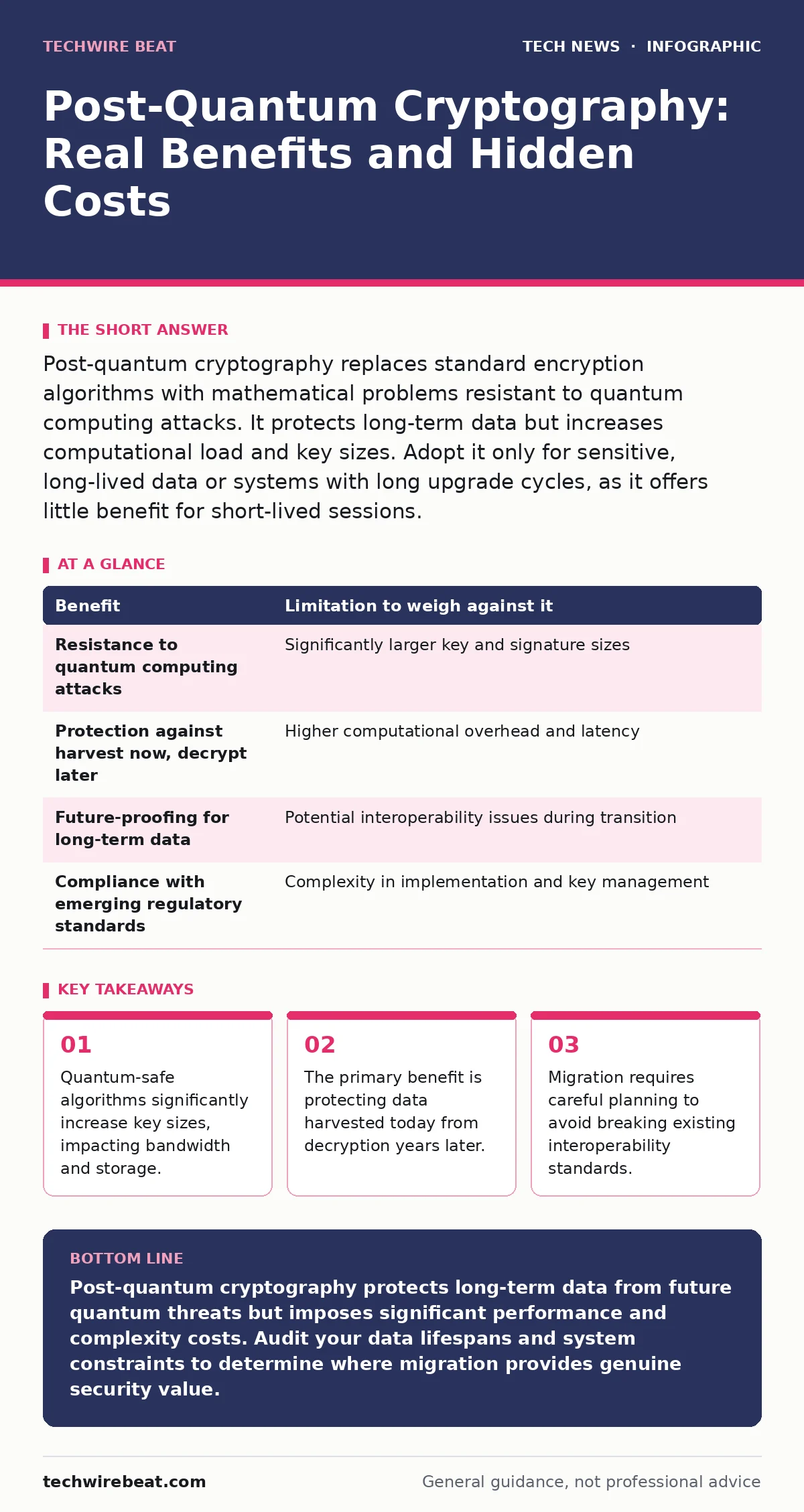
Post-quantum cryptography replaces standard encryption algorithms with mathematical problems resistant to quantum computing attacks. It protects long-term data but increases computational load and key sizes. Adopt it only for sensitive, long-lived data or systems with long upgrade cycles, as it offers little benefit for short-lived sessions.
The Threat of Harvest Now, Decrypt Later
Quantum computers threaten the mathematical foundations of current public-key cryptography. Algorithms like RSA and Elliptic Curve Cryptography rely on problems that are hard for classical computers to solve. Shor’s algorithm, when run on a sufficiently powerful quantum machine, could solve these problems efficiently. This capability enables a specific attack vector known as harvest now, decrypt later.
Attackers collect encrypted data today with the intention of decrypting it once quantum technology matures. This means data you encrypt today with standard algorithms may already be compromised. The value of this data often persists for years, making current encryption insufficient for long-term confidentiality. Post-quantum cryptography addresses this by using mathematical structures that remain difficult even for quantum processors.
Post-quantum algorithms aim to keep that data secure regardless of future hardware advances. This shift is not about immediate decryption risks but about preserving the integrity of long-lived secrets.
Algorithmic Changes and Performance Costs
Post-quantum cryptography relies on different mathematical problems, such as lattice-based or code-based cryptography. Lattice-based cryptography uses geometric structures in high-dimensional spaces to create secure keys. These structures are resistant to known quantum attacks. However, this resistance comes at a computational and storage cost.
Key sizes in post-quantum systems are substantially larger than those in current standards. A typical RSA key might be 2048 bits, while a comparable post-quantum key can exceed thousands of bits. This increase affects bandwidth usage, especially in constrained environments like mobile networks or IoT devices. Signature sizes also grow, impacting storage requirements for digital certificates and logs.
Processing power requirements increase as well. Encrypting and decrypting data takes longer on standard processors. This latency can degrade user experience in real-time applications. You must balance security needs against performance constraints. Not every application can tolerate the overhead of larger keys and slower operations.
| Benefit | Limitation to weigh against it |
|---|---|
| Resistance to quantum computing attacks | Significantly larger key and signature sizes |
| Protection against harvest now, decrypt later | Higher computational overhead and latency |
| Future-proofing for long-term data | Potential interoperability issues during transition |
| Compliance with emerging regulatory standards | Complexity in implementation and key management |
Implementation Challenges and Interoperability
Migrating to post-quantum cryptography is not a simple software update. It requires changes to protocol stacks, key management systems, and hardware security modules. Many existing systems do not support the larger key sizes or different algorithmic structures. You may need to upgrade hardware to handle the increased processing load.
Interoperability becomes a critical concern during the transition period. Systems must communicate with both legacy and post-quantum endpoints. Hybrid approaches, which combine classical and post-quantum algorithms, are often used to ensure continuity. This hybridisation increases complexity and can introduce new attack surfaces if not implemented correctly.
Certificate Transparency logs must also adapt to handle new certificate formats. If your infrastructure relies on public key infrastructure, you must ensure that certificate authorities and validators support post-quantum signatures. Failure to coordinate across the entire ecosystem can lead to broken connections and service outages.
When It Is Worth It
You should prioritise post-quantum cryptography for data that requires long-term confidentiality. Government records, medical histories, and intellectual property often remain sensitive for decades. Protecting these assets against future quantum threats justifies the performance cost. If the data loses value quickly, the investment may not be warranted.
Systems with long lifecycle durations also benefit from early adoption. Industrial control systems, embedded devices, and infrastructure components may operate for ten years or more. Upgrading these systems mid-life is difficult and expensive. Implementing post-quantum cryptography at deployment ensures they remain secure throughout their operational life.
High-value targets that store sensitive credentials should also consider migration. If an attacker compromises your key management system, they can impersonate your services. Post-quantum algorithms add a layer of defence against future decryption attempts. This is particularly relevant for organisations that manage critical infrastructure or financial data.
When It Is Not
For short-lived sessions, post-quantum cryptography offers minimal benefit. Web browsing sessions, instant messaging, and temporary API calls expire quickly. The window for a harvest now, decrypt later attack is negligible. The performance overhead of larger keys outweighs the security gain in these scenarios.
Low-resource devices may struggle with post-quantum algorithms. Simple IoT sensors, smart home devices, and legacy embedded systems lack the processing power for complex cryptographic operations. Forcing post-quantum cryptography on these devices can cause failures or excessive power consumption. In such cases, network-level security or physical protection may be more effective.
Applications with strict latency requirements should avoid premature adoption. Real-time gaming, high-frequency trading, and VoIP services cannot tolerate the delay introduced by post-quantum encryption. Until hardware accelerators become widespread, these applications should rely on classical cryptography. The risk of quantum decryption is too low to justify service degradation.
Integration with Existing Security Frameworks
Post-quantum cryptography does not replace other security measures. It complements existing frameworks by addressing a specific threat. You must still maintain strong key management practices and regular audits. Consider how post-quantum keys interact with your current IT asset management processes. Tracking these keys is more complex due to their size and variety.
Review your bring your own device policies to ensure they account for new encryption standards. Personal devices may not support post-quantum algorithms, creating security gaps. You may need to enforce specific configurations or use managed profiles to maintain security. Similarly, update your macOS security settings to reflect the new cryptographic requirements.
Network security protocols must also evolve. IPv6 security mechanisms should be tested with post-quantum algorithms to ensure compatibility. Packet headers may need expansion to accommodate larger keys. This requires coordination with network operators and service providers.
Planning for the Transition
Start by inventorying your cryptographic assets. Identify where you use public-key cryptography and assess the sensitivity of the data. Prioritise systems that handle long-term secrets or have long upgrade cycles. Develop a migration roadmap that includes testing, training, and stakeholder communication.
Engage with vendors and partners early. Many will need to update their products to support post-quantum standards. Ensure that your supply chain can deliver quantum-safe components. Monitor standardisation efforts to stay informed about recommended algorithms and best practices.
Consider the broader context of your security posture. Post-quantum cryptography is one part of a defence-in-depth strategy. Combine it with strong authentication, access controls, and monitoring. This holistic approach ensures that you address current threats while preparing for future challenges.
Key takeaways
- Quantum-safe algorithms significantly increase key sizes, impacting bandwidth and storage.
- The primary benefit is protecting data harvested today from decryption years later.
- Migration requires careful planning to avoid breaking existing interoperability standards.
Post-quantum cryptography protects long-term data from future quantum threats but imposes significant performance and complexity costs. Audit your data lifespans and system constraints to determine where migration provides genuine security value.
Frequently asked questions
Does post-quantum cryptography protect against all cyber threats?
No, it only addresses the specific risk of quantum computers breaking public-key algorithms. It does not protect against malware, phishing, or poor key management.
When will quantum computers break current encryption?
No one knows the exact timeline, but the harvest now, decrypt later threat is immediate. Data encrypted today could be decrypted in the future.
Can I use post-quantum algorithms on my smartphone?
Yes, but performance may vary. Modern smartphones can handle post-quantum encryption, but it may increase battery usage and data consumption.
How do I know if a vendor supports post-quantum cryptography?
Check their documentation for support of standardised post-quantum algorithms. Look for updates related to NIST standards or equivalent frameworks.
How this guide was produced: written by the TechWire Beat editorial team with AI assistance, checked against the public references listed below, and reviewed when the facts change. See our editorial policy or report an error.