Difference between public key cryptography and digital signature explained
Public key cryptography secures the confidentiality of data while digital signatures prove authenticity and origin without revealing contents.

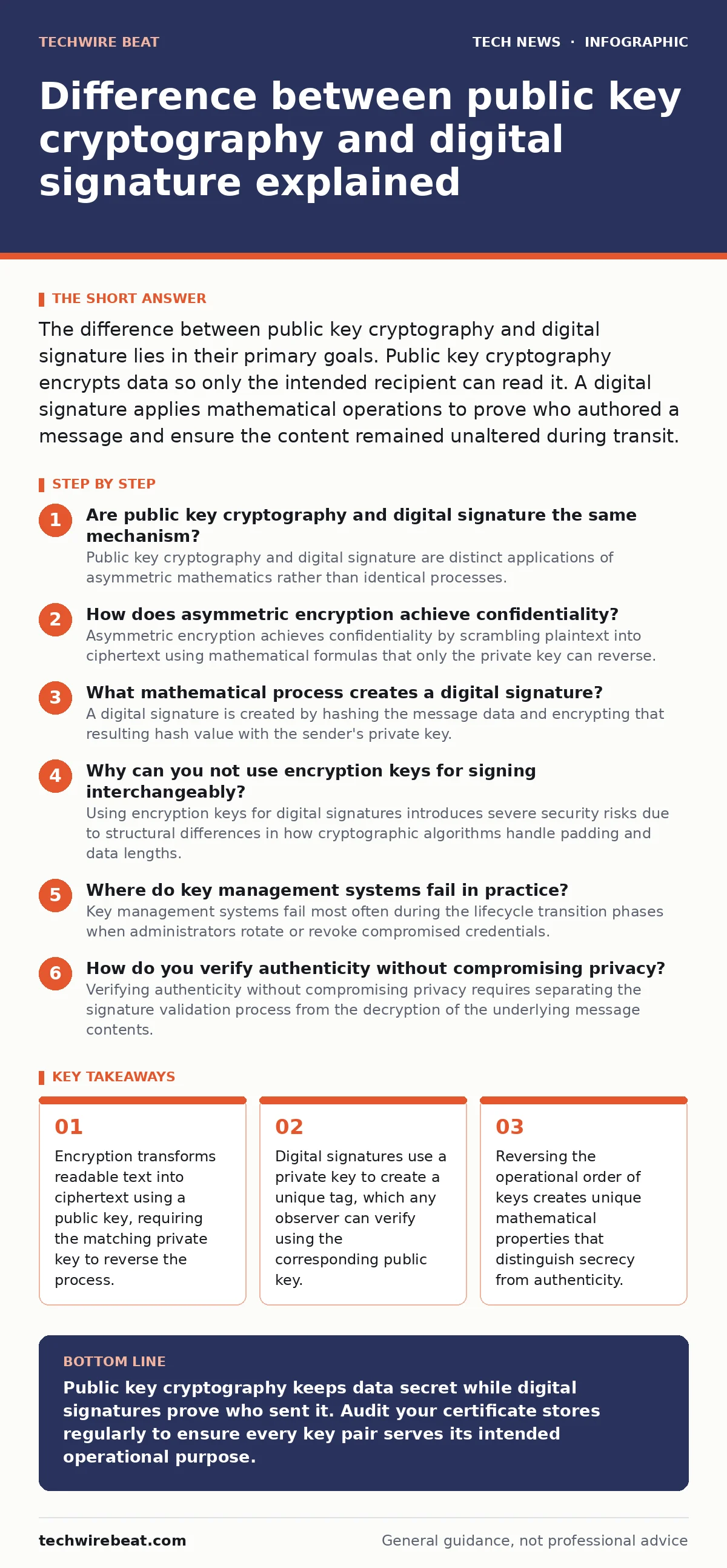
The difference between public key cryptography and digital signature lies in their primary goals. Public key cryptography encrypts data so only the intended recipient can read it. A digital signature applies mathematical operations to prove who authored a message and ensure the content remained unaltered during transit.
Are public key cryptography and digital signature the same mechanism?
Public key cryptography and digital signature are distinct applications of asymmetric mathematics rather than identical processes. Asymmetric cryptography uses a mathematically linked pair of keys where one component distributes publicly and the other remains secret. Applying these keys in reverse directions changes whether the system achieves confidentiality or authenticity.
Confidentiality relies on encrypting data with a public key so only the private key holder reads it. Authenticity relies on signing data with a private key so anyone with the public key verifies the sender. You cannot assume a secure channel automatically guarantees the identity of the sender without additional verification checks. Website security relies on combining both mechanisms to establish encrypted sessions while validating server identities.
| Mechanism | Primary Goal | Key Used First | Failure Mode |
|---|---|---|---|
| Public Key Cryptography | Confidentiality | Public Key | Data interception yields readable text |
| Digital Signature | Authenticity | Private Key | Forged origin goes undetected |
How does asymmetric encryption achieve confidentiality?
Asymmetric encryption achieves confidentiality by scrambling plaintext into ciphertext using mathematical formulas that only the private key can reverse. The sender obtains your public key from a directory, applies it to the message, and transmits the resulting ciphertext across untrusted networks. Anyone intercepting the transmission sees only randomized data blocks.
Computers handling end-of-life hardware often leak residual memory containing private keys if administrators fail to wipe storage media securely before disposal. Mathematical complexity forms the primary defense, relying on problems that are easy to compute in one direction but hard to reverse without the private key. This directional asymmetry prevents unauthorized parties from decrypting intercepted messages even when they possess the public key used to lock them.
What mathematical process creates a digital signature?
A digital signature is created by hashing the message data and encrypting that resulting hash value with the sender's private key. Hashing reduces any input file down to a fixed-length string of characters that changes dramatically if even a single comma alters in the original text.
Encrypting this hash with a private key produces the signature block attached to the transmission. The recipient hashes the received message independently and compares that result with the decrypted signature. Matching hash values confirm that the message originated from the private key holder and suffered no tampering along the way.
Why can you not use encryption keys for signing interchangeably?
Using encryption keys for digital signatures introduces severe security risks due to structural differences in how cryptographic algorithms handle padding and data lengths. Reusing the exact same key pair for both operations allows attackers to trick a key owner into decrypting a malicious payload disguised as a signature verification challenge.
Proper implementations maintain strict separation between signing keys and encryption keys to isolate potential protocol failures. Virtual machines running cryptographic operations must enforce memory isolation to prevent signing keys from leaking through shared cache side channels. Separating these functions ensures that a compromise in confidentiality mechanisms does not automatically grant authorization privileges.
Where do key management systems fail in practice?
Key management systems fail most often during the lifecycle transition phases when administrators rotate or revoke compromised credentials. Trust depends entirely on the integrity of the path connecting a public key to a real-world entity.
Imagine an attacker steals an administrative private key and uses it to issue fraudulent digital signatures across an enterprise network. Traditional monitoring tools often struggle to detect this abuse because the cryptographic operations themselves appear completely valid and well-formed. IT asset management records must track the exact physical locations and expiration dates of every certificate to prevent unauthorized key generation.
See also: Large language models: five common misunderstandings and how to read them
How do you verify authenticity without compromising privacy?
Verifying authenticity without compromising privacy requires separating the signature validation process from the decryption of the underlying message contents. Senders can encrypt a message for confidentiality using the recipient's public key, and then append a digital signature created with the sender's own private key.
- Receive the incoming transmission containing both ciphertext and the attached signature block.
- Decrypt the ciphertext using your private key to recover the original readable message.
- Validate the attached signature using the sender's public key to confirm authorship.
This dual-layer approach ensures that intermediate relay nodes read neither the message contents nor the true identity of the communicating parties beyond what the network headers expose. DNS security frameworks apply similar nested validation steps to ensure domain name lookups arrive untampered without exposing user query habits to local network observers.
Key takeaways
- Encryption transforms readable text into ciphertext using a public key, requiring the matching private key to reverse the process.
- Digital signatures use a private key to create a unique tag, which any observer can verify using the corresponding public key.
- Reversing the operational order of keys creates unique mathematical properties that distinguish secrecy from authenticity.
Public key cryptography keeps data secret while digital signatures prove who sent it. Audit your certificate stores regularly to ensure every key pair serves its intended operational purpose.
Frequently asked questions
Can a digital signature prove when a message was created?
Standard digital signatures prove authorship and integrity but do not verify creation time without relying on a trusted timestamping authority.
What happens if you lose the private key in a signature scheme?
Losing a private key prevents you from creating new valid signatures, though previously issued signatures remain verifiable until their associated certificates expire.
Are larger key sizes always better for security?
Larger key sizes increase cryptographic strength but impose heavier processing overhead on computing hardware during encryption and signature verification routines.
Do digital signatures prevent people from reading messages?
Digital signatures provide no confidentiality by themselves, meaning anyone intercepting a signed message can read its contents unless separate encryption is applied.
How this guide was produced: written by the TechWire Beat editorial team with AI assistance, checked against the public references listed below, and reviewed when the facts change. See our editorial policy or report an error.