What is DNSSEC and why is it important for web trust
Digital signatures protect domain name lookups from tampering, yet most websites still leave this layer completely unverified.

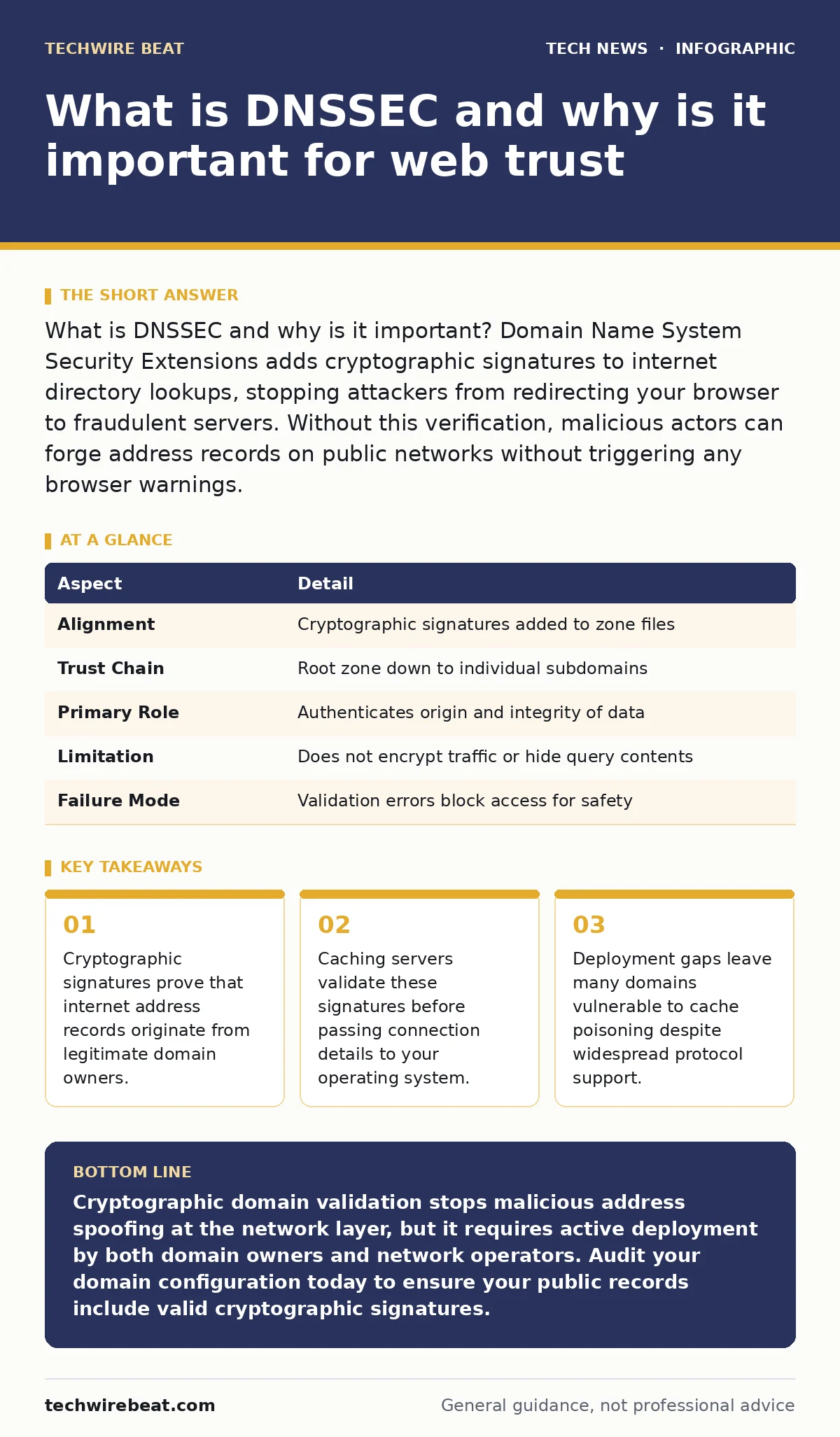
What is DNSSEC and why is it important? Domain Name System Security Extensions adds cryptographic signatures to internet directory lookups, stopping attackers from redirecting your browser to fraudulent servers. Without this verification, malicious actors can forge address records on public networks without triggering any browser warnings.
How phone books work on the modern internet
Imagine looking up a local business in a shared directory where anyone with a pen can cross out the real number and write in a scam hotline. The Domain Name System functions as the phone book of the internet, translating human-readable web addresses into numeric IP addresses that routing equipment understands. Standard domain lookups rely on plain text messages passed between recursive resolvers and authoritative name servers. This open architecture permits malicious actors to intercept queries and inject false routing data into intermediary caches.
What is DNSSEC and why is it important for lookup integrity
Domain Name System Security Extensions is a suite of protocol specifications that adds cryptographic authentication to domain lookups. Cryptographic signatures use public key cryptography to tie a domain name to its corresponding numerical address. Recursive resolvers verify these signatures against a chain of trust that extends all the way down from the root servers of the global naming hierarchy. When validation succeeds, your browser connects to the genuine destination without fear of interception.
| Aspect | Detail |
|---|---|
| Alignment | Cryptographic signatures added to zone files |
| Trust Chain | Root zone down to individual subdomains |
| Primary Role | Authenticates origin and integrity of data |
| Limitation | Does not encrypt traffic or hide query contents |
| Failure Mode | Validation errors block access for safety |
The mechanics of cryptographic trust chains
Digital signing relies on asymmetric key pairs managed by domain administrators. Authoritative name servers publish public keys alongside standard address records, while keeping private keys secret to generate signatures. When a validating resolver requests a record, it receives both the data and the signature. The resolver checks this signature using the parent domain's public key, continuing upward until it reaches the hardcoded root zone trust anchor.
Who is affected by unverified name resolution
Every internet user relies on accurate address translation every time they open a browser application or connect to an API endpoint. Internet service providers operate the recursive resolvers that perform the heavy lifting of validation on behalf of domestic connections. Enterprise network administrators must configure their local infrastructure to enforce strict validation policies. Domain owners bear the responsibility of generating keys and publishing signed zone data correctly.
What people usually get wrong about validation
Many engineers assume that enabling protocol support at the registrar level automatically secures their web traffic. Protocol deployment only authenticates the translation step and provides no encryption for the actual data stream traveling to the destination server. In this context, pairing domain validation with broader frameworks like Certificate Transparency ensures that both the address lookup and the subsequent cryptographic handshake remain trustworthy. Another common misconception involves confusing address translation security with general DNS security measures that focus on volumetric attack mitigation rather than cryptographic proof.
See also: Difference between public key cryptography and digital signature explained · Large language models: five common misunderstandings and how to read them
How to configure and maintain signed zones
Implementing cryptographic extensions requires generating key-signing keys and zone-signing keys through your domain registry interface. Zone administrators must publish DS records with parent registries to link their cryptographic chain of trust securely. Monitoring tools should track key expiration dates and algorithm rollovers to prevent accidental outages caused by stale signatures. Automated management scripts reduce human error during routine key rotation cycles.
Key takeaways
- Cryptographic signatures prove that internet address records originate from legitimate domain owners.
- Caching servers validate these signatures before passing connection details to your operating system.
- Deployment gaps leave many domains vulnerable to cache poisoning despite widespread protocol support.
Cryptographic domain validation stops malicious address spoofing at the network layer, but it requires active deployment by both domain owners and network operators. Audit your domain configuration today to ensure your public records include valid cryptographic signatures.
Frequently asked questions
Does DNSSEC encrypt my web browsing traffic?
No, the protocol only verifies the authenticity of address translation records and does not encrypt the content of your web traffic.
Why do many websites still lack cryptographic zone signatures?
Deployment complexity and the risk of self-inflicted outages due to misconfigured keys discourage some administrators from enabling validation.
What happens if a signature verification fails?
Validating resolvers treat the failure as a security threat and block access to the domain, returning a SERVFAIL error message to the client.
Does this protocol replace transport layer security certificates?
No, transport layer certificates secure the connection between your browser and the web server, whereas this protocol secures the initial address lookup.
How this guide was produced: written by the TechWire Beat editorial team with AI assistance, checked against the public references listed below, and reviewed when the facts change. See our editorial policy or report an error.