Certificate Transparency: Five Common Misreadings Explained
Certificate Transparency does not prevent fraud but exposes it, shifting the burden from prevention to rapid detection and automated response.

Certificate Transparency is a public log system, not a security control. It records every issued certificate so anyone can spot forged ones. It does not stop bad actors from obtaining certificates; it ensures they cannot hide them. Trust relies on monitoring these logs for anomalies.
Misreading: Certificate Transparency prevents certificate theft
Correct reading: Certificate Transparency (CT) is a detection mechanism, not a prevention layer. It operates on the principle of public accountability. When a Certificate Authority (CA) issues a digital certificate, it must submit that certificate to a public, append-only log. This log is cryptographically signed, meaning entries cannot be altered or removed once recorded.
The system assumes that if an attacker manages to convince a CA to issue a fraudulent certificate for your domain, they will also want to use it. By forcing the certificate into the light, CT ensures that someone will see it. It does not stop the CA from issuing the certificate in the first place. The security benefit comes from the speed of discovery, not the prevention of issuance.
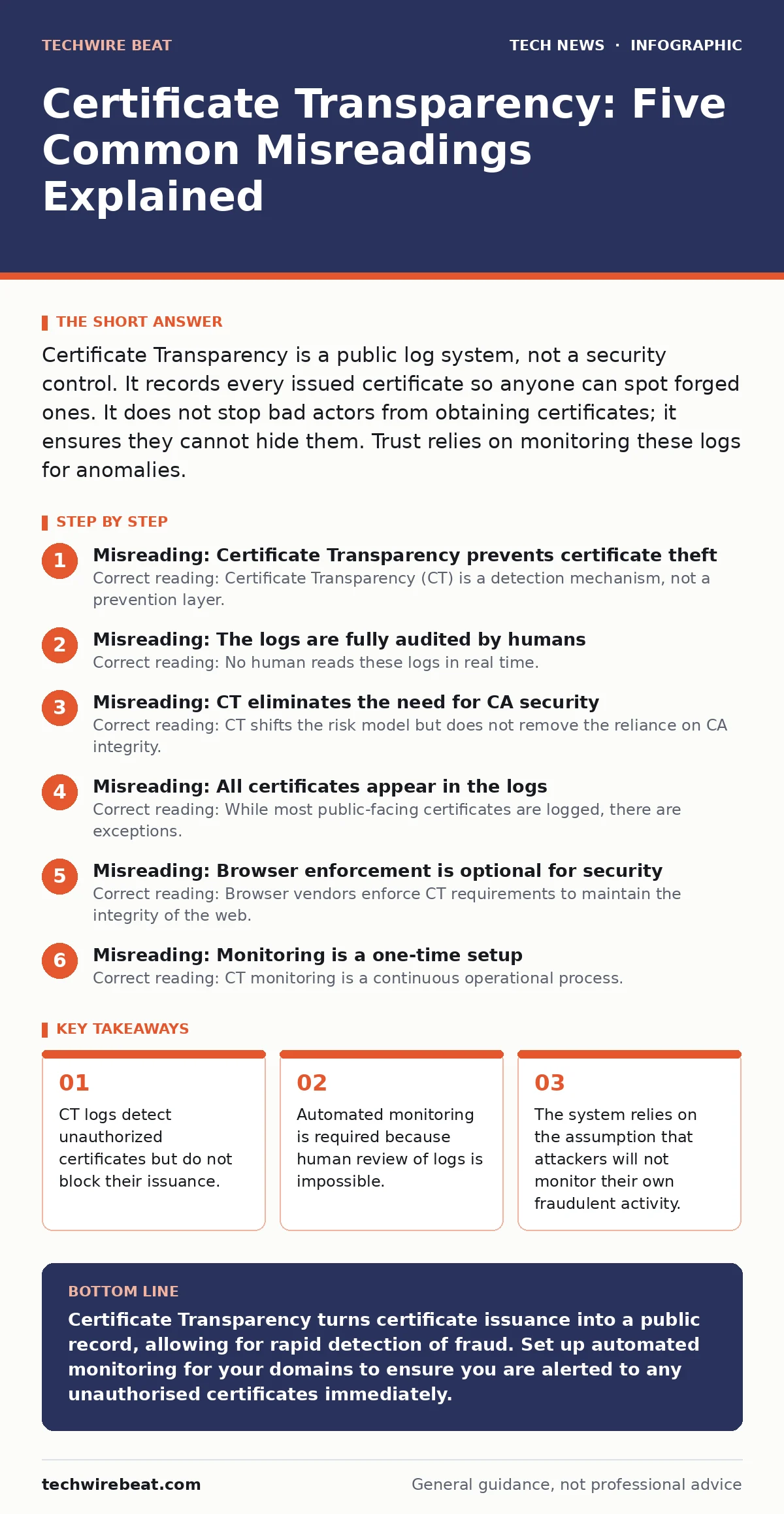
Misreading: The logs are fully audited by humans
Correct reading: No human reads these logs in real time. The volume of certificates issued globally every day is too vast for manual inspection. Instead, the system relies on automated monitoring tools. Domain owners, CAs, and third-party security firms run scripts that constantly scan the CT logs for new entries matching their domains or certificates.
If a script detects a certificate it did not authorise, it triggers an alert. This automation is the backbone of the system. Without it, the logs would be a static record with no immediate security value. You must configure your own monitoring or rely on your provider to do it for you. If you do not monitor the logs, a fraudulent certificate could remain active until a user encounters it and their browser rejects it.
Misreading: CT eliminates the need for CA security
Correct reading: CT shifts the risk model but does not remove the reliance on CA integrity. Certificate Authorities are still the gatekeepers. If a CA is compromised, an attacker can obtain valid certificates. CT ensures those certificates are logged, but the damage window exists between issuance and detection.
Therefore, strengthening CA security practices remains necessary. CT acts as a safety net, catching failures that other controls missed. It does not replace the need for secure key storage, strict identity verification, and operational security within the CA. The system works best when combined with other controls, such as DNS security measures that protect the domain name system itself.
Misreading: All certificates appear in the logs
Correct reading: While most public-facing certificates are logged, there are exceptions. Short-lived certificates, often used for automated rotation, may be handled differently depending on the CA and browser policies. Some internal certificates used within a private corporate network are not issued by public CAs and therefore do not appear in public CT logs. These private certificates rely on local trust anchors rather than public trust.
If you use internal certificates for your intranet services, CT offers no visibility into them. You must manage trust for those separately. Additionally, some CAs may use pre-certificates, which are temporary placeholders that expire quickly. These are logged but do not represent a final, long-term issuance. Understanding the lifecycle of the certificate you are using is vital for accurate monitoring.
Misreading: Browser enforcement is optional for security
Correct reading: Browser vendors enforce CT requirements to maintain the integrity of the web. Major browsers refuse to trust certificates that are not present in CT logs, with specific exceptions for short-lived certificates. This enforcement is what gives CT its power. If browsers accepted non-logged certificates, attackers could simply avoid logging their fraudulent certificates.
The threat of being logged is what drives compliance. You cannot opt out of CT if you want your site to be trusted by standard web browsers. This means your Certificate Authority must support CT logging. If your CA fails to log a certificate, your users will see security warnings. This enforcement creates a unified standard across the web, ensuring that all public certificates are subject to the same scrutiny.
See also: Detecting Apache Struts Vulnerabilities: Log Patterns and Blind Spots
Misreading: Monitoring is a one-time setup
Correct reading: CT monitoring is a continuous operational process. You must maintain your monitoring tools to ensure they are functioning correctly. False positives can occur if your own systems issue certificates that the monitoring tool does not recognise. For example, if you rotate your keys or change your CA, the monitoring tool must be updated to reflect these changes.
Otherwise, it will alert you on every legitimate renewal. Conversely, if your monitoring tool goes offline, you lose visibility. This requires ongoing maintenance. It is not a set-and-forget solution. Regular testing of your alerting mechanisms ensures that when a real threat appears, you will see it. This aligns with broader IT asset management principles, where visibility into all digital assets is maintained over time.
Misreading: CT solves the problem of mis-issued certificates entirely
Correct reading: CT exposes mis-issued certificates, but it does not automatically revoke them. Revocation is a separate process handled by the CA. When a fraudulent certificate is detected, the CA must be notified to revoke it. Revocation lists, such as Certificate Revocation Lists (CRLs) or Online Certificate Status Protocol (OCSP), must then be updated. Browsers must check these lists to know the certificate is invalid.
If revocation is slow, the window of exposure remains. CT speeds up detection, but the speed of revocation depends on the CA's processes. Some CAs have automated responses to CT alerts, which reduces this window. However, you should not assume that detection equals immediate neutralisation. The chain of trust requires multiple steps, each with its own potential for delay.
Key takeaways
- CT logs detect unauthorized certificates but do not block their issuance.
- Automated monitoring is required because human review of logs is impossible.
- The system relies on the assumption that attackers will not monitor their own fraudulent activity.
- Browser enforcement is the primary driver of CT adoption, not server-side configuration.
Certificate Transparency turns certificate issuance into a public record, allowing for rapid detection of fraud. Set up automated monitoring for your domains to ensure you are alerted to any unauthorised certificates immediately.
Frequently asked questions
Does Certificate Transparency affect my website's performance?
No. CT logging happens on the Certificate Authority's side, not your server. The browser checks the log status during the initial connection, but this has negligible impact on page load times for end users.
Can an attacker hide their certificate from CT logs?
Only if they use a CA that does not comply with CT requirements. However, major browsers will not trust certificates from non-compliant
How this guide was produced: written by the TechWire Beat editorial team with AI assistance, checked against the public references listed below, and reviewed when the facts change. See our editorial policy or report an error.