Should I force HTTPS redirect to secure your web traffic
Forcing encrypted connections can break local development environments and legacy integrations permanently.

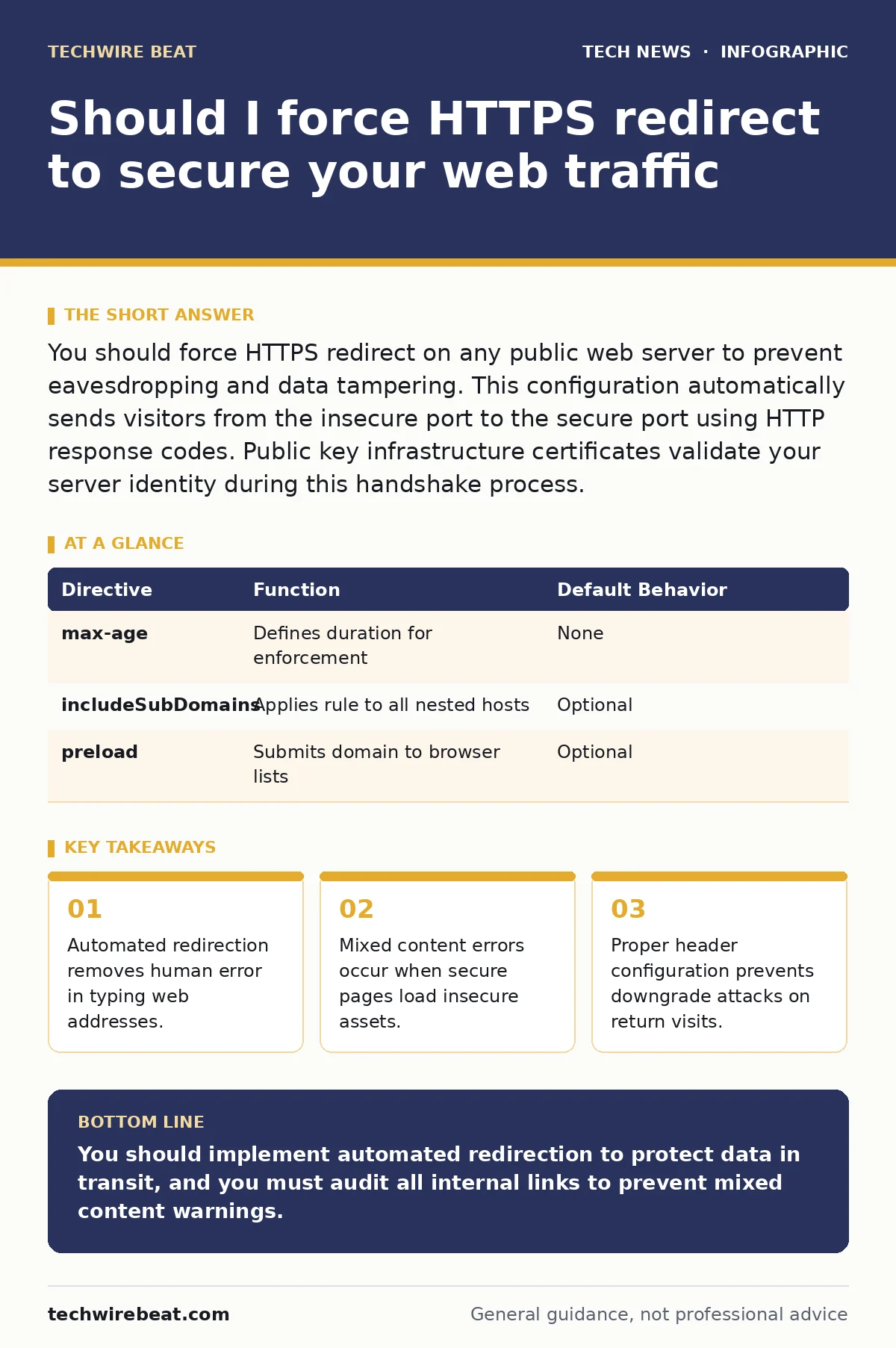
You should force HTTPS redirect on any public web server to prevent eavesdropping and data tampering. This configuration automatically sends visitors from the insecure port to the secure port using HTTP response codes. Public key infrastructure certificates validate your server identity during this handshake process.
Should you force HTTPS redirect on every website?
You should force HTTPS redirect on almost all public-facing servers unless legacy internal applications strictly require unencrypted communication. Transport Layer Security, the cryptographic protocol providing secure communication over a computer network, relies on clients initiating connections via the correct port. Leaving the unencrypted port open invites intermediaries to alter traffic before the browser establishes a secure session.
Enforcing this rule changes how browsers request resources by returning a specific status code instructing clients to remember the secure location. This redirection stops passive observers from reading transmitted data packets. Proper website security practices depend on this foundational layer to maintain user privacy across the public internet.
How does HTTP Strict Transport Security prevent downgrade attacks?
HTTP Strict Transport Security is a response header that forces browsers to interact with your domain exclusively over secure channels. Initial cleartext requests remain vulnerable to interception before the first redirect reaches the client. This protocol eliminates that window by instructing browsers to internalize the encryption requirement for future visits.
| Directive | Function | Default Behavior |
|---|---|---|
| max-age | Defines duration for enforcement | None |
| includeSubDomains | Applies rule to all nested hosts | Optional |
| preload | Submits domain to browser lists | Optional |
Preloading this setting hardcodes your domain into browser software distribution lists. You cannot easily reverse this inclusion if your certificate expires or configuration breaks. Careful planning avoids locking legitimate users out of subdomains lacking valid certificates.
What happens to internal links and third-party integrations?
Internal links pointing to the old unencrypted scheme cause unnecessary redirect loops and slow down page rendering times. Every redirected request adds a round-trip latency penalty before the server returns the requested content. Updating all internal resource references to use the secure prefix maintains optimal performance and eliminates redundant network hops.
Third-party webhooks and application programming interfaces might fail if endpoint configurations assume unencrypted transport. External services sending automated data payloads often reject redirected connections for security reasons. Testing all integration endpoints before enabling global redirection prevents sudden data flow interruptions.
Why do mixed content errors break modern web pages?
Mixed content errors occur when secure pages attempt to load subresources over unencrypted connections. Modern browsers block these insecure scripts and stylesheets automatically to protect user session integrity. Fixing these warnings requires updating every image, font, and script reference to use the secure transport scheme.
Dynamic applications often generate asset URLs based on incoming request headers. Misconfigured reverse proxies can trick your application into believing requests arrived unencrypted. Ensuring your server infrastructure correctly passes proxy headers maintains consistent asset delivery.
When should you avoid strict redirection rules?
You should avoid strict redirection rules on local development servers operating without valid cryptographic certificates. Developers frequently test applications on local loopback addresses where encrypted certificates add unnecessary friction. Forcing redirection in these environments breaks local debugging tools and staging workflows.
Imagine a staging environment where internal teams test software updates before public release. Applying production-level redirection policies here can lock developers out of administrative panels lacking local domain validation. Maintaining separate configuration profiles for development and production prevents these operational bottlenecks.
See also: Cross-Site Scripting Explained: 8 Questions Answered for Secure Code
How do search engines handle protocol transitions?
Search engines treat the secure and insecure variants of your domain as entirely separate entities until properly consolidated. Implementing proper redirection signals crawlers to transfer ranking authority from the old address to the new destination. Failing to configure these rules correctly results in duplicate content penalties and fractured analytics data.
Canonical tags must be updated alongside redirection rules to point directly to the secure URLs. Search crawlers use these tags to determine the preferred version of a document for indexing. Consistent signaling across headers, tags, and redirects ensures smooth transitions during search engine recrawling cycles.
Key takeaways
- Automated redirection removes human error in typing web addresses.
- Mixed content errors occur when secure pages load insecure assets.
- Proper header configuration prevents downgrade attacks on return visits.
You should implement automated redirection to protect data in transit, and you must audit all internal links to prevent mixed content warnings.
Frequently asked questions
Does forcing HTTPS slow down website loading times?
Initial connections require a cryptographic handshake that adds minimal latency, but subsequent requests benefit from connection reuse and HTTP/2 optimisations.
What causes an infinite redirect loop when enabling HTTPS?
Infinite loops happen when a reverse proxy or load balancer terminates encryption before reaching the application server, which then attempts to redirect the unencrypted traffic again.
Can search engines penalise a site for lacking HTTPS?
Major search engines give ranking preference to secure sites and may display active security warnings to visitors on unencrypted pages.
How long do browsers remember HSTS settings?
Browsers respect the duration specified in the max-age directive sent by your server header, which can range from a few weeks to several years.
How this guide was produced: written by the TechWire Beat editorial team with AI assistance, checked against the public references listed below, and reviewed when the facts change. See our editorial policy or report an error.