DNS Security: Real Benefits and Hidden Costs for Your Network
Domain name system security stops interception but cannot verify the safety of the destination server or protect against application-layer attacks.

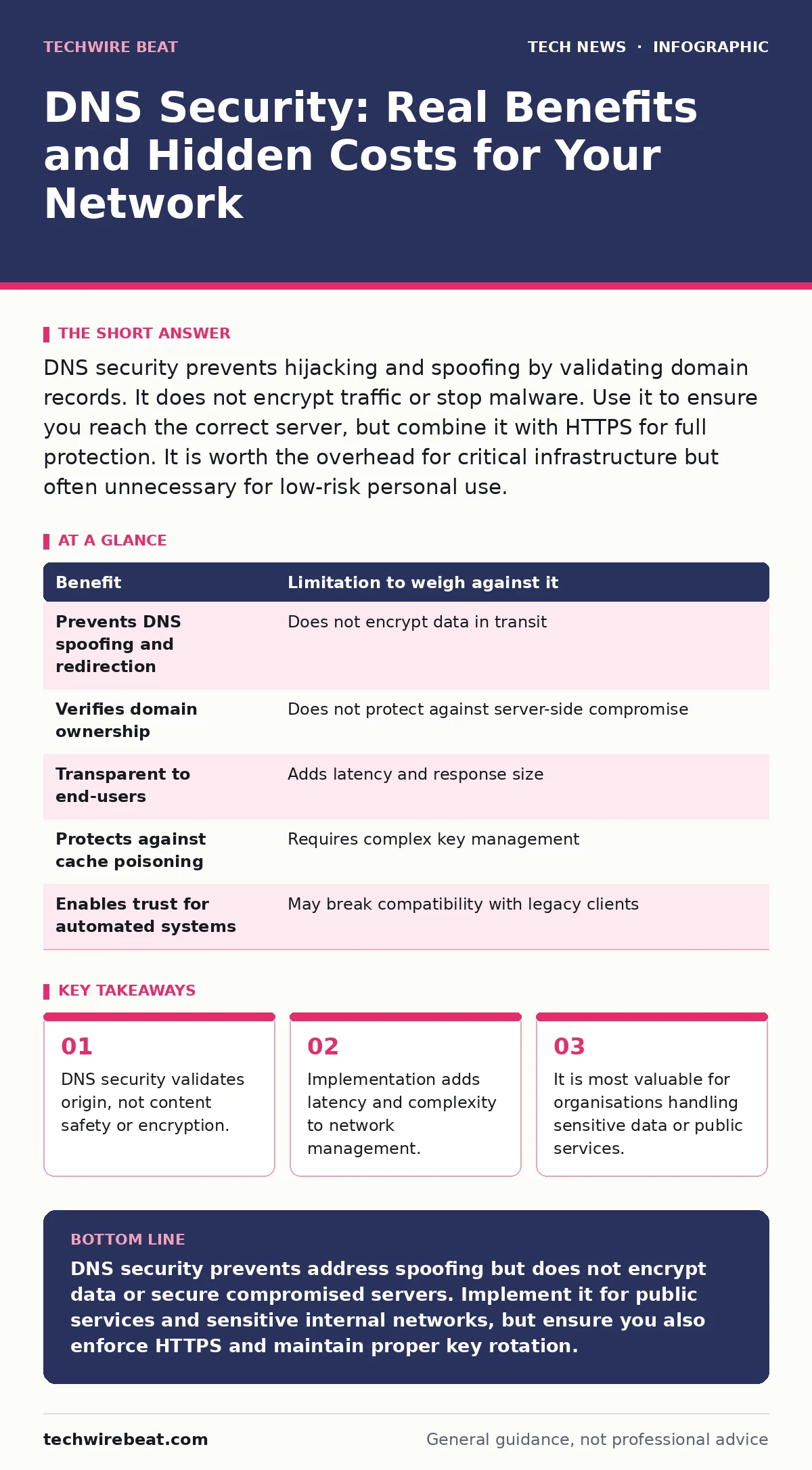
DNS security prevents hijacking and spoofing by validating domain records. It does not encrypt traffic or stop malware. Use it to ensure you reach the correct server, but combine it with HTTPS for full protection. It is worth the overhead for critical infrastructure but often unnecessary for low-risk personal use.
The Mechanism of Domain Validation
The domain name system translates human-readable addresses into numerical IP addresses. Without security measures, this translation process is vulnerable to manipulation. An attacker can intercept the query and return a false address, directing you to a malicious server. This is known as DNS spoofing.
Security protocols like DNSSEC add digital signatures to these records. Your resolver checks the signature against a public key to verify the record has not been altered. This ensures the address comes from the legitimate owner of the domain name. It does not encrypt the data you send to that address.
Concrete Benefits of Implementation
The primary benefit is authentication. You know the IP address belongs to the domain you requested. This breaks the chain of man-in-the-middle attacks that rely on redirecting traffic. It also prevents cache poisoning, where an attacker injects false data into a recursive resolver’s memory.
This protection is transparent to the user. Once configured, it operates in the background without requiring changes to user behaviour. It also provides a baseline of trust for automated systems. Scripts and bots can rely on the integrity of the domain resolution without manual verification.
Imagine a banking application that relies on a specific domain for two-factor authentication. If an attacker spoofs the DNS response, they could intercept the authentication code. DNS security prevents this redirection, ensuring the code reaches the legitimate server.
Honest Limitations and Blind Spots
DNS security does not encrypt the payload of your communication. It only secures the address lookup. Once connected, your data travels in plain text unless you also use HTTPS or TLS. An attacker can still eavesdrop on or modify the content of your session.
It also does not protect against application-layer attacks. If the legitimate server is compromised, DNS security will faithfully direct you to it. You cannot distinguish between a legitimate server hosting malware and a legitimate server hosting clean content.
Furthermore, DNSSEC adds computational overhead. Signing and verifying records requires processing power and increases the size of DNS responses. This can lead to higher latency, particularly for users with slow connections or devices with limited resources.
The Cost of Maintenance
Implementing DNS security requires ongoing maintenance. Keys must be rotated regularly to prevent compromise. If a private signing key is lost or stolen, the entire chain of trust is broken. Recovery can be complex and may result in temporary service outages.
For large organisations, managing these keys across thousands of domains is operationally heavy. It requires specialised tools and trained staff. For small teams, the administrative burden may outweigh the security benefits, especially if the risk profile is low.
There is also a compatibility cost. Older clients or misconfigured resolvers may fail to validate signed records. This can result in "security downgrades" where the client refuses to connect, causing service disruption for a subset of users.
Trade-offs in Practice
| Benefit | Limitation to weigh against it |
|---|---|
| Prevents DNS spoofing and redirection | Does not encrypt data in transit |
| Verifies domain ownership | Does not protect against server-side compromise |
| Transparent to end-users | Adds latency and response size |
| Protects against cache poisoning | Requires complex key management |
| Enables trust for automated systems | May break compatibility with legacy clients |
See also: What is DNSSEC and why is it important for web trust
When It Is Worth It
You should implement DNS security if you host public-facing services. Websites, APIs, and email servers are high-value targets for redirection attacks. The cost of a successful spoofing attack can include reputational damage and loss of user trust.
It is also worth it for internal networks handling sensitive data. If an attacker poisons internal DNS records, they can redirect employees to fake internal portals. This is a common technique in advanced persistent threats.
Consider the scope of your user base. If you serve a global audience, the risk of interception is higher. DNS security ensures that users in regions with less secure internet infrastructure still reach the correct servers.
When It Is Not Worth It
For small, private networks with no public exposure, the benefits are marginal. If your devices only communicate with known, trusted servers, the risk of DNS spoofing is low. The complexity of key management may not be justified.
It is also not worth it if you lack the resources to maintain it properly. A poorly implemented DNSSEC configuration can be worse than none at all. If you cannot guarantee regular key rotations and monitoring, you may introduce more vulnerabilities than you solve.
Finally, if your primary concern is data privacy, DNS security alone is insufficient. You need encryption protocols like HTTPS or end-to-end encryption. DNS security is a building block, not a complete solution.
Beyond DNS Protection
DNS security is one layer in a broader defence strategy. It works best when combined with other measures. For instance, Certificate Transparency logs all issued certificates, making it harder to hide rogue certificates. This complements DNS security by securing the encryption layer.
Similarly, IPv6 security requires careful configuration to prevent neighbour discovery attacks, which can also redirect traffic. Ensuring your network is secure across both IPv4 and IPv6 is necessary for comprehensive protection.
For devices in the home, smart home security and IoT security are often more pressing concerns. Many IoT devices have weak default configurations that are easier to exploit than the DNS layer. Prioritise patching and securing these devices first.
If you are concerned about future threats, post-quantum cryptography may eventually replace current signature algorithms. However, this is a long-term consideration. For now, current cryptographic standards are sufficient for DNS security.
Also consider end-of-life hardware risks. Old routers and servers may not support modern DNS security protocols. Upgrading hardware is often a prerequisite for effective implementation.
Key takeaways
- DNS security validates origin, not content safety or encryption.
- Implementation adds latency and complexity to network management.
- It is most valuable for organisations handling sensitive data or public services.
DNS security prevents address spoofing but does not encrypt data or secure compromised servers. Implement it for public services and sensitive internal networks, but ensure you also enforce HTTPS and maintain proper key rotation.
Frequently asked questions
Does DNS security encrypt my browsing data?
No, it only verifies the IP address. You must use HTTPS to encrypt the actual data transmitted between your browser and the server.
Can DNS security stop phishing attacks?
It can stop phishing that relies on redirecting you to a fake IP address, but it cannot stop phishing emails or fake websites that use legitimate domains.
Is DNS security mandatory for all websites?
No, it is optional. However, it is highly recommended for public-facing services to prevent traffic interception and maintain trust.
How does DNS security affect website speed?
It may slightly increase latency due to the extra verification steps, but the impact is usually negligible for modern networks and users.
How this guide was produced: written by the TechWire Beat editorial team with AI assistance, checked against the public references listed below, and reviewed when the facts change. See our editorial policy or report an error.