sudo vulnerabilities: how privilege escalation breaks and how to stop it
Default sudo configurations often allow local attackers to bypass complex authentication mechanisms by exploiting path resolution flaws and environment variable inheritance.

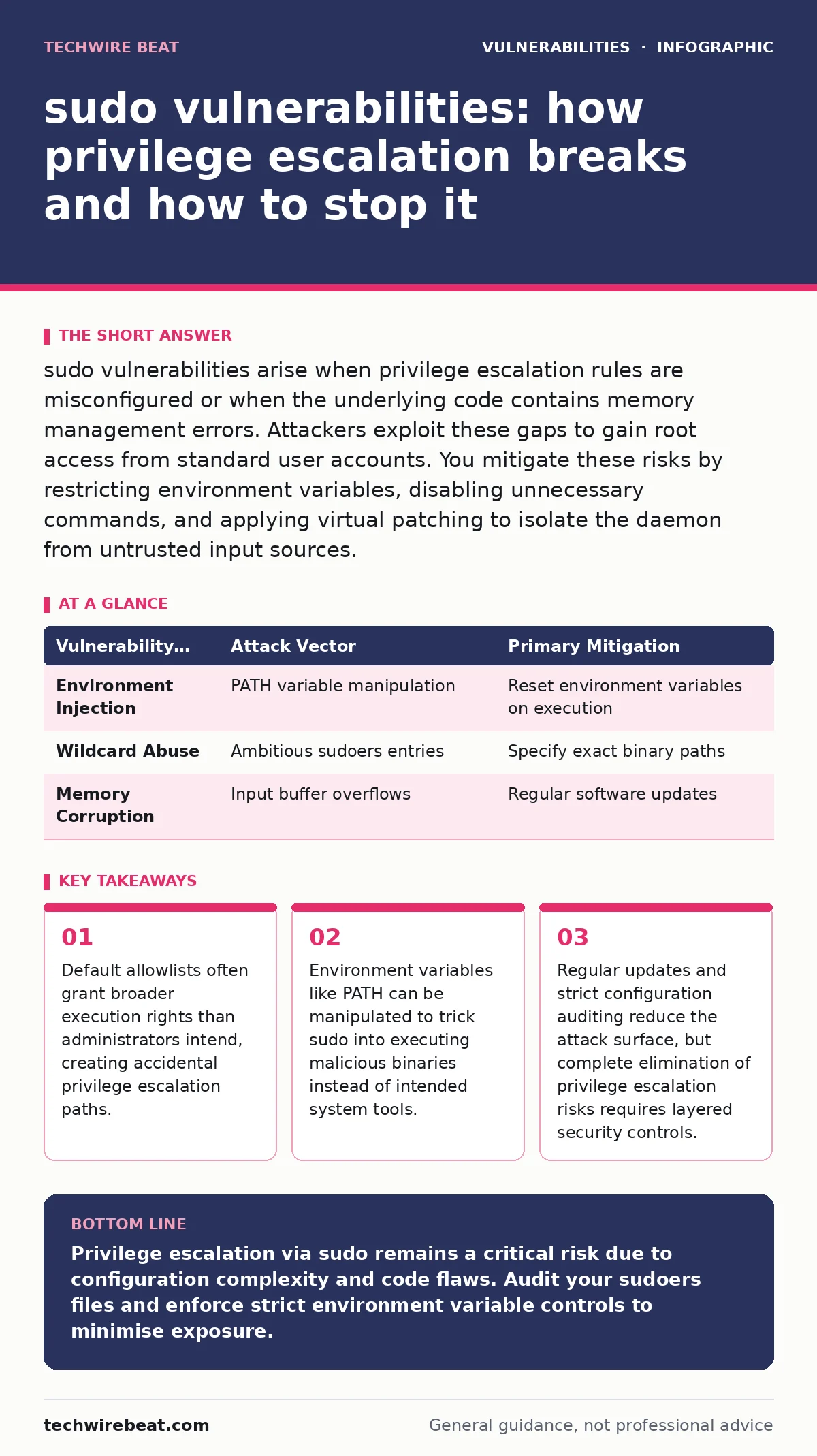
sudo vulnerabilities arise when privilege escalation rules are misconfigured or when the underlying code contains memory management errors. Attackers exploit these gaps to gain root access from standard user accounts. You mitigate these risks by restricting environment variables, disabling unnecessary commands, and applying virtual patching to isolate the daemon from untrusted input sources.
What is a sudo vulnerability?
A sudo vulnerability is a flaw in the privilege escalation mechanism that allows a user to gain higher privileges than intended. The sudo command lets authorised users execute programs as the superuser or another user. Vulnerabilities occur when the software fails to enforce these restrictions correctly. This failure can stem from coding errors, such as buffer overflows, or from configuration mistakes, such as overly permissive rules.
Why is sudo a high-value target for attackers?
sudo is a high-value target because it grants direct access to the highest level of system control. Compromising a standard user account is often the first step in an intrusion. If an attacker can escalate privileges via sudo, they gain full administrative rights. This allows them to modify system files, install persistent backdoors, and access sensitive data. The impact is immediate and severe, making sudo a primary focus for threat actors seeking total system compromise.
How do environment variables create security risks?
Environment variables create security risks by altering the behaviour of commands executed through sudo. Variables like PATH define where the system looks for executable files. An attacker can modify these variables to point to a malicious script with the same name as a legitimate system tool. When sudo runs the command, it executes the attacker's code instead. This technique, known as path hijacking, bypasses many standard security controls and grants root-level execution.
What is the impact of wildcard abuse in sudoers?
Wildcard abuse in sudoers allows attackers to execute arbitrary commands by exploiting ambiguous path specifications. If a rule permits execution of all files in a directory using an asterisk, an attacker can place a malicious file in that directory. The wildcard matches the malicious file, granting it elevated privileges. This configuration error turns a broad permission into a direct privilege escalation vector. Administrators must specify exact file paths rather than using wildcards to prevent this exploitation.
How does sudo interact with use-after-free vulnerabilities?
sudo interacts with use-after-free vulnerabilities when the program accesses memory that has already been freed. This memory corruption can overwrite critical data structures within the sudo process. An attacker can manipulate this corrupted memory to redirect execution flow. By crafting specific inputs, they can trigger the use-after-free condition and execute arbitrary code with root privileges. This type of vulnerability requires careful memory management in the software code.
| Vulnerability Type | Attack Vector | Primary Mitigation |
|---|---|---|
| Environment Injection | PATH variable manipulation | Reset environment variables on execution |
| Wildcard Abuse | Ambitious sudoers entries | Specify exact binary paths |
| Memory Corruption | Input buffer overflows | Regular software updates |
Can configuration errors bypass authentication requirements?
Configuration errors can bypass authentication requirements by allowing passwordless execution of specific commands. If a sudoers rule omits the password prompt for a command, any user can run it without verification. Attackers exploit this by chaining multiple allowed commands to achieve root access. Even commands that seem harmless can be combined to modify system files or execute new shells. Strict authentication policies for all privileged commands prevent this silent escalation.
How does software composition analysis help identify risks?
Software composition analysis helps identify risks by scanning dependencies for known vulnerabilities. sudo often relies on shared libraries and external components. If a dependency contains a flaw, sudo inherits that risk. Analysis tools map these dependencies and flag versions with known issues. This proactive approach allows administrators to patch vulnerable components before exploitation. It complements regular updates by providing visibility into the entire software supply chain.
What is the role of virtual patching in protection?
Virtual patching provides protection by intercepting and filtering malicious traffic before it reaches the application. Instead of updating the sudo binary immediately, you deploy a rule set that blocks known exploit patterns. This approach reduces downtime during patching cycles. It also provides immediate mitigation against zero-day vulnerabilities while a permanent fix is developed. Virtual patching acts as a temporary shield, buying time for proper remediation.
How does a secure software development lifecycle prevent flaws?
A secure software development lifecycle prevents flaws by integrating security checks at every stage of development. Developers write code with security in mind, following established standards. Automated testing identifies memory errors and logic flaws early. Code reviews catch configuration mistakes and improper privilege handling. This disciplined approach reduces the number of vulnerabilities present in the final software release. It shifts security left, making fixes cheaper and faster.
Key takeaways
- Default allowlists often grant broader execution rights than administrators intend, creating accidental privilege escalation paths.
- Environment variables like PATH can be manipulated to trick sudo into executing malicious binaries instead of intended system tools.
- Regular updates and strict configuration auditing reduce the attack surface, but complete elimination of privilege escalation risks requires layered security controls.
Privilege escalation via sudo remains a critical risk due to configuration complexity and code flaws. Audit your sudoers files and enforce strict environment variable controls to minimise exposure.
Frequently asked questions
Does disabling sudo completely eliminate privilege escalation risks?
Disabling sudo removes that specific vector, but attackers may still exploit other privilege escalation methods, such as kernel exploits or misconfigured setuid binaries.
How often should I review sudo permissions?
You should review sudo permissions after any system change and at least quarterly to ensure permissions align with current user roles and security requirements.
Can cross-site scripting (XSS) attacks lead to sudo exploitation?
XSS attacks typically target web applications, not command-line tools like sudo. However, if a web interface wraps sudo calls, an XSS flaw could potentially trigger malicious sudo executions.
Is it safe to allow sudo without a password for system updates?
Allowing sudo without a password reduces security significantly. Attackers can exploit this to execute arbitrary commands during the update process, gaining full system control.
How this guide was produced: written by the TechWire Beat editorial team with AI assistance, checked against the public references listed below, and reviewed when the facts change. See our editorial policy or report an error.