Use-After-Free Vulnerabilities Prevention Checklist for Secure Code
Use-after-free errors persist because compilers cannot detect logical ownership mistakes, making automated static analysis insufficient for full protection.

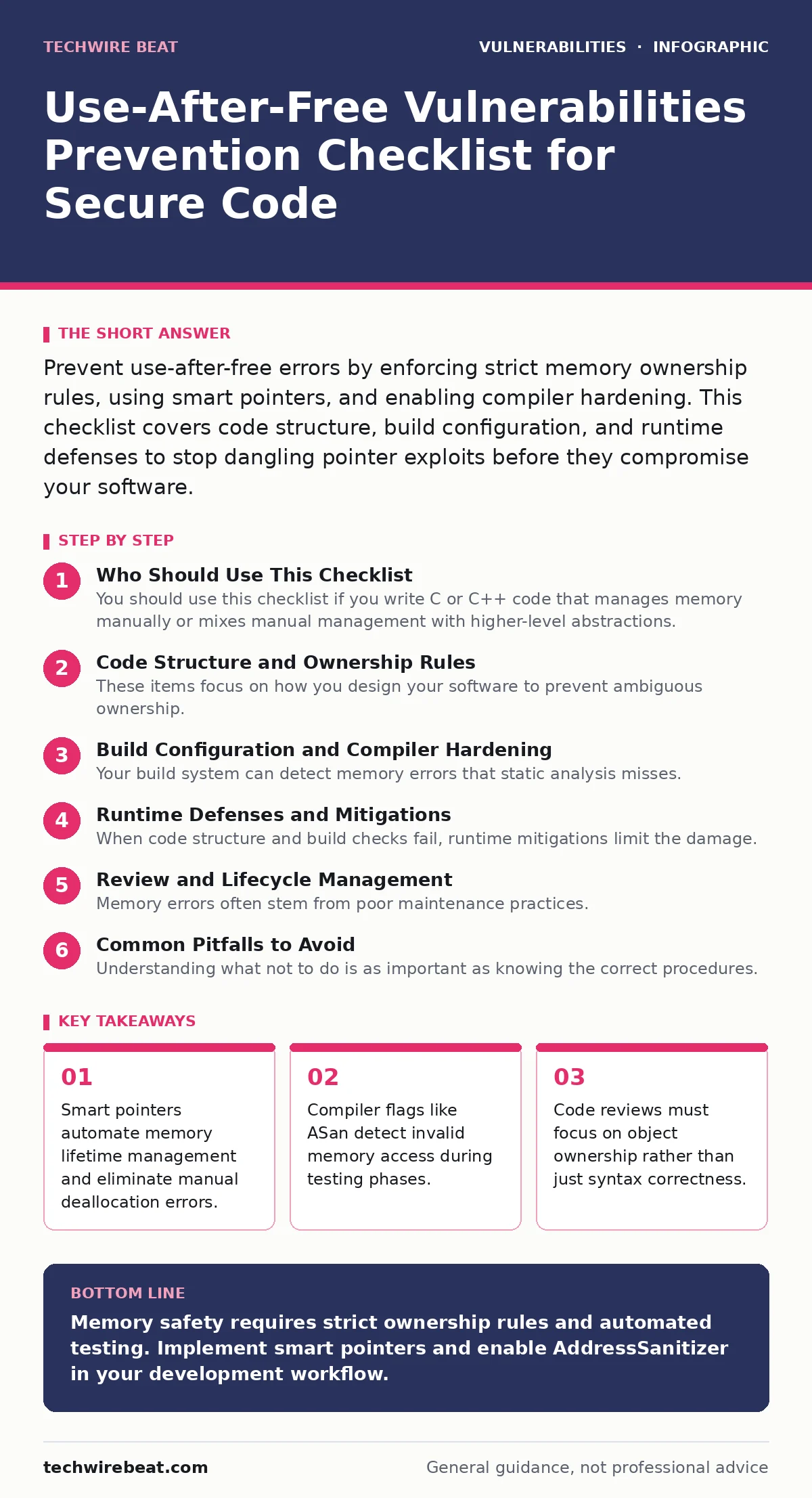
Prevent use-after-free errors by enforcing strict memory ownership rules, using smart pointers, and enabling compiler hardening. This checklist covers code structure, build configuration, and runtime defenses to stop dangling pointer exploits before they compromise your software.
Who Should Use This Checklist
You should use this checklist if you write C or C++ code that manages memory manually or mixes manual management with higher-level abstractions. It applies to systems programmers, library authors, and security engineers who need to verify that their software handles object lifetimes correctly. Do not use this list if your project relies entirely on garbage-collected languages, as those environments handle memory reclamation automatically. Follow the items in order to build layers of defense around your memory management logic.
Code Structure and Ownership Rules
These items focus on how you design your software to prevent ambiguous ownership. Ambiguity leads to premature deallocation or double free errors, which are the precursors to use-after-free conditions. Clear ownership prevents the scenario where two parts of the program believe they control the same resource.
- Define single ownership for every heap-allocated object: one component must be responsible for creation and destruction to avoid concurrent deallocation attempts.
- Use smart pointers for automatic lifetime management:
std::unique_ptrandstd::shared_ptrprevent manual delete calls that often lead to dangling references. - Avoid raw pointer storage in containers: containers should hold objects or smart pointers, not raw addresses that may become invalid when the source object is freed.
- Validate callback lifetimes explicitly: ensure the object calling a callback remains alive for the duration of the callback execution to prevent access after return.
Build Configuration and Compiler Hardening
Your build system can detect memory errors that static analysis misses. These flags add runtime checks that slow down execution but catch invalid memory access during testing. They are ineffective in production due to performance costs but are vital for development cycles.
- Enable AddressSanitizer (ASan) in debug builds: this tool instruments memory accesses to detect use-after-free at runtime with high precision.
- Use static analysis tools focused on memory safety: tools like Clang Static Analyzer can find potential dangling pointer paths without executing the code.
- Disable optimizations that obscure control flow in tests: aggressive optimizations can hide timing-related memory errors that appear only in specific execution paths.
- Integrate fuzz testing into your CI pipeline: random input generation exposes edge cases where memory management logic breaks under unexpected conditions.
Runtime Defenses and Mitigations
When code structure and build checks fail, runtime mitigations limit the damage. These measures do not prevent the vulnerability but make exploitation significantly harder. They add overhead but provide a safety net for legacy code that cannot be rewritten.
- Enable stack and heap canaries: these values detect buffer overflows and metadata corruption before an attacker can redirect execution flow.
- Use control flow integrity (CFI) mechanisms: CFI ensures that indirect jumps and calls only go to valid targets, limiting the impact of a successful memory corruption.
- Implement strict input validation: validate all external data before it influences memory allocation sizes or object lifetimes to prevent controlled corruption.
- Apply virtual patching for critical legacy systems: if you cannot fix the code, use runtime interception to block exploit attempts targeting known vulnerable functions.
Review and Lifecycle Management
Memory errors often stem from poor maintenance practices. As code evolves, ownership assumptions break. Regular audits and strict change management help maintain the integrity of memory handling logic over time.
- Audit all
freeordeletecalls for nullification: set pointers to null immediately after deallocation to catch accidental reuse quickly. - Review multi-threaded access patterns: race conditions can cause an object to be freed while another thread is still using it, creating a use-after-free window.
- Monitor the vulnerability lifecycle of dependencies: third-party libraries may introduce memory management bugs that affect your application's stability.
- Avoid hard-coded credentials in memory management modules: while not a direct cause, storing secrets in long-lived objects increases the risk if those objects are corrupted.
Common Pitfalls to Avoid
Understanding what not to do is as important as knowing the correct procedures. Many developers make mistakes that seem logical but create subtle memory safety issues. Recognising these patterns helps you spot problems before they become exploitable vulnerabilities.
- Do not rely on compiler warnings alone: compilers cannot detect logical errors in object lifetime management, only syntax or type mismatches.
- Avoid global state for object references: global variables obscure ownership and make it difficult to track when an object should be destroyed.
- Do not mix allocation and deallocation functions: using
mallocwithdeleteornewwithfreeleads to undefined behaviour and memory corruption. - Beware of circular references in shared pointers: cycles prevent automatic deletion, leading to memory leaks that may indirectly cause other stability issues.
Imagine a developer who assumes that a callback will finish before the host object is destroyed. If the callback is asynchronous, the host may be freed while the callback is still executing. This is a classic use-after-free scenario. The checklist above helps you identify such dependencies and enforce proper lifetime management.
Key takeaways
- Smart pointers automate memory lifetime management and eliminate manual deallocation errors.
- Compiler flags like ASan detect invalid memory access during testing phases.
- Code reviews must focus on object ownership rather than just syntax correctness.
Memory safety requires strict ownership rules and automated testing. Implement smart pointers and enable AddressSanitizer in your development workflow.
Frequently asked questions
Does using smart pointers eliminate all use-after-free vulnerabilities?
No. Smart pointers manage lifetime but cannot prevent logical errors where an object is used after its logical lifetime ends, such as in race conditions or circular dependencies.
Can static analysis tools find use-after-free bugs?
Yes, but with limitations. Static analysers can find obvious dangling pointer dereferences but often miss complex logic errors that depend on runtime state or timing.
Is AddressSanitizer safe to use in production?
No. AddressSanitizer adds significant memory and CPU overhead. It should only be used in development and testing environments to catch bugs before deployment.
How do use-after-free vulnerabilities differ from buffer overflows?
Buffer overflows write beyond allocated memory boundaries, while use-after-free accesses memory that has been returned to the allocator. Both corrupt memory but through different mechanisms.
How this guide was produced: written by the TechWire Beat editorial team with AI assistance, checked against the public references listed below, and reviewed when the facts change. See our editorial policy or report an error.