Hard Coded Credentials: Why Baking Secrets Into Code Fails
Hard coded credentials create a permanent attack surface because the secret travels with the software, making removal impossible without rebuilding the entire application.

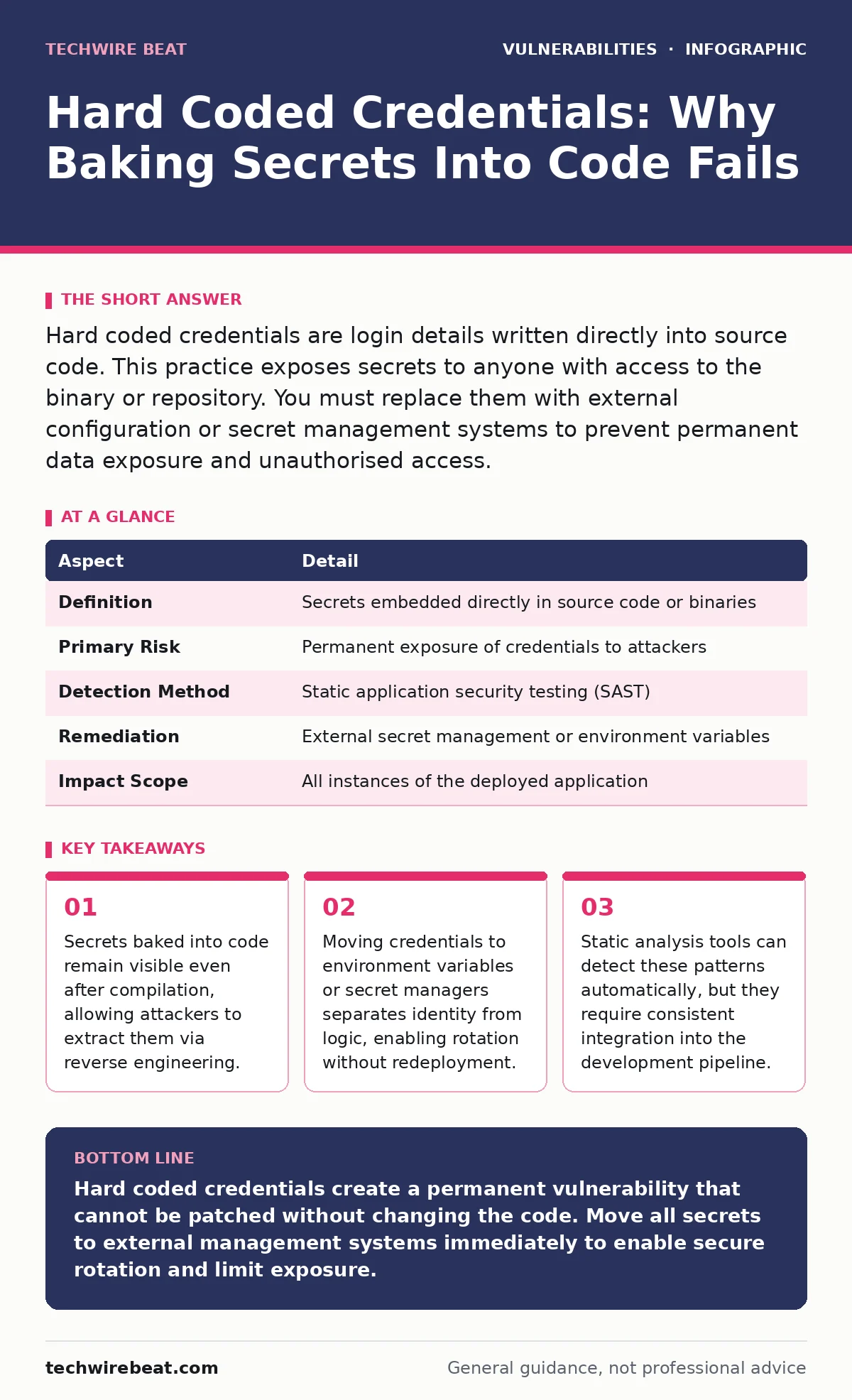
Hard coded credentials are login details written directly into source code. This practice exposes secrets to anyone with access to the binary or repository. You must replace them with external configuration or secret management systems to prevent permanent data exposure and unauthorised access.
Hard Coded Credentials Explained
Hard coded credentials are usernames, passwords, API keys, or cryptographic tokens that developers embed directly into the source code of an application. Instead of retrieving these secrets from a secure external store at runtime, the software contains the actual secret values within its logic. This approach treats sensitive authentication data as static constants rather than dynamic inputs.
Imagine a baker who seals a recipe into every cookie before baking it. Anyone who eats the cookie can find the recipe, and the baker cannot change the ingredients without baking a new batch. Software works similarly when secrets are hard coded. The secret travels with the application to every server, device, and user who runs it. This creates a single point of failure that scales with the deployment.
| Aspect | Detail |
|---|---|
| Definition | Secrets embedded directly in source code or binaries |
| Primary Risk | Permanent exposure of credentials to attackers |
| Detection Method | Static application security testing (SAST) |
| Remediation | External secret management or environment variables |
| Impact Scope | All instances of the deployed application |
How Hard Coded Credentials Work in Practice
Developers often use hard coded credentials for convenience during testing or to avoid configuring complex authentication systems. The code might contain a line that assigns a password string to a variable. When the application runs, it reads this value from memory. The secret exists in the compiled binary, often in plain text or with simple obfuscation that provides no real security.
Attackers exploit this by obtaining a copy of the software. They do not need to hack the server or intercept network traffic. They simply analyse the binary file. Reverse engineering tools can scan the executable for strings that resemble passwords, API keys, or connection strings. Once found, the attacker has full access to the associated service. This bypasses all other security controls, such as firewalls or intrusion detection systems, because the attacker possesses valid authentication tokens.
The mechanism relies on the assumption that the code is private. In open-source projects, this assumption fails immediately. In proprietary software, the assumption fails once the software is distributed or leaked. The secret is no longer secret; it is public data hidden in plain sight.
Who Hard Coded Credentials Affect
This vulnerability affects any organisation that develops software, from small startups to large enterprises. It impacts internal tools, customer-facing applications, and mobile apps. The risk is highest in distributed systems where code runs on devices outside the organisation's control. Mobile applications are particularly vulnerable because they run on user devices that attackers can physically access or jailbreak.
Cloud-native applications also face significant risks. When code is deployed to container images, the secrets inside those images persist across deployments. If a container image is pushed to a public registry, the secrets become publicly accessible. Even private registries can be compromised, exposing the credentials stored within the images.
Legacy systems are another major target. Older applications often lack modern secret management features. Developers may have added quick fixes that became permanent. These systems continue to run with embedded secrets for years, creating a hidden liability that grows as the software accumulates users and data.
What People Usually Get Wrong
Many developers believe that compiling code hides the secrets. Compilation transforms source code into machine instructions, but it does not encrypt the data. The password string remains in the binary, often in a section that is easy to extract. Simple hex editors or disassemblers can reveal these strings. Obfuscation tools may scramble the text, but determined attackers can reverse the process. Security through obscurity is not security.
Another common mistake is using environment variables as a final solution. While moving secrets out of the code is a step forward, storing them in environment variables on a server still exposes them to processes that can read the environment. If an application suffers from a command injection vulnerability, an attacker can execute commands that print the environment variables. The secret is then leaked through the application's output. Environment variables are better than hard coding, but they are not a secure storage mechanism.
Detecting Hard Coded Credentials
Static application security testing (SAST) tools are the primary defence against hard coded credentials. These tools analyse source code without running it. They look for patterns that resemble secrets, such as long alphanumeric strings assigned to variables named "password" or "key". Integrating these tools into the continuous integration pipeline ensures that code with embedded secrets is rejected before it reaches production.
Regular code reviews are also necessary. Automated tools can miss context-specific secrets. Human reviewers can identify variables that hold sensitive data but do not match standard patterns. Teams should establish a clear policy that forbids committing secrets to version control. Pre-commit hooks can block developers from pushing files that contain obvious secret patterns.
For existing codebases, a thorough audit is required. Tools can scan the entire repository history, not just the current state. This reveals secrets that were added and then deleted. These historical secrets must be rotated immediately. The old credentials are no longer valid, but the fact that they existed is a permanent record.
What To Do About Hard Coded Credentials
The first step is to identify all instances of hard coded credentials. Use automated scanning tools to find them in the source code and binary files. Create a list of every secret found, including its location and the service it accesses. Prioritise remediation based on the sensitivity of the data and the exposure of the application.
Replace the hard coded values with references to external secret stores. Secret management systems provide a secure way to store and retrieve credentials at runtime. The application requests the secret from the store using an identity, not a stored password. This allows secrets to be rotated without changing the code. It also limits the exposure window if a secret is compromised.
For simple applications, environment variables or configuration files stored outside the codebase are acceptable alternatives. Ensure that these files are protected with strict file permissions. Only the application process should be able to read them. Rotate the secrets regularly to limit the damage if they are exposed.
Long-Term Prevention Strategies
Preventing hard coded credentials requires a cultural shift in how development teams handle secrets. Developers must understand that secrets are data, not code. They should be treated with the same care as customer information. Training programmes should emphasise the risks of embedding secrets in code and the proper use of secret management tools.
Integrate security checks early in the development lifecycle. Shift left by adding secret scanning to the local development environment. Developers should see warnings before they commit code. This feedback loop helps them build good habits. Over time, the team will naturally avoid hard coding secrets.
Regularly audit third-party libraries and dependencies. These components may also contain hard coded credentials. Keep dependencies updated to benefit from security patches. Use tools that analyse the entire software supply chain, not just your own code. A single vulnerable library can expose your entire application.
The Hidden Cost of Convenience
The immediate benefit of hard coding credentials is speed. Developers save time configuring authentication systems. However, the long-term cost is high. Rotating a hard coded password requires rebuilding and redeploying the entire application. This creates operational friction and delays. In contrast, external secret stores allow instant rotation. The application picks up the new secret on the next request.
The security cost is even higher. A single exposed credential can lead to a full system compromise. Attackers use the initial access to escalate privileges and move laterally. The damage can include data theft, service disruption, and reputational harm. The time saved during development is negligible compared to the cost of a breach.
Key takeaways
- Secrets baked into code remain visible even after compilation, allowing attackers to extract them via reverse engineering.
- Moving credentials to environment variables or secret managers separates identity from logic, enabling rotation without redeployment.
- Static analysis tools can detect these patterns automatically, but they require consistent integration into the development pipeline.
Hard coded credentials create a permanent vulnerability that cannot be patched without changing the code. Move all secrets to external management systems immediately to enable secure rotation and limit exposure.
Frequently asked questions
Can I use encryption to hide hard coded credentials?
Encryption does not solve the problem because the decryption key must also be stored in the code. Attackers can extract both the encrypted secret and the key.
How do I remove secrets from version control history?
Use tools designed to rewrite git history, such as BFG Repo-Cleaner. After cleaning, rotate the compromised secrets and force all users to pull the new history.
Are environment variables safe for production secrets?
They are safer than hard coding but still risky. They can be leaked through logs, error messages, or command injection attacks. Use dedicated secret managers for high-value secrets.
What is the difference between a secret and a configuration value?
Configuration values, like database hostnames, are not sensitive. Secrets, like passwords, provide access. Only secrets require strict protection and rotation.
How this guide was produced: written by the TechWire Beat editorial team with AI assistance, checked against the public references listed below, and reviewed when the facts change. See our editorial policy or report an error.