Secret Scanning: How Automated Tools Find Leaked Credentials
Automated secret scanning detects exposed keys in code repositories before attackers can harvest them, preventing immediate account compromise and data theft.
Secret scanning is an automated process that searches code repositories for hardcoded credentials, API keys, and tokens. It identifies these secrets using pattern matching and context analysis. This defence stops attackers from accessing sensitive systems through leaked access tokens found in public or private code bases.
The Digital Lockbox Analogy
Imagine you leave your house keys taped to the front door frame. A burglar does not need to break the lock. They simply read the key and enter. Secret scanning acts as a security guard who walks past your house every few minutes. The guard checks if any keys are visible on the door frame. If the guard finds a key, they alert you immediately. You then change the lock and retrieve the key. This prevents unauthorised entry before it happens.
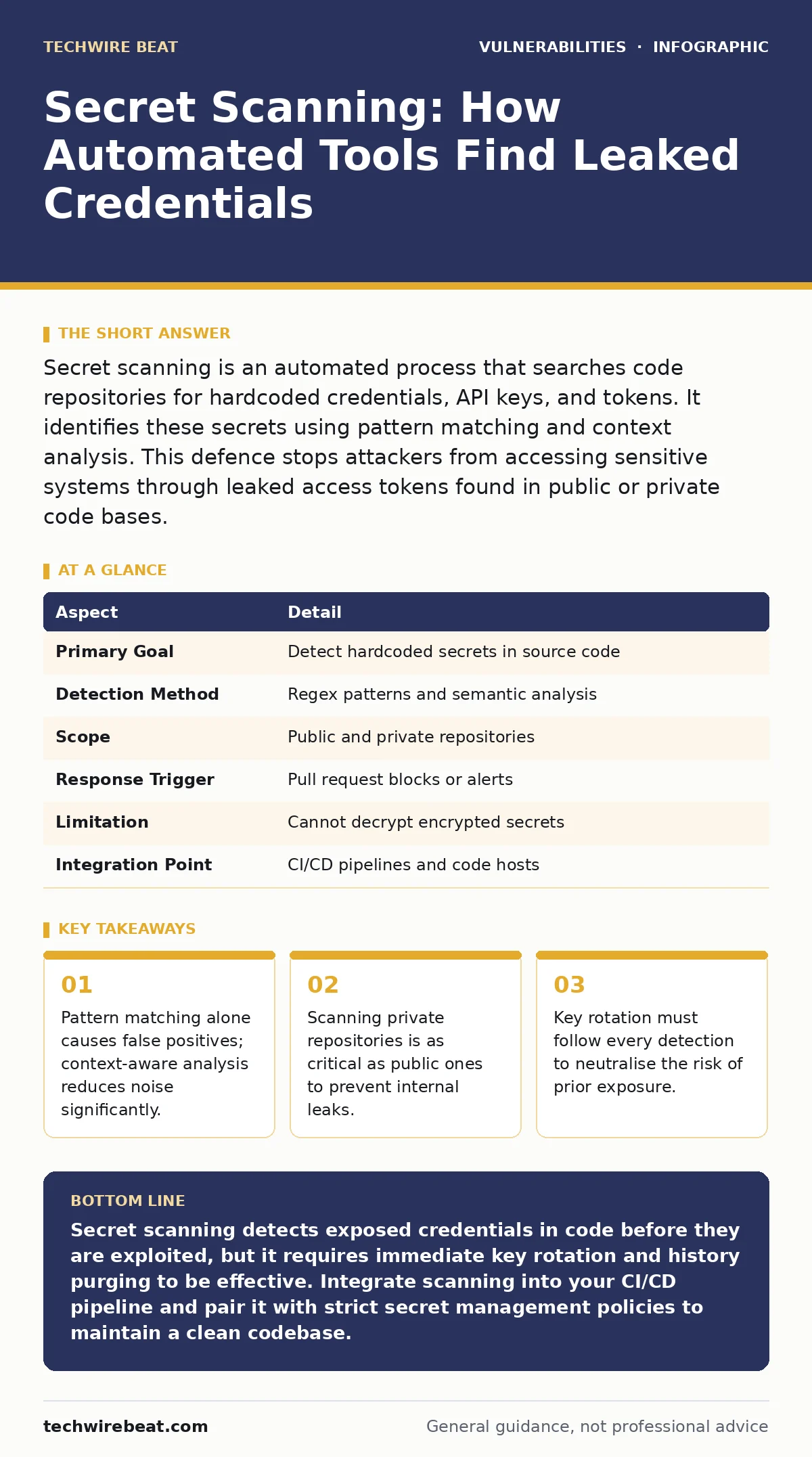
At a Glance
| Aspect | Detail |
|---|---|
| Primary Goal | Detect hardcoded secrets in source code |
| Detection Method | Regex patterns and semantic analysis |
| Scope | Public and private repositories |
| Response Trigger | Pull request blocks or alerts |
| Limitation | Cannot decrypt encrypted secrets |
| Integration Point | CI/CD pipelines and code hosts |
How Secret Scanning Works
Secret scanning relies on two main mechanisms: pattern matching and context analysis. Pattern matching uses regular expressions to find strings that look like secrets. For example, an AWS access key always starts with specific letters and has a fixed length. The scanner looks for this structure. Context analysis goes deeper. It examines the code surrounding the pattern. This step determines if the string is actually a secret or just a test value. This combination reduces false positives. A false positive occurs when the tool flags something that is not a real secret.
Where It Fits in Defence
Secret scanning is a detection control. It does not prevent developers from writing secrets into code. It finds them after the fact. This makes it complementary to prevention tools. You should pair it with software composition analysis. That tool checks third-party libraries for known vulnerabilities. Secret scanning checks your own code for leaked credentials. Together they cover different attack surfaces. One looks at what you build. The other looks at what you borrow.
Common Misunderstandings
Many teams believe secret scanning is a one-time fix. This is incorrect. Secrets leak continuously. New developers join. Old code is refactored. Scanning must run on every commit. Another mistake is ignoring private repositories. Attackers often breach internal networks to steal code from private repos. If your secrets are in a private repo, they are still exposed. You must scan both public and private code.
False Positives and Noise
Pattern matching is blunt. It finds strings that look like secrets. A UUID might look like an API key. A test string might match a token pattern. This creates noise. Developers ignore alerts when they are mostly false positives. This is alert fatigue. To reduce noise, use allowlists. An allowlist tells the scanner to ignore specific files or patterns. For example, you can exclude test directories. You can also define custom patterns for your internal tokens. This keeps the signal clear.
Handling Detected Secrets
Finding a secret is only the first step. You must rotate the secret immediately. Rotation means generating a new secret and invalidating the old one. If you do not rotate, the old secret remains valid. An attacker who already copied it can still use it. You must also remove the secret from the code history. Git history retains all previous versions. You cannot simply delete the file. You must rewrite history or use a tool to purge the secret. This ensures the secret is gone from all branches.
Integration with Workflows
Secret scanning works best when integrated into the development workflow. You can run it as a pre-commit hook. This checks code before it leaves your machine. You can also run it in the CI/CD pipeline. This checks code after it is pushed to the repository. Blocking pull requests on detection forces developers to fix the issue immediately. This shifts security left. It catches problems early. Early detection is cheaper and faster. It avoids production incidents.
Beyond Code Repositories
Secrets hide in places other than code. They appear in logs, configuration files, and environment variables. Secret scanning tools are expanding to cover these areas. Some tools scan cloud storage buckets. Others scan infrastructure-as-code templates. This broader scope is necessary. Attackers look everywhere. They check logs for leaked tokens. They scan cloud configs for misconfigurations. Your defence must cover all these surfaces.
The Human Factor
Tools cannot fix bad habits. Developers must understand why secrets should not be in code. Training helps. Explain the risk of hardcoded credentials. Show how easy it is to leak them. Encourage the use of secret management systems. These systems store secrets securely. They inject them into applications at runtime. This keeps secrets out of the code. It reduces the attack surface. It also makes rotation easier. You change the secret in the vault. The application picks up the new value. No code changes are needed.
Limitations of Secret Scanning
Secret scanning has blind spots. It cannot detect secrets that are obfuscated. If a developer splits a key into multiple variables, the scanner may miss it. It also cannot detect secrets that are fetched at runtime from untrusted sources. If your code pulls a token from a public website, the scanner sees no secret in the code. You must audit these runtime behaviours separately. Additionally, scanning large repositories is slow. It consumes compute resources. You must balance scan frequency with performance costs.
Connecting to Other Vulnerabilities
Secret leaks often lead to other exploits. An attacker with an API key might trigger privilege escalation vulnerabilities. They gain higher access than intended. They might then exploit container escape vulnerabilities. This allows them to break out of the isolated environment. They could also use GitHub Actions workflow injection to run malicious code. This happens if a workflow processes untrusted input. Understanding these links helps you prioritise fixes. A leaked secret is not just a data leak. It is a gateway to deeper system compromise.
Maintaining the Programme
Secret scanning requires ongoing maintenance. Patterns change. New cloud providers release new key formats. You must update your scanner rules. Review false positives regularly. Tune your allowlists. Keep your secret management policies up to date. Audit access to secret stores. Ensure only authorised personnel can view secrets. Rotate secrets on a schedule. Do not wait for a leak. Proactive rotation limits the damage of any future breach. It reduces the window of opportunity for attackers.
Key takeaways
- Pattern matching alone causes false positives; context-aware analysis reduces noise significantly.
- Scanning private repositories is as critical as public ones to prevent internal leaks.
- Key rotation must follow every detection to neutralise the risk of prior exposure.
Secret scanning detects exposed credentials in code before they are exploited, but it requires immediate key rotation and history purging to be effective. Integrate scanning into your CI/CD pipeline and pair it with strict secret management policies to maintain a clean codebase.
Frequently asked questions
Does secret scanning protect against all types of data leaks?
No, it only detects patterns that match known secret formats. It cannot detect logical flaws or unstructured data leaks like personal information in logs.
Can secret scanning be bypassed by attackers?
Yes, attackers can obfuscate secrets or split them into multiple variables to evade pattern matching. Context-aware analysis helps but is not foolproof.
How often should secret scanning run?
It should run on every commit and pull request. This ensures immediate detection and allows developers to fix issues before code merges.
Is secret scanning enough to secure my repositories?
No, it is one layer of defence. You also need access controls, code signing, and regular audits to ensure comprehensive security.
How this guide was produced: written by the TechWire Beat editorial team with AI assistance, checked against the public references listed below, and reviewed when the facts change. See our editorial policy or report an error.