Warning Signs of Out-of-Bounds Write Vulnerabilities in Software
Out-of-bounds writes corrupt adjacent memory, causing crashes or control hijacking that often masquerade as unrelated stability issues.

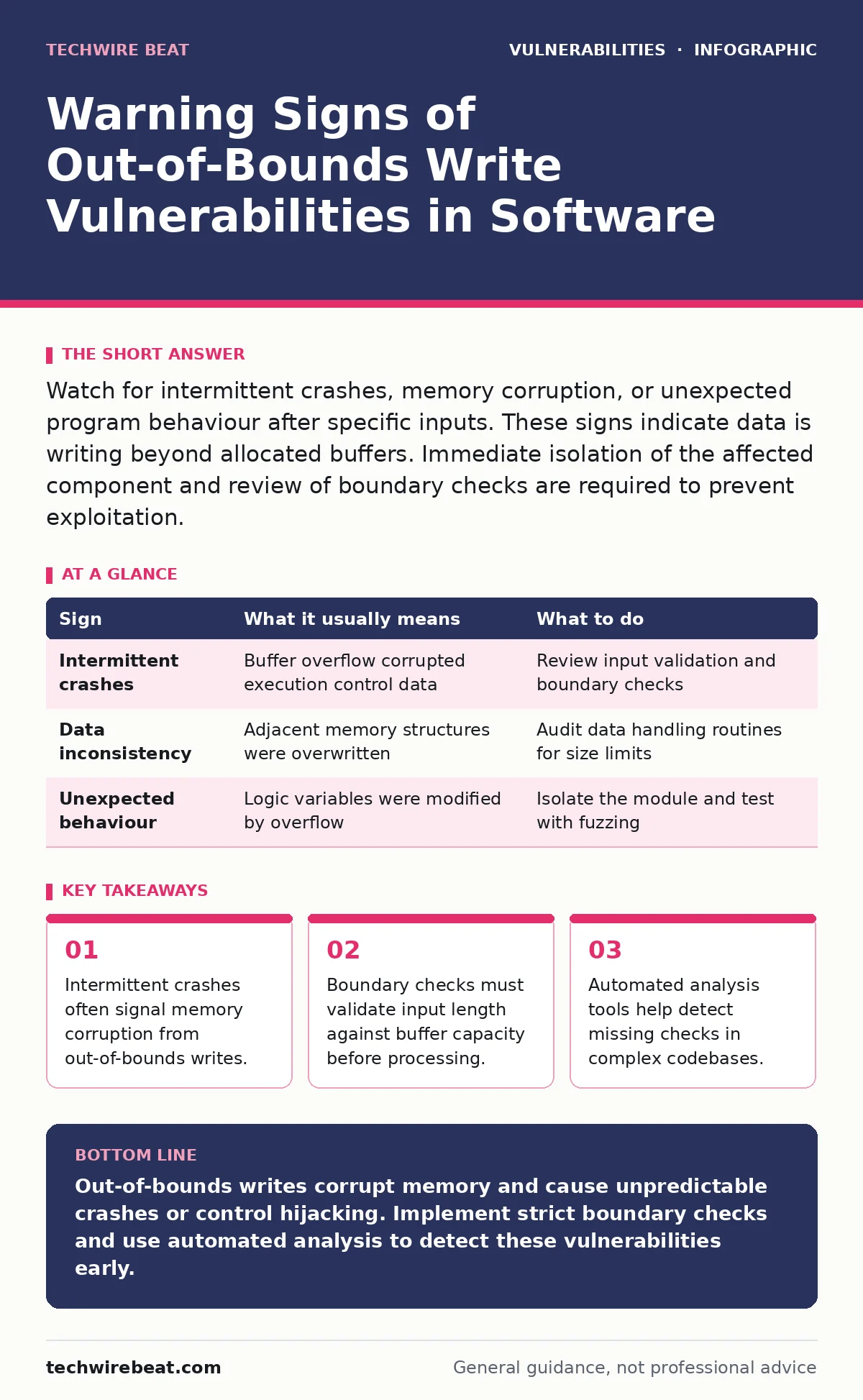
Watch for intermittent crashes, memory corruption, or unexpected program behaviour after specific inputs. These signs indicate data is writing beyond allocated buffers. Immediate isolation of the affected component and review of boundary checks are required to prevent exploitation.
Immediate Symptoms of Memory Corruption
Out-of-bounds write vulnerabilities occur when a program writes data past the end of a designated memory buffer. You notice these issues first through application instability. The software may crash unexpectedly when processing large or specially crafted inputs. These crashes are not random; they result from the program overwriting critical memory structures.
The operating system terminates the process to prevent further damage. This behaviour is a direct consequence of memory integrity violations. You should treat every unexplained crash as a potential security incident. Investigate the input that triggered the failure. Identify which buffer was involved in the operation. Check if the input size exceeded the expected limits.
Subtle Indicators of Silent Corruption
Some out-of-bounds writes do not crash the application immediately. The program continues running, but the corrupted memory causes erratic behaviour later. You might see data appearing in wrong fields or variables holding unexpected values. These silent corruptions are harder to detect because the application seems to function normally.
The damage accumulates until a critical operation fails. This delay makes it difficult to trace the root cause. Look for inconsistencies in data that should remain constant. Monitor for logic errors that appear only under specific load conditions. These subtle signs often indicate a deeper memory management flaw. They require careful debugging to identify the original write operation.
Common Misinterpretations of Error Logs
Developers often misinterpret out-of-bounds write symptoms as unrelated issues. A crash might be blamed on a memory leak or a hardware fault. This misdirection delays the discovery of the vulnerability. You must look beyond the error message. The stack trace may point to a safe function, but the corruption originated elsewhere. The overwritten memory might belong to a completely different module. This disconnect between cause and effect is common. Do not assume the crashing function is the vulnerable one. Trace the memory usage backward from the point of failure. Identify which write operation occurred just before the crash. This forensic approach reveals the true source of the problem.
| Sign | What it usually means | What to do |
|---|---|---|
| Intermittent crashes | Buffer overflow corrupted execution control data | Review input validation and boundary checks |
| Data inconsistency | Adjacent memory structures were overwritten | Audit data handling routines for size limits |
| Unexpected behaviour | Logic variables were modified by overflow | Isolate the module and test with fuzzing |
The Role of Boundary Checks
Preventing out-of-bounds writes relies on strict boundary checks. Every write operation must verify that the destination buffer has sufficient space. This check must occur before the data is copied. You cannot rely on input sanitization alone. Sanitization removes harmful characters but does not enforce size limits. The code must explicitly compare the input length with the buffer capacity. If the input is larger, the operation must be rejected or truncated. This simple check prevents the write from exceeding the buffer. It is the primary defence against this vulnerability class. Ensure that all data paths include these checks.
Advanced Detection Techniques
Manual code review often misses complex out-of-bounds write scenarios. You need automated tools to assist with detection. Static analysis tools can scan the code for missing boundary checks. They identify patterns that suggest potential overflows. Dynamic analysis tools, such as fuzzing, test the application with random inputs. Fuzzing triggers crashes that reveal hidden vulnerabilities. These tools complement each other. Static analysis finds potential issues; dynamic analysis confirms them. Integrate both into your development pipeline. Run them regularly to catch new vulnerabilities early. This proactive approach reduces the risk of exploitation.
Remediation and Safe Coding Practices
Fixing an out-of-bounds write requires more than patching the immediate bug. You must review the entire data flow. Identify all places where the vulnerable buffer is accessed. Ensure that every access is protected by a boundary check. Use safe programming languages or libraries that enforce memory safety. If you must use low-level languages, adopt strict coding standards. Avoid manual memory management where possible. Use smart pointers or garbage-collected environments. These tools automate memory safety and reduce human error. Review the code for similar patterns. Apply the same fixes to other modules. This comprehensive approach prevents recurrence.
Comparing Related Vulnerability Types
Out-of-bounds writes differ from other memory errors. Use-after-free vulnerabilities involve accessing memory after it has been released. Cross-site scripting (XSS) injects malicious scripts into web pages. Mass assignment vulnerabilities allow users to modify unexpected parameters. Each type requires different detection methods. Out-of-bounds writes focus on memory size limits. Use-after-free focuses on memory lifecycle. Understanding these distinctions helps you apply the right tests. Do not confuse memory corruption with logic errors. Each vulnerability class has unique indicators and fixes.
Integrating Security into Development
Security must be integrated into the development process. You cannot rely on post-release testing alone. Shift left by incorporating security checks early. Use software composition analysis to identify vulnerable dependencies. Review the EPSS score to prioritize fixes based on exploit probability. Educate developers on safe coding practices. Make boundary checks a standard requirement. This cultural shift reduces the incidence of vulnerabilities. It also speeds up the remediation process. Security becomes a natural part of development. This approach builds more resilient software.
Key takeaways
- Intermittent crashes often signal memory corruption from out-of-bounds writes.
- Boundary checks must validate input length against buffer capacity before processing.
- Automated analysis tools help detect missing checks in complex codebases.
Out-of-bounds writes corrupt memory and cause unpredictable crashes or control hijacking. Implement strict boundary checks and use automated analysis to detect these vulnerabilities early.
Frequently asked questions
How do out-of-bounds writes differ from buffer overflows?
Out-of-bounds write is the general mechanism of writing outside allocated memory. Buffer overflow is a specific type of out-of-bounds write where data exceeds a buffer's capacity. Both result in memory corruption.
Can automated tools detect all out-of-bounds writes?
No, automated tools may miss complex logic errors or false positives. They are effective at finding common patterns but require human review for confirmation. Combine tools with manual code analysis for best results.
What is the risk of ignoring a suspected out-of-bounds write?
Ignoring the issue allows potential exploitation. Attackers can use the vulnerability to execute arbitrary code or escalate privileges. The risk includes data breaches and system compromise. Prompt investigation is necessary.
Do modern programming languages prevent out-of-bounds writes?
Languages with automatic memory management, like Java or Go, reduce the risk significantly. They enforce bounds checking automatically. However, unsafe code blocks or low-level libraries can still introduce vulnerabilities. Careful coding practices remain important.
How this guide was produced: written by the TechWire Beat editorial team with AI assistance, checked against the public references listed below, and reviewed when the facts change. See our editorial policy or report an error.