Mass Assignment Vulnerabilities: 6 Coding Mistakes That Expose Data
Binding user input directly to internal objects bypasses security controls and grants unauthorized access to sensitive fields without complex exploitation.

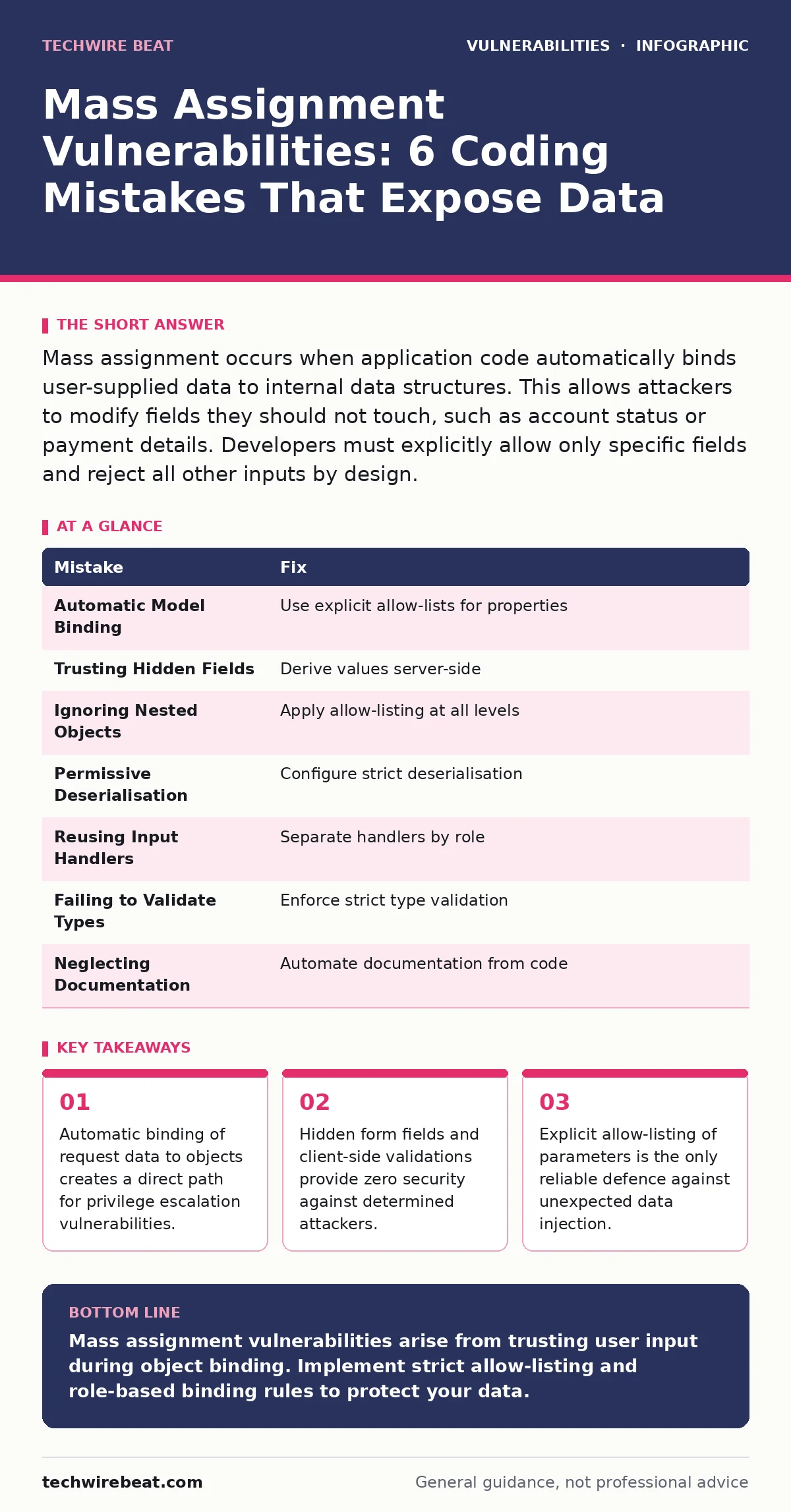
Mass assignment occurs when application code automatically binds user-supplied data to internal data structures. This allows attackers to modify fields they should not touch, such as account status or payment details. Developers must explicitly allow only specific fields and reject all other inputs by design.
Mistake 1: Automatic Model Binding Without Filtering
Frameworks often bind incoming HTTP parameters directly to object properties. This convenience feature maps every key in the request body to a matching field in the backend model. You might assume the framework only updates visible fields. It does not. The framework updates every writable property it can find in the object structure.
Why it hurts:
Attackers inspect the application’s API responses or source code to identify hidden fields. They then include these fields in their requests. The application accepts the data and persists it. This bypasses intended access controls. You expose internal state to external manipulation. The consequence is often immediate privilege escalation vulnerabilities or data corruption.
The fix:
Disable automatic binding for untrusted inputs. Define an explicit allow-list of properties that the user may modify. Reject any parameter not on this list. This approach ensures that new fields added to the model later do not accidentally become writable. You maintain control over the data surface area.
Mistake 2: Trusting Hidden Form Fields
Developers often hide sensitive fields like user roles or account balances using HTML hidden inputs. The logic assumes users cannot see or edit these values. This assumption fails against anyone who can view page source or intercept network traffic. The browser sends whatever data it is given, regardless of visibility.
Why it hurts:
An attacker modifies the hidden field value in their request. The server receives the modified value and processes it as legitimate input. If the server trusts the presence of the field, it updates the database. This leads to unauthorized changes to critical account attributes. The hidden field provides no security barrier. It is purely a presentation layer construct.
The fix:
Never trust data from hidden fields for security decisions. Derive sensitive values from the server-side session or database. If a field must be submitted, verify its expected value against the server’s record. Reject any mismatch. This ensures the server remains the single source of truth for critical data.
Mistake 3: Ignoring Nested Object Properties
Modern APIs often accept complex JSON structures with nested objects. A user profile might contain an address object, which contains a city string. Automatic binding traverses these structures. It updates not just the top-level fields but also deeply nested properties. Developers often forget to restrict binding at every level of the hierarchy.
Why it hurts:
An attacker crafts a request that targets a nested property. They might change a billing address or inject a new object reference. The application binds this data to the internal model. This can lead to unexpected state changes or even server-side request forgery (SSRF) if the nested object contains URL fields. The depth of the object tree increases the attack surface significantly.
The fix:
Apply allow-listing at every level of the object hierarchy. Define which nested properties are writable. Use serializers that ignore unknown properties by default. This prevents deep binding attacks. You ensure that only explicitly permitted paths within the data structure are updated.
Mistake 4: Overly Permissive Deserialisation
Deserialisation converts data streams into object instances. Some libraries deserialise all fields present in the input stream. If the input contains fields that exist in the class but are not intended for user input, they are updated. This is common in legacy systems or when using generic deserialisation libraries without strict configuration.
Why it hurts:
Attackers supply crafted data containing internal object fields. The deserialiser creates an object with these fields populated. This can trigger unexpected code execution or state changes. It is a form of injection that bypasses traditional input validation. The risk is similar to use-after-free vulnerabilities in memory management, where state is corrupted unexpectedly.
The fix:
Use strict deserialisation settings. Configure the library to ignore unknown properties. Prefer explicit constructors over automatic field mapping. Validate the structure of the input before deserialisation. This ensures that only expected data shapes are processed. You reduce the risk of unexpected side effects.
Mistake 5: Reusing Input Handlers for Different Roles
A single endpoint might handle updates for both regular users and administrators. The code might not distinguish between the two roles during binding. It applies the same binding rules to all inputs. This assumes that the user’s role is checked after binding. This is often incorrect or bypassed.
Why it hurts:
A regular user submits a request with admin-only fields. The binding process updates these fields. The role check happens too late or is absent. The user gains elevated privileges. This is a direct path to privilege escalation vulnerabilities. The lack of role-specific binding rules allows horizontal and vertical privilege escalation.
The fix:
Separate input handlers for different roles. Define distinct allow-lists for each role. Apply these lists before binding occurs. Verify the user’s role early in the request lifecycle. Reject inputs that do not match the role’s permissions. This ensures that binding rules align with access control policies.
See also: Server-Side Request Forgery Prevention Checklist for Secure Code
Mistake 6: Failing to Validate Data Types
Binding often assumes that input data matches the expected type. If the framework performs implicit type conversion, it might accept unexpected values. For example, a string might be converted to a boolean. This can lead to logical errors in the application. The application might interpret a string as a true value when it should be false.
Why it hurts:
Attackers exploit type coercion to bypass checks. They send data that converts to a privileged state. The application processes this data as valid. This can lead to unexpected behaviour or security bypasses. The lack of strict type validation allows attackers to manipulate the application’s logic. It undermines the integrity of the data processing pipeline.
The fix:
Enforce strict type validation before binding. Reject inputs that do not match the expected type exactly. Disable implicit type conversion where possible. Use strong typing in your application code. This ensures that data is processed as intended. You prevent logical errors caused by type coercion.
Mistake 7: Neglecting API Documentation Consistency
API documentation might not reflect all writable fields. Developers might add new fields without updating the documentation or binding rules. This creates a discrepancy between what is documented and what is accessible. Attackers discover these undocumented fields through probing. They exploit the gap between documentation and implementation.
Why it hurts:
Undocumented fields become hidden attack vectors. Attackers identify them and exploit them. The application updates these fields because they are writable. This leads to unexpected data changes. The lack of consistency between documentation and code increases the risk of accidental exposure. It makes security auditing difficult and incomplete.
The fix:
Maintain strict consistency between API documentation and implementation. Automate documentation generation from code. Regularly audit writable fields against the documentation. Remove or protect undocumented fields. This ensures that the attack surface is well understood and controlled. You reduce the risk of accidental exposure.
| Mistake | Fix |
|---|---|
| Automatic Model Binding | Use explicit allow-lists for properties |
| Trusting Hidden Fields | Derive values server-side |
| Ignoring Nested Objects | Apply allow-listing at all levels |
| Permissive Deserialisation | Configure strict deserialisation |
| Reusing Input Handlers | Separate handlers by role |
| Failing to Validate Types | Enforce strict type validation |
| Neglecting Documentation | Automate documentation from code |
Key takeaways
- Automatic binding of request data to objects creates a direct path for privilege escalation vulnerabilities.
- Hidden form fields and client-side validations provide zero security against determined attackers.
- Explicit allow-listing of parameters is the only reliable defence against unexpected data injection.
Mass assignment vulnerabilities arise from trusting user input during object binding. Implement strict allow-listing and role-based binding rules to protect your data.
Frequently asked questions
Does using parameterized queries prevent mass assignment?
No. Parameterized queries prevent SQL injection. Mass assignment is a logic error in how data is bound to objects. You need separate controls for each vulnerability type.
Can a firewall stop mass assignment attacks?
Not reliably. Firewalls inspect network traffic. Mass assignment exploits application logic. The data looks like normal API traffic. You need application-level controls to prevent it.
Is mass assignment common in modern frameworks?
It is a common mistake. Many frameworks enable automatic binding by default. Developers must explicitly configure these frameworks to restrict binding. The risk persists if configuration is neglected.
How do I test for mass assignment vulnerabilities?
Use automated security scanners. Manually test by adding unexpected fields to API requests. Verify that the application rejects these fields. Regular testing helps identify misconfigurations early.
How this guide was produced: written by the TechWire Beat editorial team with AI assistance, checked against the public references listed below, and reviewed when the facts change. See our editorial policy or report an error.