Adversarial Examples: How to Stop Model Manipulation
Tiny pixel changes can fool machine learning models into misclassifying input data, bypassing normal security filters entirely.

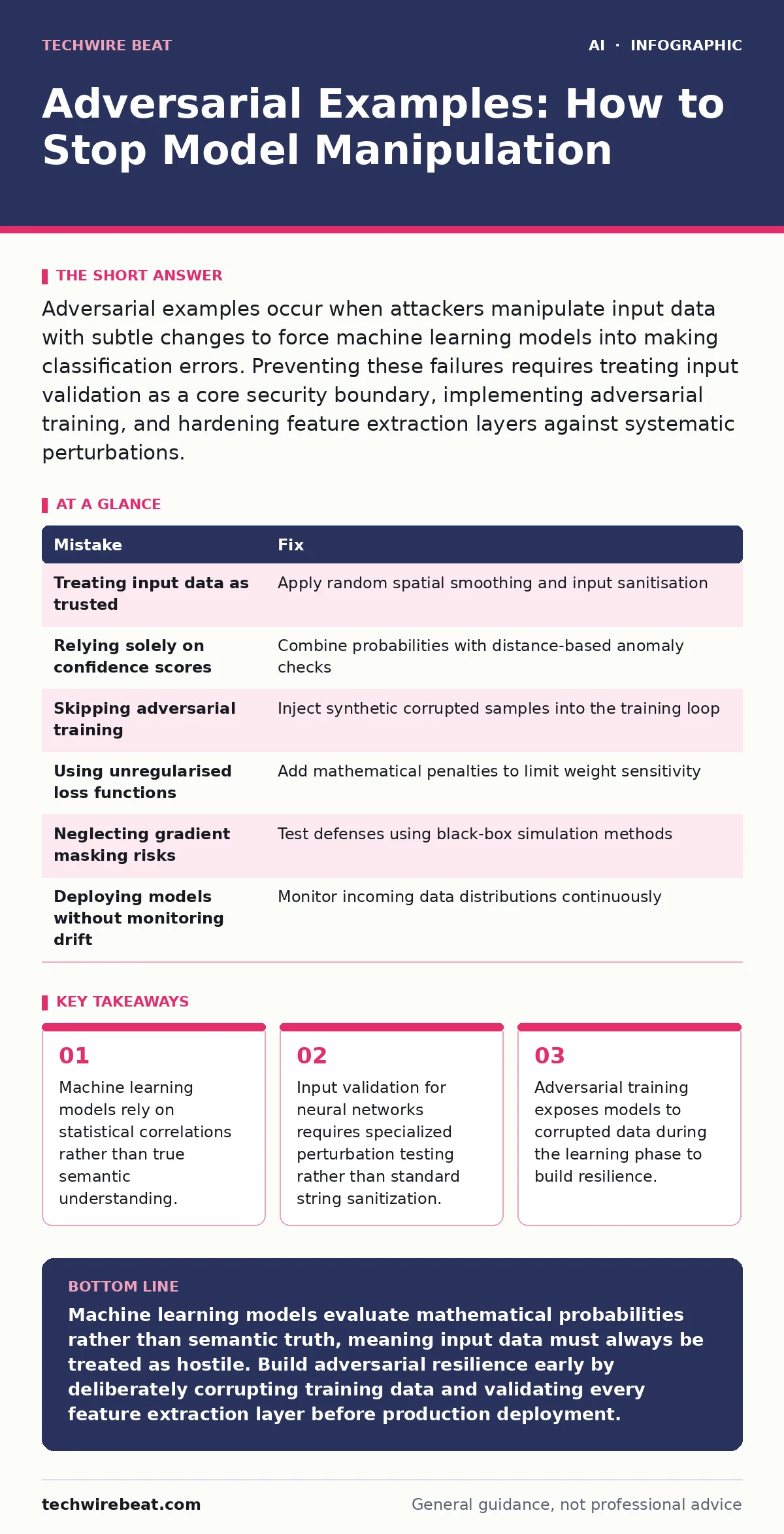
Adversarial examples occur when attackers manipulate input data with subtle changes to force machine learning models into making classification errors. Preventing these failures requires treating input validation as a core security boundary, implementing adversarial training, and hardening feature extraction layers against systematic perturbations.
Mistake 1: Treating input data as trusted
Why it hurts: Assuming images or text received from external users lack hidden manipulations exposes your system to direct exploitation. Machine learning models evaluate every pixel or token mathematically, which means an attacker can embed invisible noise patterns that completely alter the classification outcome without changing the human-perceived meaning.
The fix: Implement rigorous input sanitisation pipelines that apply random spatial smoothing or bit-depth reduction before data reaches the neural network. This strips away microscopic malicious perturbations while preserving the core features required for legitimate inference. You should align these defensive preprocessing steps with guidance found inside the NIST AI Risk Management Framework to maintain structured validation protocols across every ingestion endpoint.
Mistake 2: Relying solely on confidence scores
Attackers routinely craft inputs that push maximum mathematical certainty toward completely incorrect categories, bypassing threshold checks that assume uncertainty always accompanies manipulation.
The fix: Combine probabilistic outputs with anomaly detection layers that measure how far an incoming sample sits from established training distributions. When an input triggers high confidence alongside unusual internal activation patterns, flag the request for manual review or reject it outright.
Mistake 3: Skipping adversarial training
Why it hurts: Training models exclusively on clean, unmodified datasets leaves them entirely unprepared for structured mathematical noise. Without exposure to malicious perturbations during the learning phase, the decision boundaries remain razor-thin and easy for an external actor to cross using calculated gradient steps.
The fix: Generate synthetic corrupted samples during the development cycle and feed them back into the training loop alongside correct data. This forces the algorithm to smooth its decision boundaries and learn robust features rather than brittle shortcuts, making subsequent manipulation significantly harder to achieve in production environments.
Mistake 4: Using unregularised loss functions
Why it hurts: Standard optimisation targets penalise errors on clean data without accounting for how steeply the decision boundary slopes nearby. Steep gradients act like invisible ramps for attackers, allowing tiny input changes to trigger massive shifts in the final model output.
The fix: Apply penalty terms to your optimisation math that discourage overly sensitive internal weights and penalise high Lipschitz constants. This mathematical constraint ensures that small variations in the input translate to small variations in the output, effectively blunting the impact of targeted attacks.
Mistake 5: Neglecting gradient masking risks
Why it hurts: Obscuring your model internals or adding randomised defense layers can create a false sense of security known as gradient masking. While this stops simple automated attacks from calculating the exact path to an exploit, sophisticated adversaries simply train a substitute model locally to bypass the obfuscation.
The fix: Evaluate your defenses using derivative-free black-box attack simulations rather than assuming hidden gradients equal complete safety. You can also integrate insights from explainable AI research to verify whether the internal reasoning matches expected feature importance metrics rather than relying on superficial obfuscation tricks.
Mistake 6: Deploying models without monitoring drift
Why it hurts: Static deployment ignores how real-world data patterns shift over time, creating new vulnerabilities that attackers can weaponise against unsuspecting automated systems. As user habits change, the model encounters edge cases it misinterprets with increasing frequency.
The fix: Establish continuous logging pipelines that track input distribution shifts and flag anomalous classification clusters in real time. Periodic audits of incoming traffic help you catch emerging exploitation patterns before they compromise core business logic or automated decision workflows.
| Mistake | Fix |
|---|---|
| Treating input data as trusted | Apply random spatial smoothing and input sanitisation |
| Relying solely on confidence scores | Combine probabilities with distance-based anomaly checks |
| Skipping adversarial training | Inject synthetic corrupted samples into the training loop |
| Using unregularised loss functions | Add mathematical penalties to limit weight sensitivity |
| Neglecting gradient masking risks | Test defenses using black-box simulation methods |
| Deploying models without monitoring drift | Monitor incoming data distributions continuously |
Key takeaways
- Machine learning models rely on statistical correlations rather than true semantic understanding.
- Input validation for neural networks requires specialized perturbation testing rather than standard string sanitization.
- Adversarial training exposes models to corrupted data during the learning phase to build resilience.
Machine learning models evaluate mathematical probabilities rather than semantic truth, meaning input data must always be treated as hostile. Build adversarial resilience early by deliberately corrupting training data and validating every feature extraction layer before production deployment.
Frequently asked questions
What makes adversarial examples so difficult to detect visually?
Attackers make changes so small that human eyes perceive no difference, yet those microscopic shifts alter the underlying mathematical vectors that the model uses for classification.
Can open-source models be protected against these attacks?
Open-source models require the same defensive engineering principles as proprietary systems, including careful input sanitisation and targeted adversarial training regimes.
How do attackers find the exact perturbations needed to fool a model?
Attackers calculate internal gradients to determine which direction changes the output most rapidly, allowing them to step systematically across the decision boundary.
Do traditional firewalls protect against adversarial machine learning attacks?
Traditional firewalls inspect network traffic rather than data semantics, meaning they cannot recognise malicious pixel patterns hidden inside legitimate application payloads.
How this guide was produced: written by the TechWire Beat editorial team with AI assistance, checked against the public references listed below, and reviewed when the facts change. See our editorial policy or report an error.