Explainable AI Models: How They Work and Why Transparency Matters
Explainable AI models reveal the internal logic of decisions, allowing humans to audit outcomes and correct errors before they cause harm in critical systems.

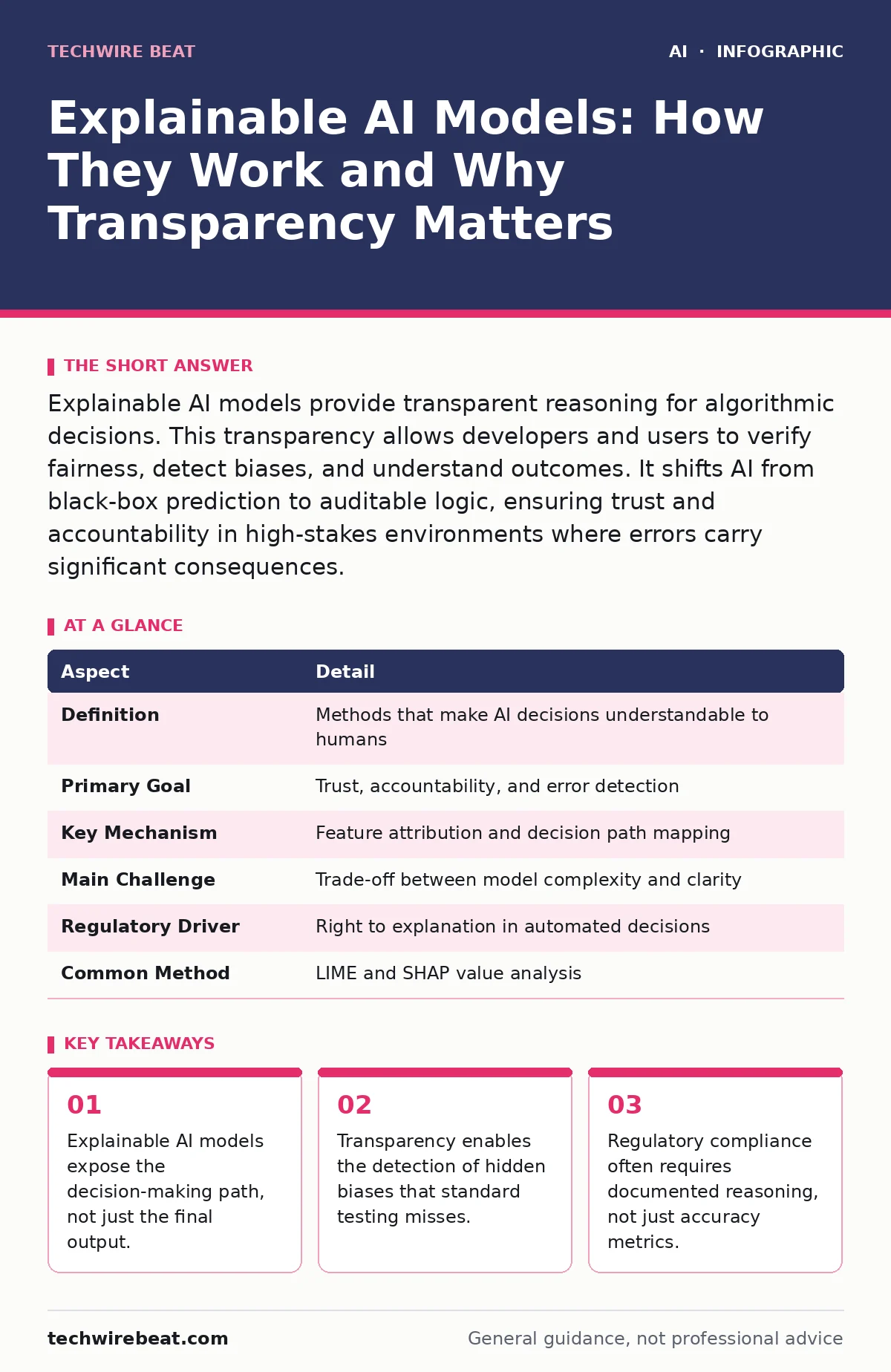
Explainable AI models provide transparent reasoning for algorithmic decisions. This transparency allows developers and users to verify fairness, detect biases, and understand outcomes. It shifts AI from black-box prediction to auditable logic, ensuring trust and accountability in high-stakes environments where errors carry significant consequences.
Everyday Analogy for Explainable AI Models
Imagine a medical specialist diagnosing a patient. You trust the diagnosis more if the doctor explains which symptoms led to the conclusion, rather than simply stating the result. Black-box artificial intelligence operates like a specialist who refuses to explain their reasoning. You get an answer, but you cannot verify if it is correct or if it relies on flawed logic. Explainable AI models function like the transparent specialist.
They provide the evidence and the logical steps taken to reach a conclusion. This distinction changes how you interact with the technology. You move from blind trust to informed verification. The system becomes a partner in decision-making rather than an oracle. This shift is critical when the stakes involve human safety or financial stability. Without visibility into the reasoning, you cannot distinguish between a correct answer derived from bad data and a wrong answer derived from good data.
| Aspect | Detail |
|---|---|
| Definition | Methods that make AI decisions understandable to humans |
| Primary Goal | Trust, accountability, and error detection |
| Key Mechanism | Feature attribution and decision path mapping |
| Main Challenge | Trade-off between model complexity and clarity |
| Regulatory Driver | Right to explanation in automated decisions |
| Common Method | LIME and SHAP value analysis |
How Explainable AI Models Work
Explainable AI models rely on techniques that map inputs to outputs. The most common approach is feature attribution. This method assigns a score to each input variable to show how much it influenced the final prediction. For example, in a loan approval system, the model might highlight income and credit history as primary factors. Another method uses surrogate models. These are simpler, interpretable models that approximate the behaviour of the complex black-box model. You train the simple model to mimic the complex one. Then you analyse the simple model to understand the decision rules.
Decision trees and linear regression often serve as these surrogates. They are inherently readable by humans. The complex model remains opaque, but the surrogate provides a clear approximation of its logic. This allows you to audit the decision process without needing to understand the millions of parameters in the original neural network. The accuracy of the surrogate determines the reliability of the explanation. If the surrogate deviates significantly from the original model, the explanation is misleading. You must validate the fidelity of the approximation before trusting the insights.
Who Explainable AI Models Affect
Developers face the primary burden of implementation. They must choose architectures that support interpretation or integrate post-hoc explanation tools. This adds complexity to the development lifecycle. Testing shifts from checking only output accuracy to verifying the consistency of the reasoning. Explainable AI models help developers detect these proxy variables. Auditors and compliance officers gain a new toolset. They can now request and review the rationale behind automated decisions. This is particularly relevant in sectors governed by strict regulations.
Financial institutions, healthcare providers, and insurance companies must justify their automated decisions. Regulators increasingly demand evidence that algorithms do not discriminate. Users and customers benefit from the resulting trust. When they understand why a decision was made, they are more likely to accept it. They can also contest decisions effectively. If a loan is denied, knowing the specific reason allows the applicant to address the issue. This transparency reduces friction and builds long-term confidence in the technology. It transforms AI from a mysterious force into a manageable tool.
What People Usually Get Wrong
Many assume that explainability equals simplicity. This is a dangerous misconception. A simple rule-based system is easy to explain but often lacks the predictive power of complex models. Explainable AI models do not necessarily simplify the algorithm. They provide a translation of the complex logic into human-readable terms. Another common error is treating explanations as truth. The explanation is a model of the model, not the model itself. It can be imperfect. If the explanation method is flawed, it may present incorrect reasons for a correct prediction. This creates a false sense of security.
You believe you understand the system, but you are looking at a distorted reflection. Over-reliance on single explanation methods is also risky. Different techniques highlight different aspects of the decision. Using multiple methods provides a more complete picture. Finally, some organisations treat explainability as a one-time checkbox. It is an ongoing process. As models update and data changes, the explanations must be re-validated. Static explanations quickly become obsolete. Dynamic monitoring of decision logic is necessary to maintain trust and compliance.
Implementing Explainable AI Models
Start by defining the level of transparency required. Not all decisions need the same depth of explanation. A recommendation engine for movies requires less rigor than a system approving surgical procedures. Select the appropriate explanation technique for your use case. Post-hoc methods like LIME (Local Interpretable Model-agnostic Explanations) are versatile and work with any model. They explain individual predictions by perturbing the input data. Global interpretation methods provide an overview of how the model behaves across the entire dataset. These methods help identify systematic biases. Integrate explanation generation into your deployment pipeline.
Do not treat it as an afterthought. Automated explanation ensures that every decision can be audited. Train your teams to interpret these explanations. Technical staff must understand the limitations of the tools. Non-technical stakeholders need guidance on how to use the insights for decision-making. Establish a feedback loop. If users question a decision, use the explanation to investigate. Update the model if the reasoning is flawed. Document the chosen methods and their limitations. This documentation supports regulatory compliance and internal audits. Consistency in approach builds organisational competence.
Regulatory and Ethical Considerations
Legal frameworks are evolving to address algorithmic accountability. The right to explanation is a central theme in many data protection laws. Organisations must be able to provide meaningful information about the logic involved in automated processing. This goes beyond technical details. It requires communicating the impact of the decision on the individual. Ethical considerations extend beyond legal compliance. Fairness, accountability, and transparency are core principles of responsible AI practices. These principles guide the design and deployment of AI systems. They ensure that technology serves human interests.
Ignoring these aspects can lead to reputational damage and loss of user trust. Bias in training data leads to biased outcomes. Explainable AI models help surface these biases before they cause harm. However, identification is only the first step. You must act on the findings. Adjusting data, retraining models, or changing the problem formulation are common remediation strategies. Engage with ethicists and diverse stakeholders during development. They can identify potential harms that technical teams might miss. This collaborative approach strengthens the ethical foundation of your AI initiatives.
Future Directions for Explainable AI
Research continues to improve the fidelity and usability of explanations. Native interpretability is a growing trend. This involves designing models that are inherently interpretable, rather than applying explanations after the fact. These models balance performance and transparency from the start. Another direction is causal reasoning. Current explanations often show correlations, not causation. Understanding cause-and-effect relationships provides deeper insights. This helps in predicting the impact of interventions. Interactive explanation tools allow users to query the model in natural language.
This makes AI more accessible to non-experts. As AI systems become more autonomous, the need for clear reasoning increases. Agents that make decisions without human oversight must be able to justify their actions. This is critical for safety in robotics and autonomous vehicles. The integration of explainability into AI vendor assessments will become standard. Buyers will demand proof of transparency. This market pressure will drive innovation in the field. The goal is not just to explain, but to enable effective human-AI collaboration.
Key takeaways
- Explainable AI models expose the decision-making path, not just the final output.
- Transparency enables the detection of hidden biases that standard testing misses.
- Regulatory compliance often requires documented reasoning, not just accuracy metrics.
Frequently asked questions
What is the difference between interpretability and explainability in AI?
Interpretability refers to the degree to which a human can understand the cause of a decision. Explainability involves the ability to provide reasons for a decision, even if the internal logic is complex. Interpretability is often intrinsic to the model, while explainability can be applied post-hoc.
Can explainable AI models reduce the accuracy of predictions?
Sometimes, simpler interpretable models have lower predictive accuracy than complex black-box models. However, explainability techniques like surrogate models aim to maintain high accuracy while providing transparency. The trade-off depends on the specific application and the chosen method.
How do I choose the right explanation technique for my project?
Consider the complexity of your model, the need for global versus local explanations, and the technical expertise of your audience. LIME and SHAP are good for local explanations of complex models. Decision trees are suitable for global interpretability if the model allows it.
Is explainability required by law in all industries?
Regulations vary by region and industry. Data protection laws like GDPR include provisions for automated decision-making transparency. Financial and healthcare sectors often have stricter requirements. Consult legal experts to determine specific obligations for your context. BOTTOM LINE: Explainable AI models transform opaque algorithms into auditable systems, enabling trust and compliance. Start by integrating explanation tools into your development pipeline to detect biases early and justify d
How this guide was produced: written by the TechWire Beat editorial team with AI assistance, checked against the public references listed below, and reviewed when the facts change. See our editorial policy or report an error.