Machine Learning in Cybersecurity: How AI Detects Threats
Machine learning models often fail because they optimise for statistical patterns rather than malicious intent, creating blind spots that attackers exploit.

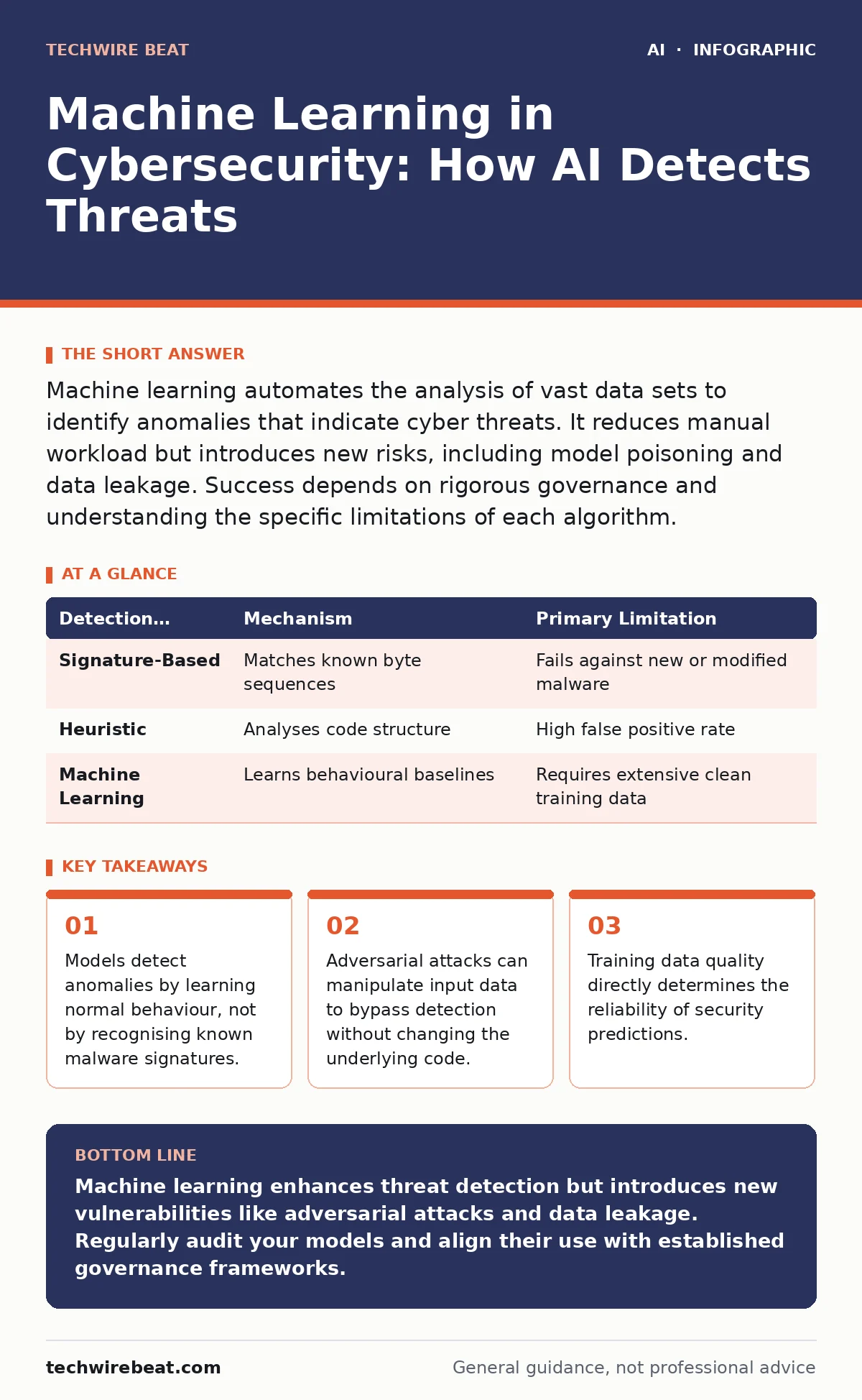
Machine learning automates the analysis of vast data sets to identify anomalies that indicate cyber threats. It reduces manual workload but introduces new risks, including model poisoning and data leakage. Success depends on rigorous governance and understanding the specific limitations of each algorithm.
Does machine learning replace human security analysts?
Automated systems process millions of log entries per second, a task impossible for any individual. However, the final decision to isolate a system or block traffic often requires human context. Algorithms lack the organisational awareness to distinguish between a legitimate system update and a malicious payload. This division of labour prevents alert fatigue while preserving human judgment for complex incidents.
How does machine learning detect threats that signatures miss?
Machine learning identifies threats by establishing a baseline of normal behaviour and flagging deviations from that pattern. Traditional signature-based tools only recognise known malware, requiring constant updates. Behavioural analysis observes how processes interact with the operating system, regardless of the file name. If a word processor begins executing code in memory, the model flags it as anomalous. This approach catches zero-day exploits, which are previously unknown attacks, because it focuses on action rather than identity.
| Detection Method | Mechanism | Primary Limitation |
|---|---|---|
| Signature-Based | Matches known byte sequences | Fails against new or modified malware |
| Heuristic | Analyses code structure | High false positive rate |
| Machine Learning | Learns behavioural baselines | Requires extensive clean training data |
Can attackers fool machine learning models?
Yes, attackers use adversarial examples to manipulate model inputs and evade detection. An adversarial example is a small, often imperceptible change to data that causes a model to misclassify it. In cybersecurity, this might involve adding hidden characters to a malicious script. The model sees the altered input as benign because it deviates from its training patterns. This vulnerability means no model is immune to sophisticated evasion techniques.
What is the risk of training data leakage?
Training data leakage occurs when sensitive information used to train a model is inadvertently exposed or reconstructed. Models memorise patterns in their training data, which can include private user behaviour or internal network configurations. An attacker might query the model to infer specific data points, effectively reverse-engineering the training set. This risk is particularly high when models are exposed via public APIs. You must sanitise training data and limit model access to prevent this form of data exfiltration. For deeper insights on this issue, consult our guide on training data leakage.
How do you prevent model drift in security tools?
Model drift happens when the accuracy of a model degrades over time because the underlying data changes. Network traffic patterns evolve as users adopt new applications or change work habits. A model trained on last year’s data may flag legitimate modern behaviour as malicious. Regular retraining with recent, labelled data keeps the model aligned with current reality. Without this maintenance, the tool becomes less effective and generates more false positives.
Is machine learning effective against insider threats?
Yes, machine learning is particularly effective at detecting insider threats because it focuses on behavioural anomalies. Insiders have legitimate access, so traditional perimeter defenses often miss their activities. Models analyse user behaviour analytics, such as login times, file access frequency, and data transfer volumes. A sudden deviation, like downloading large archives at unusual hours, triggers an alert. This method detects malicious intent even when the user’s credentials are valid.
How does bias affect cybersecurity decisions?
Bias in training data can lead to unfair or inaccurate security decisions. If a model is trained predominantly on data from one department, it may flag normal behaviour in other departments as suspicious. This creates a disproportionate burden on certain groups and increases false positives. Bias reduces the overall trust in the security system and can lead to critical alerts being ignored. Addressing this requires diverse and representative training data. Our guide on AI bias provides strategies for identifying and mitigating these skewed outcomes.
What governance frameworks apply to security AI?
Organisations should adopt established frameworks to manage the risks of AI in cybersecurity. The NIST AI Risk Management Framework provides a structured approach to identifying, assessing, and mitigating AI risks. It helps align AI usage with organisational values and regulatory requirements. Implementing these frameworks ensures that AI tools are transparent, accountable, and safe. This is not just a technical requirement but a governance imperative. For a broader view, see our guide on AI governance.
Can machine learning detect deepfakes in real time?
Machine learning can detect deepfakes by analysing subtle inconsistencies in video and audio. These inconsistencies include irregular blinking patterns, unnatural skin textures, or mismatched lip movements. However, detection is an ongoing arms race as generation techniques improve. Real-time detection is computationally expensive and may introduce latency. It is most effective when combined with provenance standards that verify the origin of media. For more on this, read our guide on deepfake detection.
How do you assess the security of AI vendors?
You must evaluate the security practices of vendors providing AI tools. This includes reviewing their data handling procedures, model training methods, and incident response plans. Ask specific questions about how they prevent model poisoning and data leakage. A vendor’s security posture directly impacts your own risk profile. Our guide on AI vendor assessments offers a checklist for evaluating third-party AI providers.
What are the risks of agentic AI in security?
Agentic AI systems can take autonomous actions without human approval, which introduces significant risk. These agents might block critical services or isolate systems based on incorrect interpretations. While they act faster than humans, they lack contextual understanding. A misconfigured agent could cause more damage than the threat it was meant to stop. Careful sandboxing and strict action limits are necessary. Explore the implications in our guide on agentic AI.
How does the OWASP Top 10 for LLMs apply to security?
The OWASP Top 10 for LLM applications highlights specific vulnerabilities in large language models. These include prompt injection, where attackers manipulate the model’s instructions, and insecure output handling. Security teams must treat LLMs as attack surfaces, not just tools. Implementing input validation and output filtering mitigates these risks. Understanding these vectors is critical for securing AI-integrated security platforms.
Key takeaways
- Models detect anomalies by learning normal behaviour, not by recognising known malware signatures.
- Adversarial attacks can manipulate input data to bypass detection without changing the underlying code.
- Training data quality directly determines the reliability of security predictions.
Machine learning enhances threat detection but introduces new vulnerabilities like adversarial attacks and data leakage. Regularly audit your models and align their use with established governance frameworks.
Frequently asked questions
How often should security models be retrained?
Retraining frequency depends on how quickly your environment changes. Monthly or quarterly reviews are common for dynamic networks.
Can small organisations use machine learning for security?
Yes, many commercial security tools include built-in machine learning. You do not need to build models from scratch to benefit from automation.
What is the biggest risk of using AI in cybersecurity?
The biggest risk is over-reliance on automated decisions without human oversight. This can lead to missed context and automated errors.
How this guide was produced: written by the TechWire Beat editorial team with AI assistance, checked against the public references listed below, and reviewed when the facts change. See our editorial policy or report an error.