Training Data Leakage: How to Stop Models Reciting Secrets
Models often memorise rare data points during training, allowing attackers to reconstruct sensitive inputs through carefully crafted queries.

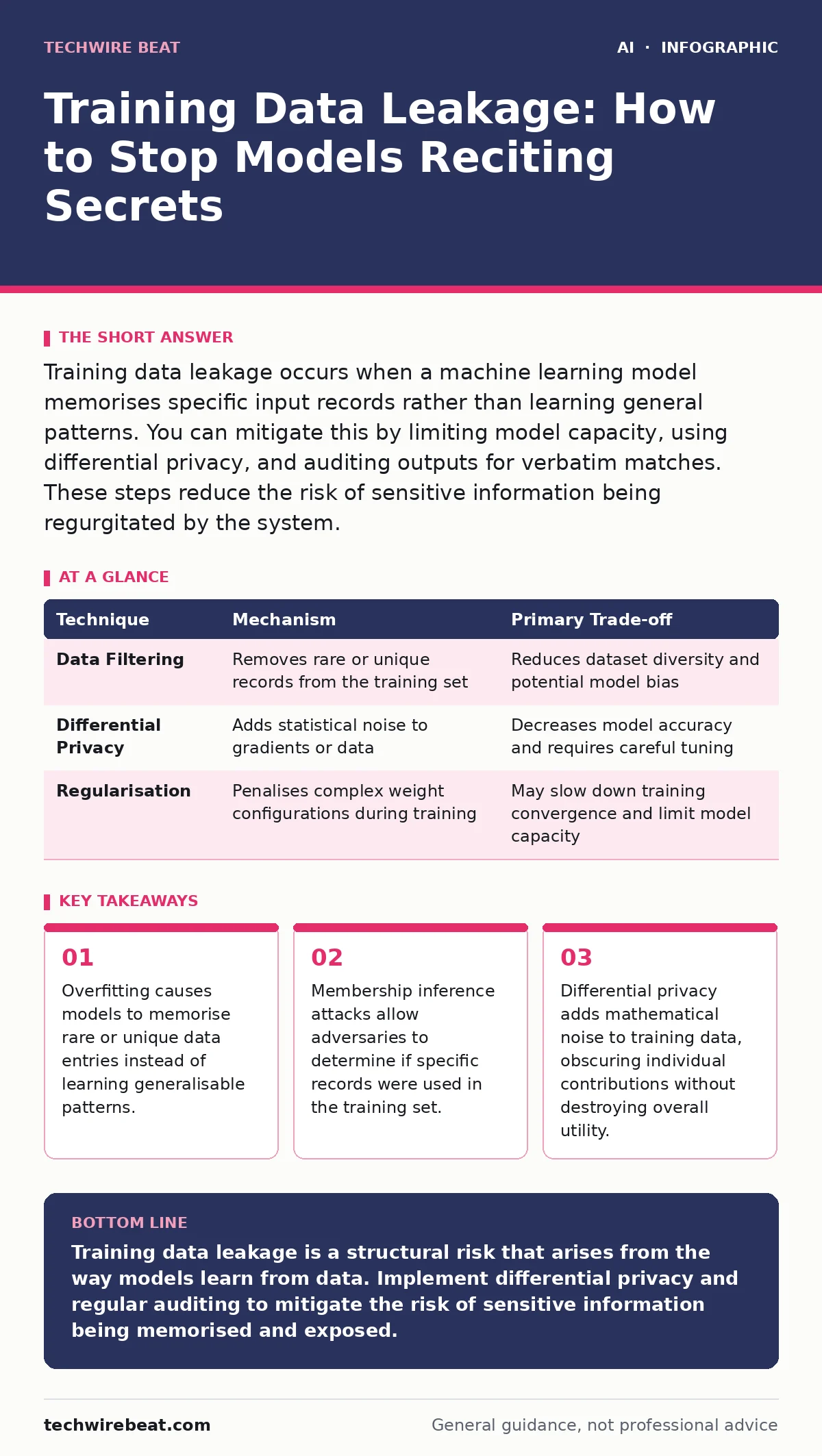
Training data leakage occurs when a machine learning model memorises specific input records rather than learning general patterns. You can mitigate this by limiting model capacity, using differential privacy, and auditing outputs for verbatim matches. These steps reduce the risk of sensitive information being regurgitated by the system.
What is training data leakage?
Training data leakage happens when a model memorises specific details from its training dataset and reproduces them in its outputs. This is distinct from the model learning general concepts or patterns from the data. Instead of understanding the underlying logic, the system effectively stores fragments of the input, much like a student memorising an answer key rather than learning the subject. This behaviour is most common in large language models and complex neural networks that have high capacity relative to the size of the dataset.
Why do models memorise sensitive information?
Models memorise information when they are too powerful for the amount of data they are given, a phenomenon known as overfitting. During training, the algorithm adjusts its internal weights to minimise error. If a specific record is rare or unique, the model may find it easier to memorise that exact sequence to reduce error than to learn a broader rule that applies to similar cases. This trade-off means that higher accuracy on training data often correlates with a higher risk of memorisation. The model prioritises fitting the known data points perfectly, leaving little room for generalisation.
How can attackers extract this memorised data?
Attackers use techniques such as membership inference attacks to probe the model’s knowledge. By sending carefully crafted inputs, they can observe subtle differences in the model’s confidence scores or output probabilities. If the model responds with unusual certainty to a specific query, it suggests that the input was part of the original training set. This allows an adversary to reconstruct private records, such as medical histories or financial details, even if the data was anonymised before training. The attack relies on the statistical fingerprint left by memorised data points.
Does anonymisation prevent data leakage?
Anonymisation alone does not prevent data leakage because models can learn correlations between seemingly harmless fields. Even if direct identifiers like names are removed, the combination of other attributes can uniquely identify an individual. A model may memorise the relationship between a rare job title, a specific location, and a unique transaction pattern. When queried, it can reconstruct the identity by linking these residual attributes. This is why anonymisation must be paired with other privacy-preserving techniques to be effective.
What is differential privacy and how does it help?
Differential privacy is a mathematical framework that adds controlled noise to the training process or the data itself. This noise ensures that the output of the model does not reveal whether any single individual’s data was included in the training set. The level of noise is calibrated to provide a specific privacy guarantee, measured by a parameter called epsilon. A lower epsilon value means stronger privacy but potentially lower model accuracy. This technique forces the model to learn general patterns rather than memorising specific instances.
| Technique | Mechanism | Primary Trade-off |
|---|---|---|
| Data Filtering | Removes rare or unique records from the training set | Reduces dataset diversity and potential model bias |
| Differential Privacy | Adds statistical noise to gradients or data | Decreases model accuracy and requires careful tuning |
| Regularisation | Penalises complex weight configurations during training | May slow down training convergence and limit model capacity |
Can you detect leakage after training?
Post-training detection involves auditing the model’s outputs for verbatim matches against the training data. You can run the model on a held-out test set and compare its responses to the original inputs. If the model reproduces long sequences of text or specific data points exactly, it indicates memorisation. Automated tools can scan for these matches and flag potential leaks. However, this method is reactive and may miss subtle leaks that do not involve exact string matches.
How does this relate to broader AI risks?
Training data leakage is a specific instance of the broader challenges addressed in AI risk management. It intersects with concerns about data provenance and the integrity of training sources. Understanding this risk is part of the NIST AI Risk Management Framework, which emphasises the need for transparency and accountability in AI development. By addressing data leakage, you also contribute to responsible AI practices, ensuring that systems do not inadvertently expose private information.
What is the role of model architecture?
The architecture of the model influences its tendency to memorise. Models with fewer parameters relative to the dataset size are less likely to overfit. Conversely, very large models with billions of parameters have the capacity to memorise vast amounts of data. The choice of architecture involves a trade-off between performance and privacy. Simpler models may be safer but less capable, while complex models offer higher performance at the cost of increased leakage risk.
How do you balance privacy and performance?
Balancing privacy and performance requires iterative testing and adjustment. You must define acceptable levels of privacy loss and performance degradation before training begins. Techniques such as machine learning in cybersecurity can help monitor for anomalies during the training process. Regular audits and the use of privacy-preserving technologies are necessary to maintain this balance. There is no perfect solution, only a managed risk that aligns with your organisational goals.
What are the next steps for mitigation?
Start by auditing your current models for signs of memorisation. Implement data filtering to remove rare or sensitive records before training. Consider using differential privacy if your use case allows for some reduction in accuracy. Stay informed about emerging standards and best practices in the field. Continuous monitoring and updating of your security measures are necessary to address evolving threats.
Key takeaways
- Overfitting causes models to memorise rare or unique data entries instead of learning generalisable patterns.
- Membership inference attacks allow adversaries to determine if specific records were used in the training set.
- Differential privacy adds mathematical noise to training data, obscuring individual contributions without destroying overall utility.
Training data leakage is a structural risk that arises from the way models learn from data. Implement differential privacy and regular auditing to mitigate the risk of sensitive information being memorised and exposed.
Frequently asked questions
Can I stop a model from leaking data without retraining it?
Retraining is often necessary to fundamentally change how the model handles data. Post-training methods like output filtering can help, but they do not remove the memorised data from the model’s internal weights.
Is training data leakage the same as data poisoning?
No. Data poisoning involves injecting malicious data to corrupt the model’s behaviour. Training data leakage involves the model inadvertently revealing private data it was trained on.
Do open-source models pose a higher risk?
Open-source models allow for greater transparency, which can help in auditing for leaks. However, they also make it easier for attackers to analyse the model’s internals and exploit vulnerabilities.
How does this differ from model inversion attacks?
Model inversion attacks attempt to reconstruct input data by querying the model’s predictions. Membership inference attacks determine if specific data was in the training set. Both are forms of privacy attacks but use different methods.
How this guide was produced: written by the TechWire Beat editorial team with AI assistance, checked against the public references listed below, and reviewed when the facts change. See our editorial policy or report an error.