Malware Targeting AI Infrastructure: Definition, Risks and Mitigation
AI-specific malware corrupts model weights and training data to create invisible failures that traditional security scans cannot detect or reverse.

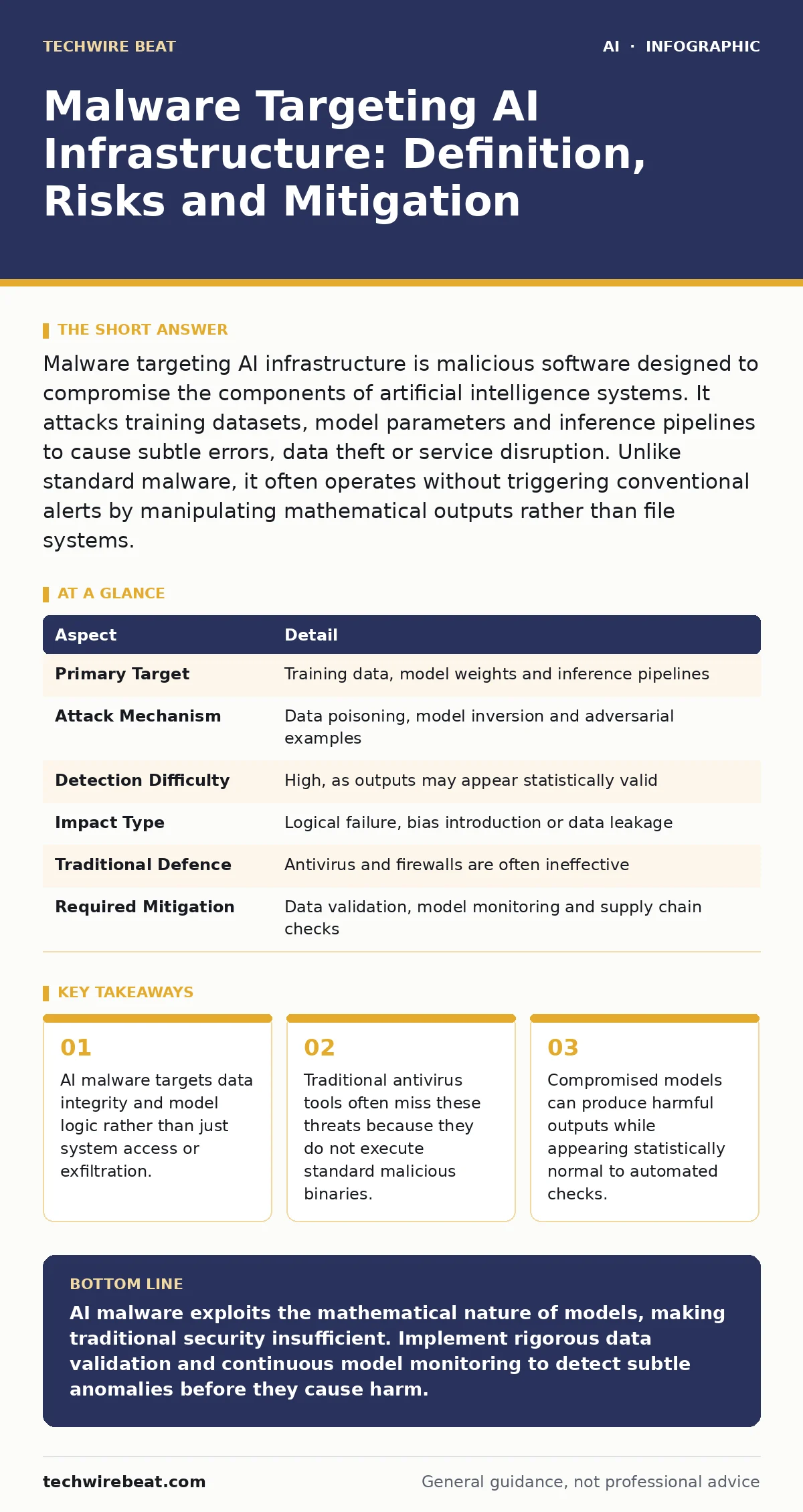
Malware targeting AI infrastructure is malicious software designed to compromise the components of artificial intelligence systems. It attacks training datasets, model parameters and inference pipelines to cause subtle errors, data theft or service disruption. Unlike standard malware, it often operates without triggering conventional alerts by manipulating mathematical outputs rather than file systems.
The Digital Poisoning of Artificial Intelligence
Imagine a recipe book where an intruder changes one ingredient measurement by a fraction of a teaspoon. The dish still looks correct, but the taste is subtly wrong. AI malware operates on this principle of subtle corruption. It does not always seek to destroy systems outright. Instead, it aims to alter the decision-making process of artificial intelligence models. This form of attack is distinct from traditional malware because its payload is often data or mathematical adjustments rather than executable code.
The threat emerges from the unique architecture of modern AI systems. These systems rely on vast amounts of data and complex mathematical weights to make predictions. An attacker who gains access to this infrastructure can inject malicious patterns into the training data. They can also modify the model weights directly. The result is a system that behaves incorrectly under specific conditions while appearing normal during general operation.
| Aspect | Detail |
|---|---|
| Primary Target | Training data, model weights and inference pipelines |
| Attack Mechanism | Data poisoning, model inversion and adversarial examples |
| Detection Difficulty | High, as outputs may appear statistically valid |
| Impact Type | Logical failure, bias introduction or data leakage |
| Traditional Defence | Antivirus and firewalls are often ineffective |
| Required Mitigation | Data validation, model monitoring and supply chain checks |
How AI Infrastructure Becomes Compromised
The attack surface for AI is broader than for conventional software. It includes the data lakes where raw information is stored. It includes the compute clusters where models are trained. It also includes the endpoints where models are deployed for inference. An attacker needs to breach only one of these layers to succeed.
Data poisoning is a common entry point. Malicious actors inject labelled data into the training set. This data contains hidden triggers. When the model encounters these triggers in the real world, it produces the desired malicious output. For example, a stop sign with a specific sticker pattern might be misclassified as a speed limit sign. The model has learned a false rule.
Another method involves direct manipulation of model weights. This requires access to the model file itself. Attackers modify the numerical parameters that define the model's behaviour. This is known as model poisoning. It allows an attacker to embed backdoors that activate only under specific conditions. The model appears to function correctly during standard testing but fails when the trigger is present.
Who Bears the Risk and Cost
Any organisation that relies on automated decision-making faces this risk. Healthcare providers using AI for diagnosis are vulnerable. A compromised model might miss critical symptoms in specific patient demographics. Financial institutions using AI for fraud detection are at risk. A poisoned model might fail to flag suspicious transactions that match a hidden pattern.
The cost extends beyond immediate financial loss. It includes reputational damage and regulatory penalties. If an AI system makes biased or incorrect decisions, the organisation responsible is liable. Trust in the technology erodes quickly. Recovery requires retraining models from scratch, which is expensive and time-consuming.
Supply chain partners also share the risk. Many organisations use pre-trained models from third parties. If the upstream provider is compromised, all downstream users inherit the vulnerability. This creates a cascading effect. One breach can impact dozens of organisations. This interdependence highlights the need for AI vendor assessments to evaluate the security posture of providers.
Common Forms of AI-Specific Malware
Adversarial examples are inputs designed to fool a model. They are often imperceptible to humans but cause the AI to make errors. These can be used to bypass security systems. For instance, an adversarial audio clip might trick a voice recognition system into granting access.
Model inversion attacks aim to reconstruct the training data. By querying the model repeatedly, an attacker can infer sensitive information. This is a form of data leakage. It violates privacy and exposes confidential information. This risk is particularly high in healthcare and finance where data is sensitive.
Membership inference attacks determine whether a specific record was part of the training set. This reveals who was included in the dataset. It can be used to identify individuals or organisations. This undermines the confidentiality of the data. It is a significant concern for training data leakage prevention strategies.
What People Usually Get Wrong
Many assume that encrypting data is sufficient. Encryption protects data at rest and in transit. It does not protect the model logic or the inference process. An attacker can still manipulate the model if they have access to the running instance. Encryption is a necessary baseline, but it is not a complete defence.
Another misconception is that AI models are static. They evolve as they learn from new data. This continuous learning process is a vulnerability. An attacker can slowly poison the model over time. This gradual degradation is hard to detect. It requires continuous monitoring of model performance and data inputs.
People often overlook the human element. Developers and data scientists can introduce vulnerabilities through poor coding practices. They might use insecure libraries or fail to validate inputs. Human error is a significant factor in AI security. This underscores the importance of AI governance frameworks that include security protocols.
How to Reduce the Risk
Start with data validation. Verify the integrity of all training data. Use statistical methods to detect anomalies. Remove outliers and suspicious entries before training. This prevents data poisoning from taking root. It is the first line of defence.
Monitor model performance continuously. Track metrics such as accuracy, precision and recall. Look for sudden drops or unusual patterns. Set up alerts for deviations from expected behaviour. This helps detect model drift and potential attacks. Early detection allows for quicker response.
Implement access controls. Restrict who can modify model weights or access training data. Use role-based access control. Log all changes and actions. This provides an audit trail. It helps identify the source of any compromise. It also deters insider threats.
The Path to Resilient AI Systems
Building resilient AI systems requires a shift in mindset. Security must be integrated into the development lifecycle. This is known as security by design. It involves considering threats at every stage. From data collection to model deployment.
Collaboration is key. Share threat intelligence with other organisations. Learn from their experiences. Participate in industry groups. This collective defence strengthens the entire ecosystem. It helps identify new threats and develop countermeasures.
Stay informed about emerging threats. The landscape of AI attacks is evolving. New techniques emerge regularly. Keep up with the latest research and best practices. Adapt your defences accordingly. This proactive approach reduces the risk of compromise. It ensures that your AI systems remain trustworthy and reliable.
Key takeaways
- AI malware targets data integrity and model logic rather than just system access or exfiltration.
- Traditional antivirus tools often miss these threats because they do not execute standard malicious binaries.
- Compromised models can produce harmful outputs while appearing statistically normal to automated checks.
AI malware exploits the mathematical nature of models, making traditional security insufficient. Implement rigorous data validation and continuous model monitoring to detect subtle anomalies before they cause harm.
Frequently asked questions
Can antivirus software detect AI malware?
Traditional antivirus software is often ineffective against AI malware. These threats operate at the data and model level, not as executable files. They do not trigger standard signature-based alerts. Specialised AI security tools are required for effective detection.
How do I know if my AI model has been poisoned?
Look for sudden drops in performance or unusual predictions on specific inputs. Monitor model metrics continuously. Compare current behaviour with historical baselines. Significant deviations may indicate poisoning. Regular audits of training data are also essential.
Is open-source AI more vulnerable to malware?
Open-source AI can be more vulnerable due to transparency. Attackers can study the code and model weights. However, community scrutiny can also identify vulnerabilities quickly. Proper security practices and regular updates mitigate these risks. Closed-source systems are not immune to supply chain attacks.
What is the role of AI agents in this context?
AI agents** can be both targets and vectors for malware. If an agent's decision-making model is compromised, it can execute harmful actions autonomously. They can also be used to automate attacks on other AI systems. Securing the underlying models of agents is critical.
How this guide was produced: written by the TechWire Beat editorial team with AI assistance, checked against the public references listed below, and reviewed when the facts change. See our editorial policy or report an error.