How the NIST AI Risk Management Framework Actually Works
The framework decouples risk decisions from technical implementation, allowing organisations to manage uncertainty without waiting for perfect security controls.

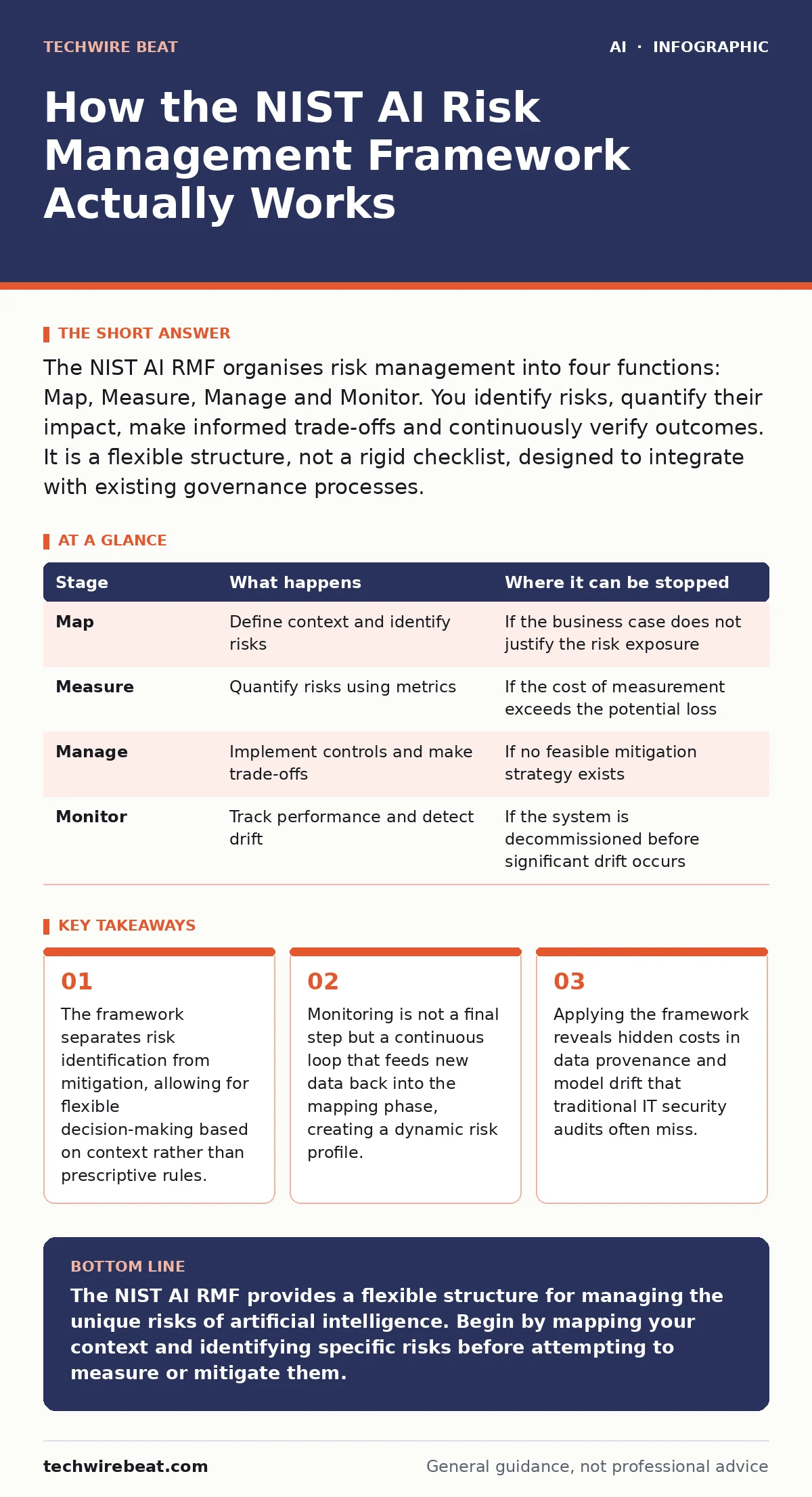
The NIST AI RMF organises risk management into four functions: Map, Measure, Manage and Monitor. You identify risks, quantify their impact, make informed trade-offs and continuously verify outcomes. It is a flexible structure, not a rigid checklist, designed to integrate with existing governance processes.
Understanding the Structure of the Framework
The NIST AI Risk Management Framework provides a structured approach to addressing risks associated with artificial intelligence. It does not dictate specific technical solutions. Instead, it offers a vocabulary and a process for organisations to articulate their risk tolerance. This distinction matters because AI systems behave differently from traditional software. They are probabilistic, meaning their outputs are not always deterministic or predictable.
You cannot secure an AI system with a firewall alone. The risks involve data bias, model drift and unintended consequences that emerge during deployment. The framework acknowledges this by focusing on the lifecycle of the AI system rather than just its perimeter. It aligns with broader responsible AI practices by providing a concrete method to operationalise ethical principles. Without a structured approach, these principles remain abstract aspirations rather than actionable controls.
Stage 1: Map
The first function is Map. Here, you define the context in which the AI system operates. This involves identifying the stakeholders, the data sources and the intended use cases. You must also establish the scope of the system. Are you managing a single chatbot or a complex supply chain optimisation model? The scope determines the depth of your analysis.
Mapping also requires you to identify the risks. These are not just technical vulnerabilities but also societal harms. You consider issues like fairness, privacy and safety. This stage forces you to confront the assumptions built into your data. For instance, if your training data reflects historical biases, the model will likely reproduce them. This stage connects directly to concerns about training data leakage, where sensitive information might inadvertently be memorised and exposed by the model.
| Stage | What happens | Where it can be stopped |
|---|---|---|
| Map | Define context and identify risks | If the business case does not justify the risk exposure |
| Measure | Quantify risks using metrics | If the cost of measurement exceeds the potential loss |
| Manage | Implement controls and make trade-offs | If no feasible mitigation strategy exists |
| Monitor | Track performance and detect drift | If the system is decommissioned before significant drift occurs |
Stage 2: Measure
Once you have mapped the risks, you must measure them. This stage involves selecting metrics that align with your risk profile. You might measure accuracy, precision or recall for technical performance. However, you also need metrics for fairness and robustness. For example, you might measure disparate impact across different demographic groups.
Measurement is often where projects stall. Collecting high-quality data for evaluation can be expensive and time-consuming. You must decide which metrics matter most for your specific use case. Not all metrics are equally important. A high accuracy score might mask a severe bias issue. This stage requires a clear understanding of what failure looks like for your system. It also overlaps with AI governance, ensuring that the metrics you choose reflect organisational values and regulatory requirements.
Stage 3: Manage
The Manage function is where you make decisions. You determine which risks are acceptable and which require mitigation. This involves implementing controls. These controls can be technical, such as input validation or output filtering. They can also be organisational, such as human-in-the-loop review processes. You must document your decisions and the rationale behind them.
This stage highlights the trade-offs inherent in AI deployment. Improving one metric might degrade another. For example, increasing model transparency might reduce performance. You must balance these competing demands. This is where the concept of agentic AI becomes relevant, as autonomous agents require more stringent controls to prevent unintended actions. You also consider the potential for deepfake fraud if your system generates synthetic media. The goal is not to eliminate all risk but to reduce it to an acceptable level.
Stage 4: Monitor
The final function is Monitor. AI systems do not remain static. Their performance can degrade over time as the data they encounter changes. This phenomenon is known as model drift. You must continuously track the system’s performance against your established metrics. You also monitor for new threats and vulnerabilities.
Monitoring is not a one-time activity. It is a continuous loop. The insights you gain from monitoring feed back into the Map stage. You may discover new risks or realise that your previous assumptions were incorrect. This iterative process ensures that your risk management remains relevant. It also supports AI risk management by providing evidence of compliance and effectiveness. Without continuous monitoring, even a well-designed system can become a liability.
See also: AI Governance for Small Teams: Practical Controls and Cost
Integrating with Existing Processes
The NIST AI RMF is designed to integrate with existing risk management frameworks. You do not need to start from scratch. You can map its functions to your current processes. This reduces the overhead of adoption. However, you must ensure that your existing processes can handle the unique characteristics of AI. Traditional IT security frameworks often lack the nuance required for probabilistic systems.
This integration is critical for organisations adopting OWASP Top 10 for LLM applications. The OWASP list provides specific technical vulnerabilities to look for. The NIST framework provides the overarching structure to manage those vulnerabilities. By combining both, you create a more resilient system. You address the technical details while maintaining strategic oversight. This dual approach ensures that you are not just patching holes but building a sustainable risk culture.
The Hidden Costs of Implementation
Implementing the framework reveals hidden costs. One such cost is the labour required for continuous evaluation. You need skilled personnel to interpret metrics and adjust models. Another cost is the potential reduction in system efficiency. Adding layers of validation and monitoring can slow down response times. You must weigh these costs against the benefits of reduced risk.
There is also a cognitive cost. Teams must shift their mindset from deterministic to probabilistic thinking. This requires training and cultural change. Leaders must accept that there is no such thing as a perfectly safe AI system. They must be comfortable with uncertainty. This shift is challenging but necessary for long-term success. It aligns with the broader goal of responsible AI practices, ensuring that innovation does not outpace safety.
Key takeaways
- The framework separates risk identification from mitigation, allowing for flexible decision-making based on context rather than prescriptive rules.
- Monitoring is not a final step but a continuous loop that feeds new data back into the mapping phase, creating a dynamic risk profile.
- Applying the framework reveals hidden costs in data provenance and model drift that traditional IT security audits often miss.
The NIST AI RMF provides a flexible structure for managing the unique risks of artificial intelligence. Begin by mapping your context and identifying specific risks before attempting to measure or mitigate them.
Frequently asked questions
Is the NIST AI RMF mandatory?
No, it is voluntary. However, many regulators and customers expect organisations to follow recognised risk management frameworks. Adopting it can demonstrate due diligence and build trust.
How does it differ from traditional IT security?
Traditional IT security focuses on protecting infrastructure and data. The NIST AI RMF focuses on the behaviour and outcomes of AI systems, including bias, fairness and unintended consequences.
Can small organisations use it?
Yes, the framework is scalable. Small organisations can apply its principles to their specific context without needing extensive resources. The key is to focus on the most significant risks.
Does it cover generative AI?
Yes, the framework is technology-agnostic. It applies to all AI systems, including generative models. The specific risks and controls will vary depending on the type of AI.
How this guide was produced: written by the TechWire Beat editorial team with AI assistance, checked against the public references listed below, and reviewed when the facts change. See our editorial policy or report an error.