Deepfake Fraud Response: Stop the Bleeding and Secure Recovery
Synthetic media attacks exploit social trust faster than technical controls can react, requiring immediate account isolation before forensic analysis.

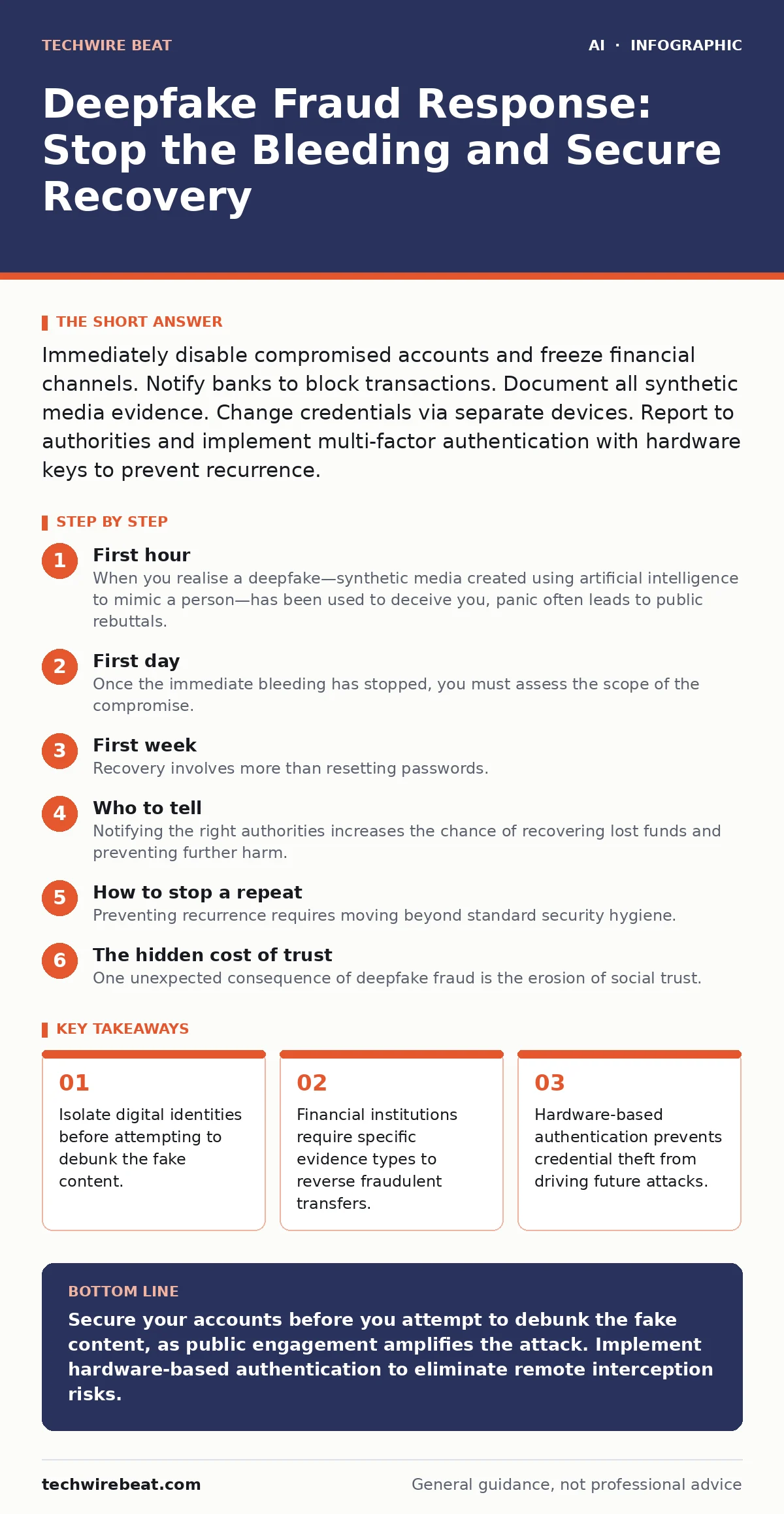
Immediately disable compromised accounts and freeze financial channels. Notify banks to block transactions. Document all synthetic media evidence. Change credentials via separate devices. Report to authorities and implement multi-factor authentication with hardware keys to prevent recurrence.
First hour
When you realise a deepfake—synthetic media created using artificial intelligence to mimic a person—has been used to deceive you, panic often leads to public rebuttals. This is the wrong first step. You must secure your digital perimeter before engaging with the narrative. The attacker is likely still probing for weaknesses.
Execute this checklist immediately. Do not skip steps.
- Disconnect from the network where the breach occurred.
- Power off devices that were used to interact with the fraudster.
- Call your bank using a number from your card or statement, not from a search engine.
- Request an immediate freeze on all outgoing payments.
- Change passwords for email and financial accounts using a separate, clean device.
- Revoke active sessions for all major services.
The goal of this phase is containment. You are not trying to prove the media is fake yet. You are stopping the attacker from using the momentum of the initial breach to access more systems.
First day
Once the immediate bleeding has stopped, you must assess the scope of the compromise. Deepfake fraud rarely exists in isolation. The attacker likely obtained some form of personal data to craft the synthetic media. This could be your voice, your image, or your behavioural patterns.
You need to determine what information the attacker accessed. Check your email logs for unusual forwarding rules. Attackers often set up auto-forwarding to keep their access alive even if you change your password. Review connected applications in your account settings. Look for third-party apps with unusual permissions that grant access to your contacts or message history.
If the fraud involved voice cloning, consider your microphone usage. Check which applications have microphone permissions on your devices. Revoke access for any app that does not strictly require real-time audio input. This limits the data available for future synthesis.
First week
Recovery involves more than resetting passwords. You must rebuild trust with the parties who were deceived. If a deepfake was used to trick a colleague or family member into sending money, that relationship has been damaged. You need to provide concrete evidence of the breach to restore credibility.
Compile a timeline of events. Include screenshots of the fraudulent messages, the synthetic media files, and any transaction records. Contact the recipients of the fraud directly. Explain the mechanism used, such as video injection or audio synthesis. This educational step helps them recognise similar attempts in the future.
Monitor your credit reports and identity services. Look for new accounts opened in your name. Attackers who can clone your voice or face may also have your personal identification details. They might attempt to open lines of credit or secure loans. Early detection of these anomalies is critical.
Who to tell
Notifying the right authorities increases the chance of recovering lost funds and preventing further harm. Start with your financial institution. They have specific fraud teams trained to handle synthetic media attacks. Provide them with the technical evidence, not just a claim of theft.
Report the incident to law enforcement. While individual response times vary, having an official record helps if you need to dispute charges later. Include the hash values of the synthetic media files if you can generate them. This creates a unique digital fingerprint of the evidence.
Inform your platform providers. If the deepfake was hosted on social media or communication platforms, report it for removal. These platforms have policies against non-consensual synthetic media. Prompt reporting can help limit the spread and prevent others from being targeted with the same asset.
How to stop a repeat
Preventing recurrence requires moving beyond standard security hygiene. Passwords and basic two-factor authentication via SMS are insufficient against sophisticated AI attacks. SMS codes can be intercepted through SIM swapping, which attackers often use alongside deepfake attacks.
Implement hardware-based multi-factor authentication. These devices generate codes locally and do not rely on network connectivity. This eliminates the risk of remote interception. For high-value interactions, establish out-of-band verification protocols. Agree on a pre-arranged code word or question that cannot be guessed from public data.
Regularly audit your digital footprint. Remove old photos and videos from public social media profiles. Attackers harvest this data to train models. The less training data they have, the harder it is to create convincing synthetic media. Consider using tools mentioned in guides on deepfake detection to scan your public profiles for unauthorized content.
The hidden cost of trust
One unexpected consequence of deepfake fraud is the erosion of social trust. Colleagues or family members may hesitate to trust future communications. This creates a friction cost in your daily interactions. You may find yourself needing to verify every request, slowing down workflows and personal relationships.
Address this by normalising verification. Make it a standard practice to verify urgent requests through a secondary channel. This is not paranoia; it is a security control. By making verification routine, you reduce the stigma associated with questioning authority or familiar voices.
Another hidden cost is the psychological toll. Victims often feel violated, as their likeness was used without consent. This is a form of identity theft that feels more personal than financial loss. Acknowledge this impact. Seek support if the violation affects your mental well-being.
Building long-term resilience
Security is not a one-time fix. It is an ongoing process of adaptation. Attackers refine their models as detection techniques improve. You must stay informed about emerging threats. Follow reputable sources on AI governance and responsible AI practices.
Review your security posture regularly. Update your authentication methods as new standards emerge. Consider the principles outlined in the NIST AI Risk Management Framework to assess risks in your digital environment. This framework provides a structured approach to managing AI-related risks, including those posed by synthetic media.
Education is your strongest defence. Teach your family and colleagues how deepfakes work. Explain the tell-tale signs, such as unnatural blinking or audio glitches. The more people understand the technology, the less effective the attacks become. Knowledge disrupts the social engineering component that makes deepfakes dangerous.
Key takeaways
- Isolate digital identities before attempting to debunk the fake content.
- Financial institutions require specific evidence types to reverse fraudulent transfers.
- Hardware-based authentication prevents credential theft from driving future attacks.
Secure your accounts before you attempt to debunk the fake content, as public engagement amplifies the attack. Implement hardware-based authentication to eliminate remote interception risks.
Frequently asked questions
Can I sue the creator of a deepfake used in fraud?
Legal recourse depends on your jurisdiction and the specific laws regarding digital likeness and fraud. Consult a legal professional to understand your options for damages and injunctions.
How do I know if a voice message is synthetic?
Look for unnatural pauses, flat intonation, or background noise inconsistencies. Use dedicated deepfake detection tools to analyse audio files for digital artefacts left by AI generation.
Should I delete all my social media to prevent this?
Deleting all accounts is extreme and may not stop attackers who have already harvested your data. Instead, tighten privacy settings, remove old media, and monitor for unauthorized use of your likeness.
Does multi-factor authentication stop deepfake attacks?
MFA stops account takeover, which is often the goal of deepfake fraud. It does not stop the creation of the fake media itself, but it prevents the attacker from using your compromised credentials to complete the fraud.
How this guide was produced: written by the TechWire Beat editorial team with AI assistance, checked against the public references listed below, and reviewed when the facts change. See our editorial policy or report an error.