Deepfake Detection AI: How Algorithms Spot Synthetic Media
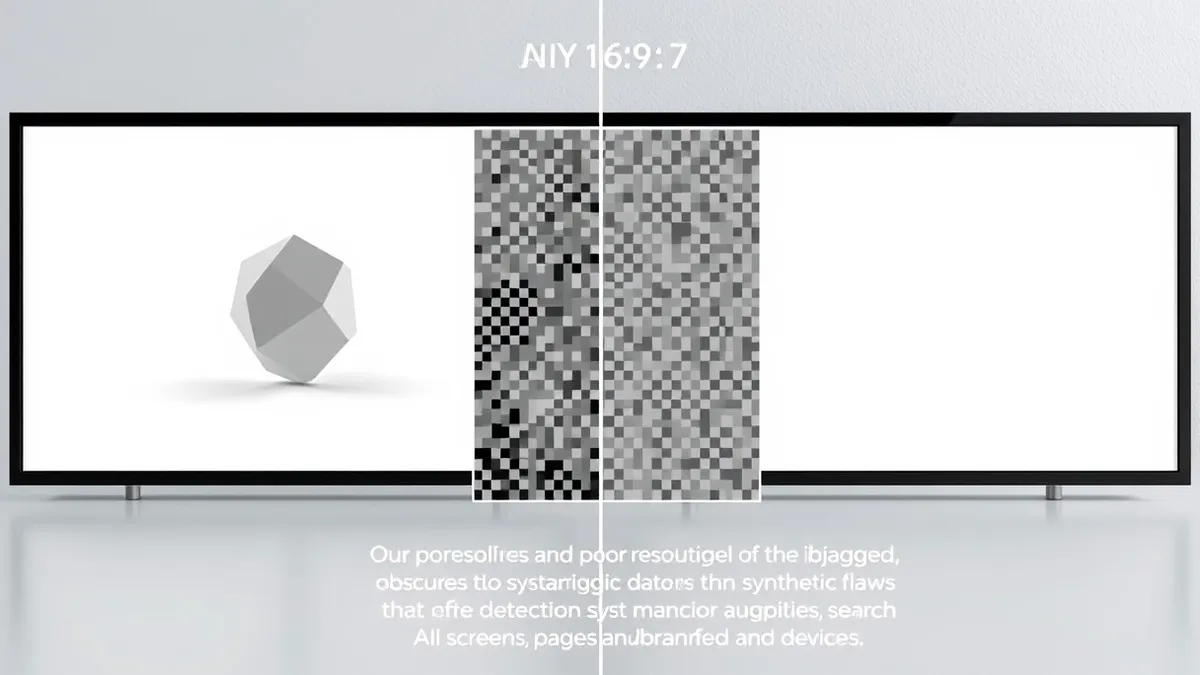
Detection systems often fail against low-resolution content, creating a paradox where poorer quality media is harder to verify than high-definition recordings.
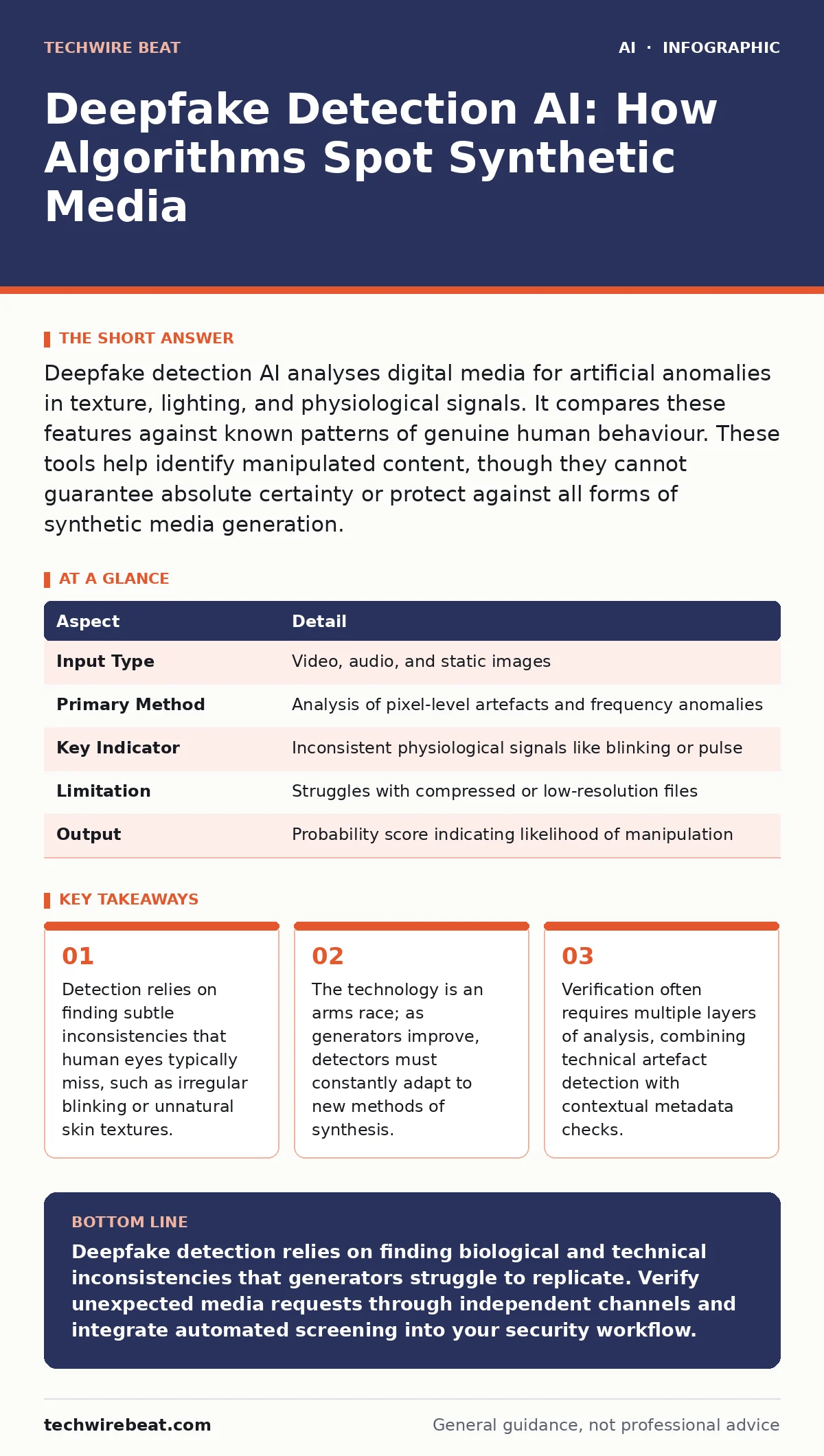
Deepfake detection AI analyses digital media for artificial anomalies in texture, lighting, and physiological signals. It compares these features against known patterns of genuine human behaviour. These tools help identify manipulated content, though they cannot guarantee absolute certainty or protect against all forms of synthetic media generation.
How Deepfake Detection AI Works
Imagine a painter trying to replicate the brushstrokes of a master artist. A human viewer might spot the forgery by noticing slight differences in pressure or angle. Deepfake detection AI operates on a similar principle but at a pixel level. It scans digital media for artefacts that generative models struggle to replicate perfectly. These artefacts include inconsistent lighting, unnatural facial movements, and missing high-frequency details.
The process begins with feature extraction. The algorithm breaks the video or audio file into small segments. It then analyses these segments for statistical irregularities. For instance, a deepfake might show a slight blur around the edges of a face where the synthetic overlay meets the original footage. The detector flags this boundary as suspicious. It does not look for specific faces but for signs of digital manipulation.
| Aspect | Detail |
|---|---|
| Input Type | Video, audio, and static images |
| Primary Method | Analysis of pixel-level artefacts and frequency anomalies |
| Key Indicator | Inconsistent physiological signals like blinking or pulse |
| Limitation | Struggles with compressed or low-resolution files |
| Output | Probability score indicating likelihood of manipulation |
Physiological and Technical Signals
Human bodies follow biological rules that machines find difficult to emulate. Your heart rate causes slight colour changes in your skin, a phenomenon detectable by sensitive cameras. Deepfake detection AI looks for these remote photoplethysmography signals. If a face shows no pulse or an erratic rhythm, the system raises an alert. This is a powerful signal because it relies on biology, not just visual appearance.
Technical signals are equally important. Generative adversarial networks, the models used to create deepfakes, often leave traces in the frequency domain. When an image is converted from spatial data to frequency data, synthetic content shows distinct patterns. Real cameras capture noise in a specific way. AI generators create noise that looks random but has a mathematical structure. Detectors analyse this structure to identify fakes. This method is effective because it targets the underlying generation process rather than the surface content.
Who Is Affected by Synthetic Media
The impact of deepfakes extends far beyond celebrity impersonations. Financial institutions face risks from voice cloning scams, where attackers mimic executive voices to authorize transfers. Journalists and news organisations must verify footage before publication to maintain credibility. Individuals risk identity theft through manipulated social media profiles. The widespread availability of generative tools means anyone can become a target.
Businesses are particularly vulnerable. A deepfake fraud attempt might involve a fake video call from a CEO instructing a finance officer to move funds. The visual and audio cues match the executive perfectly. Without detection tools, the employee has no reason to doubt the request. This shifts the burden of verification onto the organisation. Security teams must now integrate media verification into their standard operating procedures.
Common Misconceptions About Detection
Many people believe that high-quality deepfakes are indistinguishable from reality. This is a dangerous assumption. While visual quality has improved, physiological and technical artefacts remain. Another common error is assuming that metadata, such as file creation dates, proves authenticity. Metadata is easily stripped or forged. Relying on it alone provides a false sense of security.
There is also a misconception that detection is a solved problem. The technology is in a constant state of flux. As generators improve, detectors must be retrained. A model trained last year may fail against a deepfake created today. This requires continuous investment in updates and new data. Security cannot be static. It must evolve alongside the threats.
The Role of Explainable AI
Understanding why a detector flagged content is as important as the flag itself. Explainable AI provides insights into the specific artefacts that triggered an alert. Instead of a simple "fake" label, the system highlights regions of concern. It might show a heatmap indicating where the skin texture appears unnatural. This transparency helps analysts make informed decisions.
Without explainability, defenders cannot trust the tool. A black-box model that outputs a probability score offers little guidance. Analysts need to know what to look for. Explainable features allow for better training and improved processes. They also help in communicating risks to stakeholders. If a video is flagged, you can show exactly why it is suspicious.
Integrating Detection into Security
Effective defence requires a multi-layered approach. Deepfake detection AI should be part of a broader machine learning in cybersecurity strategy. It works best when combined with other verification methods. For example, cross-referencing a video with known sources can confirm authenticity. Contextual analysis is also vital. Does the content align with known facts?
Organisations must also consider responsible AI practices when deploying these tools. Bias in detection models can lead to false positives, particularly for certain demographics. Regular audits ensure the system treats all subjects fairly. Training data leakage is another risk. Ensure that the detection system does not inadvertently expose sensitive information during the analysis process.
What To Do About It
You cannot stop the creation of deepfakes, but you can verify their authenticity. Start by establishing a baseline for normal communications. If you receive an unexpected request via video or audio, verify it through a separate channel. Call the person directly using a known number. Do not use the contact details provided in the suspicious message.
For organisations, implement automated screening for high-risk communications. Integrate deepfake detection ai into your email and messaging platforms. This provides real-time alerts before a user acts on manipulated content. Regularly update your detection models to keep pace with new techniques. Educate your staff on the signs of synthetic media. Awareness reduces the risk of social engineering attacks.
Consider the implications of AI vendor assessments when choosing detection tools. Not all solutions are equal. Evaluate their accuracy, bias mitigation, and explainability features. Ensure they align with your security requirements. Proactive verification is the only reliable defence against the growing threat of synthetic media.
Key takeaways
- Detection relies on finding subtle inconsistencies that human eyes typically miss, such as irregular blinking or unnatural skin textures.
- The technology is an arms race; as generators improve, detectors must constantly adapt to new methods of synthesis.
- Verification often requires multiple layers of analysis, combining technical artefact detection with contextual metadata checks.
Deepfake detection relies on finding biological and technical inconsistencies that generators struggle to replicate. Verify unexpected media requests through independent channels and integrate automated screening into your security workflow.
Frequently asked questions
Can deepfake detection AI identify audio fakes?
Yes, detectors analyse voice patterns, background noise, and physiological cues like breathing to identify synthetic audio.
How do I know if a video is a deepfake?
Look for unnatural blinking, inconsistent lighting, and irregular facial movements. Automated tools can provide a more accurate assessment.
Are deepfakes always high quality?
No, many deepfakes are low resolution or contain obvious artefacts. Quality varies depending on the tools and resources used.
How this guide was produced: written by the TechWire Beat editorial team with AI assistance, checked against the public references listed below, and reviewed when the facts change. See our editorial policy or report an error.