Deepfake Detection: Seven Technical Defences Against Synthetic Media
Most detection fails because it hunts for visual artefacts that modern generative models no longer produce, leaving signal analysis as the only reliable defence.

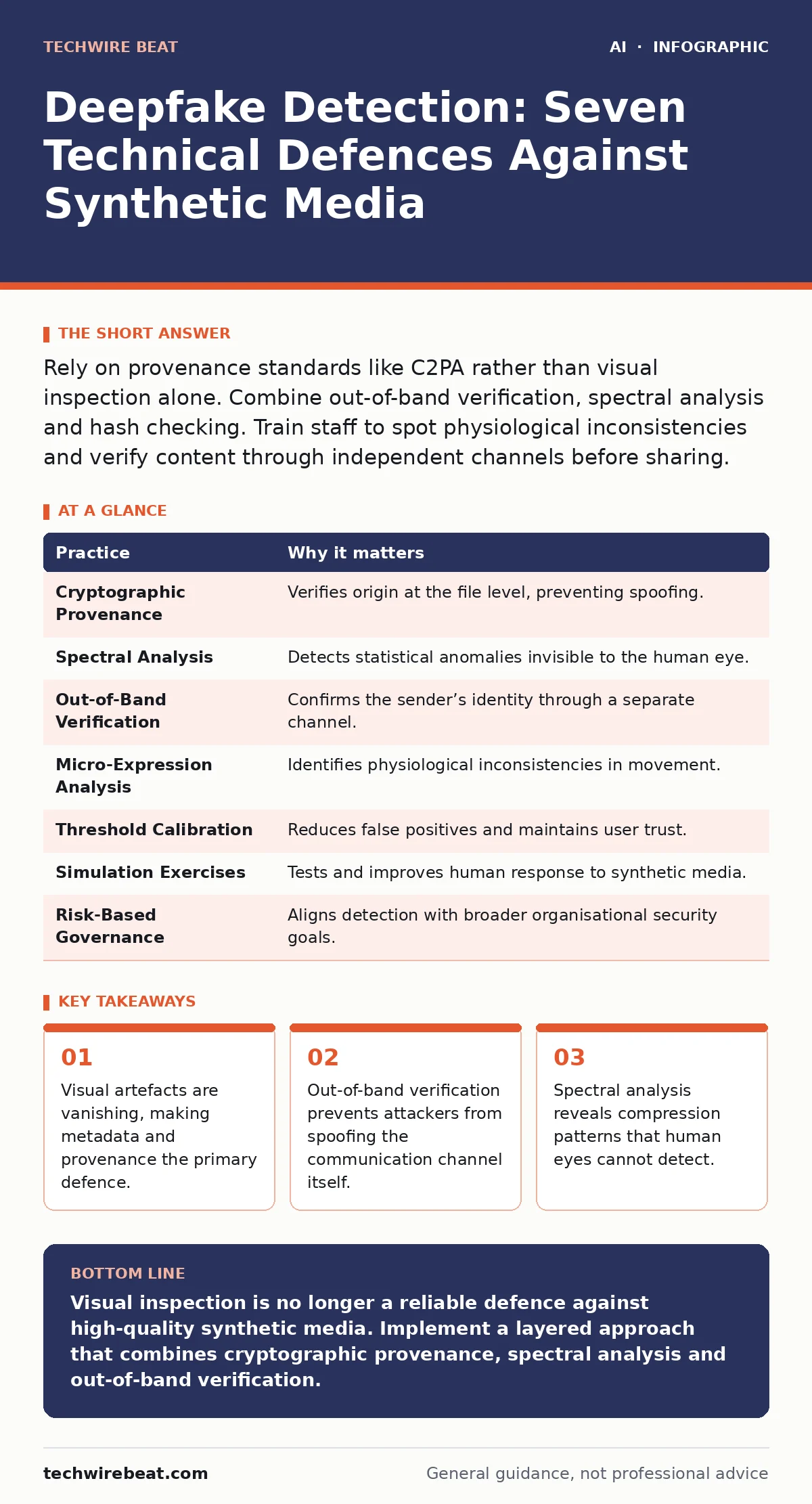
Rely on provenance standards like C2PA rather than visual inspection alone. Combine out-of-band verification, spectral analysis and hash checking. Train staff to spot physiological inconsistencies and verify content through independent channels before sharing.
The Failure of Visual Inspection
Relying on human eyes to spot deepfakes is a strategy that is already failing. Early generative models produced visible seams, mismatched lighting and unnatural eye movements. Current models correct these errors automatically during training. You cannot trust your perception of reality when the medium is digital.
Visual inspection works only against low-effort attempts. High-quality synthetic media passes the casual glance test every time. You must shift your defence from what you see to how the file was created and transmitted. This requires a change in mindset from detection to verification.
1. Prioritise Cryptographic Provenance
Provenance establishes the origin of a digital asset. The C2PA standard embeds cryptographically signed metadata into files at creation. This signature survives editing and compression, allowing you to verify the camera or software that generated the content. If a file lacks this chain of custody, treat it as unverified.
Tip: Configure your organisation’s media management systems to reject or flag files that lack valid C2PA signatures. Do not assume missing metadata means the file is fake, but do assume it is unproven.
Signal Integrity and Compression Artifacts
Every time a video is saved, shared or streamed, it undergoes compression. This process alters the statistical properties of the pixel data. Real cameras produce noise patterns that follow physical laws. Generative models produce noise that follows mathematical distributions. These distributions leave subtle traces in the frequency domain.
Spectral analysis examines these traces. It looks for anomalies in the way light and colour are represented at a microscopic level. This method is harder for attackers to defeat because it targets the underlying structure of the data, not the surface appearance.
2. Deploy Spectral Analysis Tools
Use software that analyses the frequency spectrum of video frames. Look for inconsistencies in the noise texture between different parts of the image. A generated face may have smoother noise than the surrounding environment. This mismatch indicates synthetic origin.
Tip: Integrate spectral analysis plugins into your video review workflow. Run them automatically on any media that requires high-level verification. Do not rely on manual review for this step.
The Channel is the Vulnerability
Attackers do not just generate fake content. They also spoof the channel used to deliver it. Email headers, SMS metadata and social media accounts can all be forged. If you verify the content but not the source, you remain vulnerable. An attacker can send a real video from a fake account. They can also send a fake video from a real account.
You must separate the verification of the message from the verification of the messenger. This is known as out-of-band verification. It requires you to contact the purported sender through a different, trusted channel.
3. Implement Out-of-Band Verification
When you receive urgent or unusual requests via digital media, verify them through a separate method. If a CEO sends a video message asking for a transfer, call their known phone number. Do not use the number in the email. Do not use the number in the video description. Use a number you already have in your contact list.
Tip: Establish a pre-agreed challenge phrase with key stakeholders. Ask them to use this phrase in any verified communication. This adds a layer of complexity that automated scripts cannot replicate.
Physiological Consistency Checks
Even advanced models struggle with complex biological rhythms. Humans blink, breathe and shift their weight in predictable patterns. Generative models often miss these micro-movements. They may produce faces that do not move in sync with the body. They may produce voices that do not match the lip movements perfectly.
These inconsistencies are subtle. They require careful observation or specialised software to detect. You should not rely on this method alone, as it is not foolproof. However, it provides a secondary layer of defence.
4. Analyse Micro-Expression Synchronisation
Look for delays between facial movements and audio cues. Check for unnatural blinking rates. Observe whether the head movements match the expected physics of the scene. If the video is static, check for subtle breathing movements in the chest or neck.
Tip: Use slow-motion playback to examine lip-sync accuracy. Look for frames where the mouth shape does not match the phoneme being spoken. Note any discrepancies and investigate further.
The Hidden Cost of False Positives
Detection tools are not perfect. They produce false positives, flagging real content as fake. This creates friction for users and staff. They may stop sharing legitimate content out of fear. This chilling effect damages trust and communication.
You must balance security with usability. Overly aggressive detection leads to alert fatigue. Users will ignore warnings if they occur too frequently. This undermines the entire defence strategy.
5. Calibrate Detection Thresholds
Set your detection tools to a level that minimises false positives. Test them against known real content from your organisation. Adjust the sensitivity until you find a balance between catching fakes and allowing genuine content through.
Tip: Review false positive logs weekly. Identify patterns in what is being incorrectly flagged. Adjust your tools or training data to address these specific issues. Do not ignore false positives as they erode trust in the system.
Training and Awareness
Technology alone cannot solve the deepfake problem. You need human vigilance. Staff must understand how deepfakes work. They must know the risks and the verification procedures. Training should focus on critical thinking rather than technical details.
Training should be ongoing, not a one-time event. New models emerge constantly. Your defence must evolve with them. Use hypothetical scenarios to test your staff’s response.
6. Conduct Regular Simulation Exercises
Run phishing simulations that include deepfake audio or video. Measure how many staff members fall for the trick. Use the results to improve training. Focus on the decision-making process, not just the outcome.
Tip: After each simulation, debrief with participants. Ask them what cues made them suspicious or what made them trust the content. Use this feedback to refine your messaging and procedures.
Governance and Frameworks
Deepfake detection is part of a broader AI risk management strategy. You cannot address it in isolation. You need policies that govern the use of AI-generated content. You need procedures for reporting and investigating suspected fakes.
Refer to established frameworks like the NIST AI Risk Management Framework for guidance. These frameworks provide a structured approach to identifying and mitigating risks. They help you align your defence with industry best practices.
7. Adopt a Risk-Based Governance Model
Develop policies that define acceptable use of AI tools. Include deepfake detection as a key control. Assign responsibility for monitoring and updating these controls. Ensure that legal and compliance teams are involved in the process.
Tip: Review your AI governance policies annually. Update them to reflect new threats and technologies. Ensure that all staff are aware of their responsibilities under these policies.
| Practice | Why it matters |
|---|---|
| Cryptographic Provenance | Verifies origin at the file level, preventing spoofing. |
| Spectral Analysis | Detects statistical anomalies invisible to the human eye. |
| Out-of-Band Verification | Confirms the sender’s identity through a separate channel. |
| Micro-Expression Analysis | Identifies physiological inconsistencies in movement. |
| Threshold Calibration | Reduces false positives and maintains user trust. |
| Simulation Exercises | Tests and improves human response to synthetic media. |
| Risk-Based Governance | Aligns detection with broader organisational security goals. |
Key takeaways
- Visual artefacts are vanishing, making metadata and provenance the primary defence.
- Out-of-band verification prevents attackers from spoofing the communication channel itself.
- Spectral analysis reveals compression patterns that human eyes cannot detect.
Visual inspection is no longer a reliable defence against high-quality synthetic media. Implement a layered approach that combines cryptographic provenance, spectral analysis and out-of-band verification.
Frequently asked questions
Can I detect a deepfake by looking at the eyes?
No, modern models replicate eye movement and blinking accurately. You must rely on technical analysis and provenance data instead.
Is C2PA available for all video formats?
It is widely supported by major camera manufacturers and editing software, but not all legacy systems support it yet.
How often should I update my detection tools?
Update them regularly, as new generative models are released frequently. Monitor vendor advisories for patches and improvements.
What should I do if I receive a suspicious video?
Do not share it. Verify the content through out-of-band channels and report it to your security team for analysis. TAGS
How this guide was produced: written by the TechWire Beat editorial team with AI assistance, checked against the public references listed below, and reviewed when the facts change. See our editorial policy or report an error.