Social Media Privacy Risks: The Hidden Data Costs You Accept
Your social media privacy risks extend far beyond your posts, as platforms sell inferred behavioural profiles to data brokers without your explicit consent.

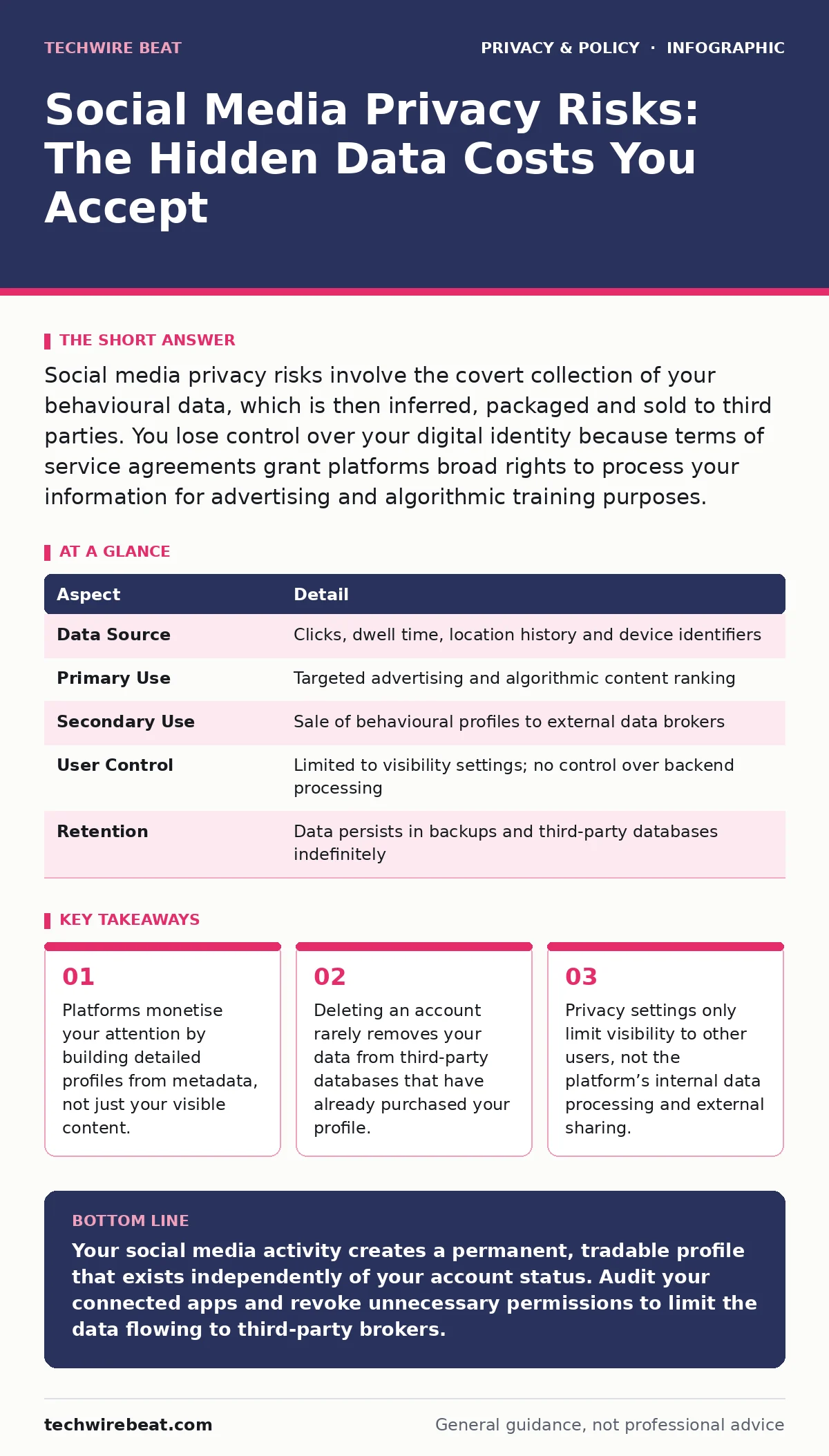
Social media privacy risks involve the covert collection of your behavioural data, which is then inferred, packaged and sold to third parties. You lose control over your digital identity because terms of service agreements grant platforms broad rights to process your information for advertising and algorithmic training purposes.
The Digital Footprint Analogy
Imagine leaving a trail of breadcrumbs while walking through a forest. You intend to reach a specific clearing, but every step you take is recorded by invisible sensors. These sensors do not just note where you walk. They record how fast you move, which trees you glance at and how long you pause near a stream. Social media platforms operate on this same principle. They track your interactions to build a predictive model of your behaviour.
This model is more valuable than the content you post. The platform sells the prediction of what you will buy, click or believe next. Your social media privacy risks stem from this secondary market. You are not merely sharing a photo. You are providing raw material for a commercial engine that refines your identity into a tradable asset.
Understanding Social Media Privacy Risks
Social media privacy risks refer to the exposure of personal data through the use of online networking services. This exposure occurs because these services require extensive data collection to function. The mechanism relies on inferred data. Inferred data is information the platform deduces about you based on your actions, rather than facts you explicitly provide.
For example, if you linger on political news articles, the platform infers your political leaning. If you view travel content, it infers your income level and leisure habits. These inferences are compiled into a dossier. This dossier is then shared with advertisers and data brokers. The risk is not that someone reads your private messages. The risk is that a stranger knows your habits better than your family does.
| Aspect | Detail |
|---|---|
| Data Source | Clicks, dwell time, location history and device identifiers |
| Primary Use | Targeted advertising and algorithmic content ranking |
| Secondary Use | Sale of behavioural profiles to external data brokers |
| User Control | Limited to visibility settings; no control over backend processing |
| Retention | Data persists in backups and third-party databases indefinitely |
Who Is Affected by Data Harvesting
You are affected if you create an account on any major social network. The impact varies by user type. Active users generate more data points, making their profiles more accurate and valuable. Passive users, who only scroll without posting, are still tracked. Their dwell time and scroll speed reveal interest levels.
Children are particularly vulnerable because their behavioural patterns are still forming. Platforms often target young users with persuasive design techniques that encourage excessive sharing. Parents may assume privacy settings protect their children. These settings do not stop the platform from collecting data. They only stop other users from seeing posts. The platform still retains the data for its own use.
Adults with professional profiles face career risks. Recruiters and employers often scan social media for cultural fit. A controversial post from years ago can resurface. Even deleted content may exist in archived copies. This creates a permanent record of opinions that may no longer reflect your current views.
What People Usually Get Wrong
Most users believe that privacy settings control data collection. This is incorrect. Privacy settings control who can view your public profile. They do not stop the platform from recording your activity. The platform needs this activity to serve you relevant ads. You cannot opt out of this processing without deleting your account.
Another common mistake is assuming that deleting an account removes your data. When you delete an account, the platform retains your data for legal and operational reasons. This data may also have been sold to data brokers. Those brokers do not update their records when you delete your account. Your profile remains active in their databases. This is why people-search sites often display outdated information.
A third misconception is that pseudonyms protect your identity. Platforms link pseudonymous accounts to real identities through device IDs, IP addresses and payment information. Once linked, your anonymous activity is attached to your real name. The pseudonym offers no protection against the platform or its partners.
The Role of Third-Party Data Brokers
Data brokers are companies that buy and sell personal information. They aggregate data from social media, public records and online purchases. They create detailed profiles of individuals. These profiles are sold to advertisers, insurers and employers. You rarely know these companies exist. You have not consented to share your data with them.
The connection between social media and data brokers is seamless. When you log in to a website using your social media credentials, you share your profile data with that website. The website may then share that data with brokers. This chain of sharing happens without your direct knowledge. The data accumulates across multiple sources. The resulting profile is often more accurate than anything you provided directly.
This ecosystem thrives on opacity. There is no central registry of data brokers. There is no easy way to opt out of all sales. You must contact each broker individually to request deletion. This process is time-consuming and often ineffective. The data may reappear if the broker buys it from another source.
See also: Email breach checkers: what they reveal and what they miss
Practical Steps to Reduce Exposure
You can reduce your social media privacy risks by limiting the data you provide. Start by creating a separate email address for social media accounts. This prevents the platform from linking your social activity to your primary email. Use a password manager to generate unique passwords. This prevents credential stuffing attacks.
Review your app permissions regularly. Mobile apps often request access to your contacts, microphone and camera. Deny permissions that are not necessary for the app’s core function. For example, a flashlight app does not need access to your contacts. Check your phone’s privacy dashboard to see which apps have accessed your sensitive data.
Consider using a private browsing mode for social media. This prevents the platform from tracking your activity across other websites. It does not hide your activity from the social media platform itself. It only stops cross-site tracking. For stronger protection, consult our guide on VPNs to understand how they mask your IP address.
Finally, think about creating a burner account. Use this account for casual browsing and interactions. Keep your main account strictly professional. This separation limits the amount of personal data linked to your real identity. It does not eliminate risk, but it reduces the surface area for data harvesting.
The Long-Term Cost of Convenience
Convenience is the currency you pay for social media access. You trade your data for free services. The cost is not immediate. It accumulates over time. Your digital identity becomes a commodity. It is traded in markets you cannot see. You have little recourse if this data is misused.
Understanding these risks changes how you use these platforms. You may choose to use them less frequently. You may choose to share less personal information. You may choose to use alternative platforms that prioritise privacy. These choices require effort. They also protect your autonomy.
For a deeper understanding of how companies handle your consent, read our guide on consent management. For insights into how apps exploit your trust, see mobile app permission abuse. These resources provide the technical context for the risks described here.
Protecting Your Digital Identity
Protecting your digital identity requires ongoing vigilance. It is not a one-time setup. It is a continuous process. You must adapt as platforms change their policies. You must stay informed about new data harvesting techniques. You must be willing to inconvenience yourself to protect your privacy.
The goal is not to disappear. The goal is to maintain control over your personal information. You decide what to share and with whom. You limit the data available to third parties. You understand the trade-offs. This approach reduces your social media privacy risks to a manageable level. It does not eliminate them. Total privacy is impossible in a connected world. But you can minimise the exposure.
Key takeaways
- Platforms monetise your attention by building detailed profiles from metadata, not just your visible content.
- Deleting an account rarely removes your data from third-party databases that have already purchased your profile.
- Privacy settings only limit visibility to other users, not the platform’s internal data processing and external sharing.
Your social media activity creates a permanent, tradable profile that exists independently of your account status. Audit your connected apps and revoke unnecessary permissions to limit the data flowing to third-party brokers.
Frequently asked questions
Does deleting my social media account remove my data from the internet?
No, deleting your account stops new data collection, but historical data may remain in platform backups and third-party databases.
Can social media companies see my private messages?
Platforms can access private messages for content moderation and legal compliance, even if they do not read them manually.
How do data brokers get my information if I never sold it?
Data brokers purchase aggregated behavioural data from platforms and other sources, linking it to your identity through public records and cookies.
Is using a pseudonym enough to protect my privacy?
No, platforms link pseudonyms to real identities via device IDs and payment info, rendering the pseudonym ineffective against data harvesting.
How this guide was produced: written by the TechWire Beat editorial team with AI assistance, checked against the public references listed below, and reviewed when the facts change. See our editorial policy or report an error.