Data Brokers Opt Out: How to Remove Your Personal Information
Removing your data from brokers requires persistent manual effort because they republish information from public records and resellers constantly.

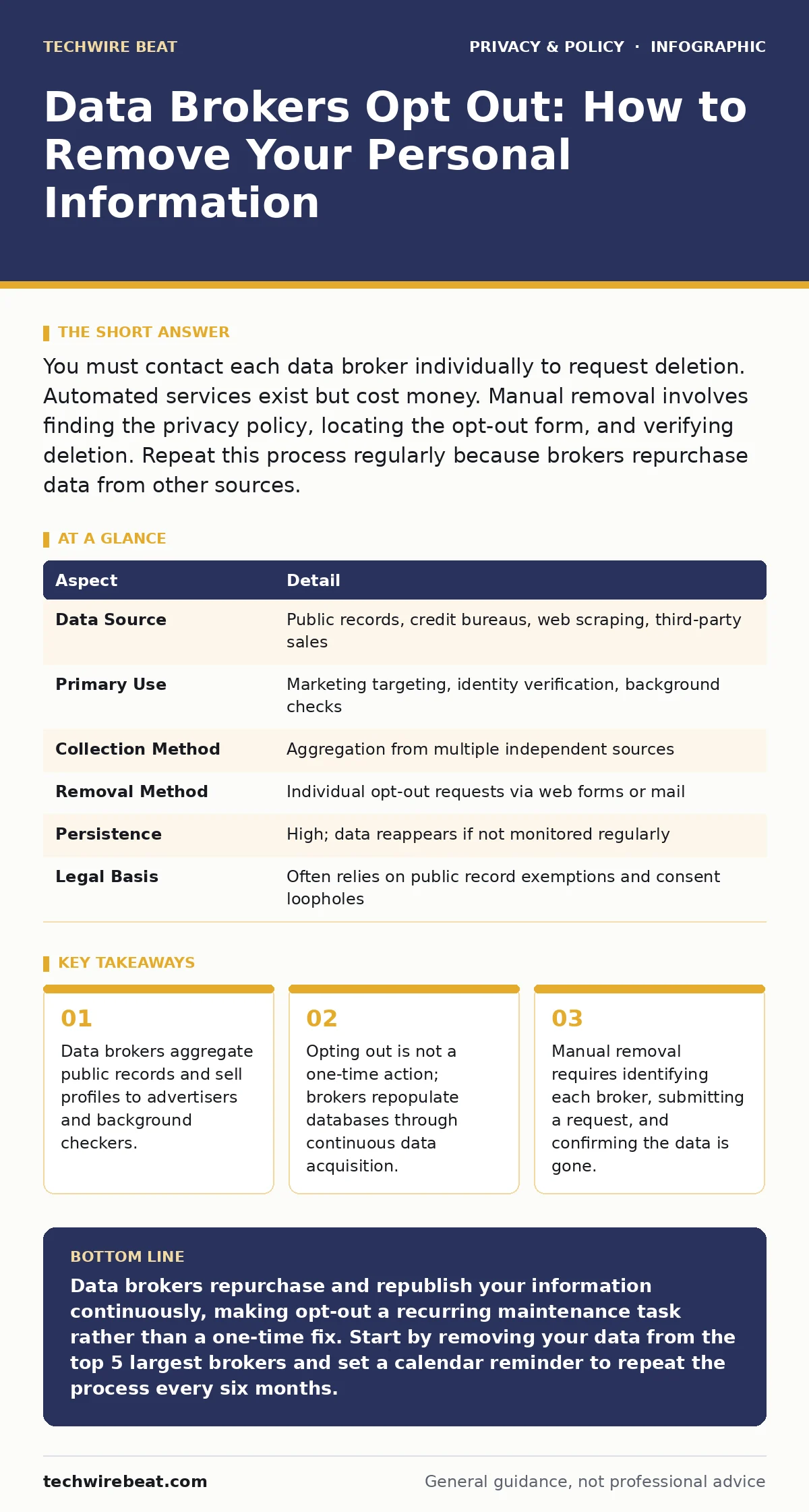
You must contact each data broker individually to request deletion. Automated services exist but cost money. Manual removal involves finding the privacy policy, locating the opt-out form, and verifying deletion. Repeat this process regularly because brokers repurchase data from other sources.
Understanding the Data Broker Ecosystem
Data brokers are companies that collect, aggregate and sell personal information about individuals without their direct knowledge. They do not create data from thin air but compile it from sources you already interact with daily. Imagine a library that does not lend books but instead sells indexes of who borrowed which books, when and from which branch. This analogy captures the essence of the business model: the value lies in the connection of disparate data points.
The brokers purchase data from credit bureaus, public records offices and other data aggregators. They also scrape websites and track online behaviour to enrich these profiles. The resulting dossier includes your name, address history, phone number, email address, family connections and sometimes financial indicators. This information is then sold to marketing firms, insurance companies and background check services.
| Aspect | Detail |
|---|---|
| Data Source | Public records, credit bureaus, web scraping, third-party sales |
| Primary Use | Marketing targeting, identity verification, background checks |
| Collection Method | Aggregation from multiple independent sources |
| Removal Method | Individual opt-out requests via web forms or mail |
| Persistence | High; data reappears if not monitored regularly |
| Legal Basis | Often relies on public record exemptions and consent loopholes |
How Data Aggregation Works in Practice
The mechanism relies on cross-referencing partial information to create a complete identity. A broker might start with a voter registration list that contains your name and address. It then matches this against a credit header file that adds your phone number and previous addresses. Finally, it links this core identity to social media profiles or forum posts found through web scraping.
This process creates a persistent digital footprint that exists independently of your own online accounts. You do not need to have signed up for any service to have a profile. The data exists because you participated in society: you voted, you bought a house, you registered a car. These interactions generate public records that brokers harvest.
The trade-off for this convenience is a loss of control over your personal narrative. Once the data is aggregated, it is difficult to know exactly what is being sold and to whom. The brokers rarely disclose their full client list. This opacity means you are often unaware of the extent of your exposure until you search for yourself online and find detailed profiles.
Who Is Affected by Data Brokerage
Everyone with a public footprint is affected, but certain groups face higher risks. Individuals with common names may find their data mixed with others, leading to inaccurate profiles. Conversely, people with unique identifiers may be singled out more easily. Victims of identity theft or domestic violence are particularly vulnerable because their safety depends on keeping their location and contact details private.
Professionals in high-risk jobs, such as law enforcement or journalism, may also be targeted. Adversaries can use broker data to find addresses, family members and routines. This information facilitates physical stalking, harassment or targeted attacks. The risk is not just about unwanted marketing emails. It is about the potential for real-world harm derived from accessible personal data.
The impact extends to financial privacy as well. Brokers often include data points that indicate wealth, such as property ownership or vehicle types. This information allows for sophisticated profiling that can influence insurance premiums or credit offers. You may find yourself categorised by algorithms you never agreed to and based on data you did not intentionally share.
Why Data Brokers Opt Out Is Difficult
Searching for "data brokers opt out" reveals a fragmented and tedious process. There is no single switch to turn off data collection. Each broker operates independently with its own privacy policy and removal procedure. Some provide online forms, while others require written letters sent via postal mail. This lack of standardisation forces you to become a researcher of your own data.
The difficulty is intentional. Brokers make the process cumbersome to discourage removal. If opting out were easy, their business model would collapse. They rely on the inertia of consumers who give up after a few failed attempts. This is why you will find many services that claim to automate the process. These services charge a fee to handle the repetitive task of contacting brokers on your behalf.
Even after successful removal, the data often returns. Brokers repurchase data from other aggregators. If you remove your data from Broker A, but Broker A sells its list to Broker B, your information reappears in Broker B’s database. This cycle requires continuous monitoring. You cannot set it and forget it.
Step-by-Step Manual Removal Process
- Identify the major data brokers. Start with the largest aggregators that are most likely to hold your information. Search for lists of "people search sites" or "data brokers" to compile a target list.
- Visit each broker’s website. Look for the privacy policy or a dedicated "opt-out" page. These are usually linked in the footer of the website.
- Submit the removal request. Fill out the required form with the exact details as they appear on the site. Some sites require proof of identity to prevent false removals.
- Verify the deletion. Return to the site after a few days or weeks to ensure your profile is gone. If it remains, submit another request or contact customer support.
- Repeat for all identified brokers. Do not skip any. Each site is a separate entity with its own database.
See also: Social Media Privacy Concerns: How Platforms Use Your Data · Data Privacy Principles: How to Protect Your Digital Life
What People Usually Get Wrong
Many believe that deleting their social media accounts stops data brokerage. This is incorrect. Brokers scrape data from public pages and cache it. Even if you delete your account, the snapshot remains in the broker’s database. You must opt out of the broker directly, not just the source platform.
Another common mistake is assuming that privacy laws automatically protect you. While laws like GDPR and CCPA provide some rights, they often have exemptions for public records and certain types of data processing. Compliance is not always enforced, and brokers may ignore requests if they believe they are legally exempt. You must assert your rights actively.
People also underestimate the time required. Removing data from 20 major brokers can take dozens of hours of research and form-filling. This hidden cost is the primary reason many people hire removal services. Understanding this effort helps you decide whether to do it yourself or pay for assistance.
Maintaining Privacy Long-Term
Privacy is a continuous practice, not a one-time fix. You should periodically search for your name online to check for new profiles. Use different search engines and variations of your name. This helps you catch new brokers or re-added data early.
Consider using tools that enhance your digital privacy. For example, end-to-end encryption ensures that your communications remain private, reducing the data available for brokers to scrape. Similarly, using Tor Browser can help you browse without leaving a trace that brokers can follow. These tools do not remove existing data but prevent new data from being collected.
You may also want to conduct regular privacy audits of your online presence. This involves checking which apps have access to your contacts and location. Limiting these permissions reduces the amount of data you inadvertently share. Combining these proactive measures with regular opt-out requests creates a more defensible privacy posture.
Navigating Legal and Technical Limits
No technical solution completely stops data brokerage. The data exists in public records and is legally accessible. Your goal is to reduce exposure, not eliminate it entirely. Understanding this limit prevents frustration when you find your name on a site again.
Some jurisdictions have passed laws requiring brokers to delete data upon request. However, enforcement varies. If a broker ignores your request, you may need to file a complaint with the relevant data protection authority. This step is time-consuming but can be effective for persistent violators.
Remember that privacy laws for small businesses may not apply to large data brokers, who often have dedicated legal teams to navigate exemptions. Knowing the legal landscape helps you set realistic expectations. You are playing a long game of attrition against well-funded entities.
Key takeaways
- Data brokers aggregate public records and sell profiles to advertisers and background checkers.
- Opting out is not a one-time action; brokers repopulate databases through continuous data acquisition.
- Manual removal requires identifying each broker, submitting a request, and confirming the data is gone.
Data brokers repurchase and republish your information continuously, making opt-out a recurring maintenance task rather than a one-time fix. Start by removing your data from the top 5 largest brokers and set a calendar reminder to repeat the process every six months.
Frequently asked questions
Does deleting my social media accounts remove my data from brokers?
No, brokers cache public data and do not automatically delete it when you remove the source. You must opt out of each broker individually.
Are there free ways to remove data from all brokers?
No, manual removal is free but time-consuming. Automated services charge a fee to handle the repetitive process for you.
How often should I check for new data broker profiles?
Check every 6 to 12 months. Data repopulation happens frequently as brokers buy new data sets from other sources.
Can I sue a data broker for having my information?
Generally no, unless they violated specific privacy laws in your jurisdiction. Most operate within legal frameworks that allow data aggregation.
How this guide was produced: written by the TechWire Beat editorial team with AI assistance, checked against the public references listed below, and reviewed when the facts change. See our editorial policy or report an error.