Consent Management Checklist: Verify Your Data Handling Practices
Most consent failures occur not because users click the wrong button, but because systems fail to map which data flows stop when that button is clicked.

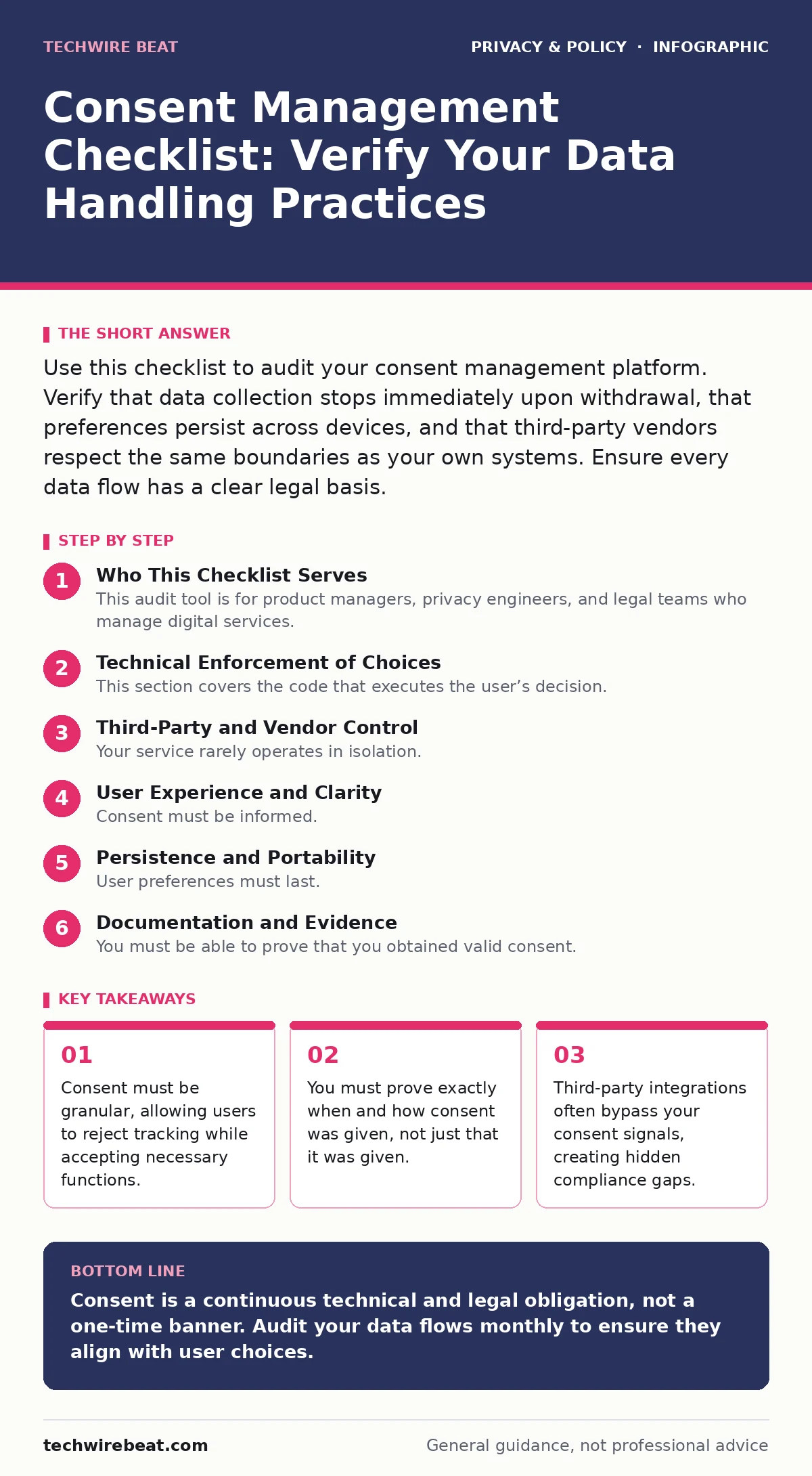
Use this checklist to audit your consent management platform. Verify that data collection stops immediately upon withdrawal, that preferences persist across devices, and that third-party vendors respect the same boundaries as your own systems. Ensure every data flow has a clear legal basis.
Who This Checklist Serves
This audit tool is for product managers, privacy engineers, and legal teams who manage digital services. You use it to verify that your consent management platform (CMP) actually enforces the choices users make. A CMP is the software layer that presents consent banners and records user preferences.
Many teams assume that displaying a banner satisfies their duties. This is incorrect. The banner is only the interface. The real work happens in the background code that reads the user’s choice and blocks or allows data transmission. If the code does not respect the choice, the banner is merely decorative.
Technical Enforcement of Choices
This section covers the code that executes the user’s decision. You must ensure that the technical implementation matches the legal promise.
- Verify script blocking: Confirm that non-essential scripts do not load before consent is granted. This prevents data leakage during the initial page render.
- Check for pre-consent analytics: Ensure no tracking pixels fire during the loading phase. Early firing often happens by accident and is hard to detect.
- Test withdrawal latency: Measure how quickly data collection stops after a user withdraws consent. Immediate cessation is required to avoid processing unauthorized data.
- Validate default states: Confirm that all non-essential categories default to 'opt-out'. Pre-ticked boxes are invalid under most modern privacy frameworks.
- Audit cookie storage: Ensure that consent records are stored securely and are not accessible to third-party scripts. This prevents tampering with user preferences.
Third-Party and Vendor Control
Your service rarely operates in isolation. You likely use analytics, advertising, or mapping services from other companies. These vendors are data processors who must follow your instructions.
- Map vendor data flows: List every third-party service and the specific data it receives. You cannot protect data you do not know exists.
- Verify vendor CMP integration: Confirm that vendors respect the consent signals sent by your platform. Many vendors ignore these signals if not explicitly configured.
- Check for sub-processor leakage: Ensure that vendors do not share data with their own suppliers without additional consent. Data often travels further than you intend.
- Test cross-domain tracking: Verify that user consent applies when they move between your site and vendor domains. Domain boundaries often break consent continuity.
- Review vendor contract clauses: Ensure your contracts explicitly state that vendors must stop processing upon consent withdrawal. Legal terms must match technical reality.
For deeper context on how external services interact with your data, see our guide on data privacy. Understanding the broader framework helps you negotiate better terms with vendors.
User Experience and Clarity
Consent must be informed. If users cannot understand what they are agreeing to, their consent is not valid. The interface must be clear, concise, and accessible.
- Simplify consent text: Use plain language to describe data purposes. Legal jargon confuses users and leads to random clicking.
- Ensure equal ease for rejection: The 'Reject' button must be as easy to find and click as the 'Accept' button. Dark patterns that hide rejection options are illegal.
- Provide granular choices: Allow users to accept necessary cookies while rejecting marketing ones. Bundled consent is often considered invalid.
- Test mobile accessibility: Verify that consent interfaces work correctly on small screens. Poor mobile UX leads to accidental consent.
- Offer a privacy dashboard: Provide a persistent link where users can change their minds later. Consent is not a one-time event.
Persistence and Portability
User preferences must last. If a user clears their cookies or switches devices, their consent history should remain intact where possible. This reduces friction and respects their ongoing choice.
- Implement consent portability: Use standard protocols to share consent preferences across devices. This allows users to maintain their choices without re-entering them.
- Verify session consistency: Ensure that consent state does not reset during a single browsing session. Inconsistent state leads to mixed data collection.
- Check long-term storage: Ensure consent records are stored for the required legal retention period. You must prove past consent if challenged later.
- Test refresh scenarios: Confirm that consent banners reappear when preferences change or after a long break. Stale consent is not valid consent.
- Audit data deletion: Ensure that withdrawing consent triggers the deletion of previously collected data where required. Withdrawing consent is not just about the future.
See also: Social Media Privacy Concerns: How Platforms Use Your Data · Data Privacy Principles: How to Protect Your Digital Life
Documentation and Evidence
You must be able to prove that you obtained valid consent. This requires detailed logs and clear documentation.
- Log consent timestamps: Record the exact date and time of each consent action. Timestamps are critical for legal defence.
- Store versioned consent texts: Keep a copy of the privacy notice shown at the time of consent. The text may change, but the original promise stands.
- Document IP addresses: Store anonymised or pseudonymised IP addresses linked to consent records. This helps verify the identity of the user.
- Create a data map: Maintain an up-to-date map of all data flows and their legal bases. This is the foundation of your privacy programme.
- Schedule regular audits: Review your consent mechanisms every six months. Technology changes, and so do compliance requirements.
For a broader look at how to assess your overall security posture, refer to our privacy audits guide. Regular audits catch issues that automated tools miss.
Hidden Costs and Edge Cases
There are non-obvious consequences to how you handle consent. One hidden cost is the performance impact of blocking scripts. If your CMP is poorly configured, it can slow down page loads, hurting user experience and conversion rates.
Another edge case is the conflict between consent and legal obligations. Some data collection is required by law, such as fraud prevention. You must clearly distinguish between consensual data and legally mandated data. Mixing these categories can invalidate the entire consent process.
Understanding how data moves across networks is also relevant here. See our secure DNS guide for more on how infrastructure choices impact privacy. Additionally, reducing your digital footprint can help you understand what data is exposed even with consent in place.
Key takeaways
- Consent must be granular, allowing users to reject tracking while accepting necessary functions.
- You must prove exactly when and how consent was given, not just that it was given.
- Third-party integrations often bypass your consent signals, creating hidden compliance gaps.
Consent is a continuous technical and legal obligation, not a one-time banner. Audit your data flows monthly to ensure they align with user choices.
Frequently asked questions
Do I need consent for first-party analytics?
It depends on your jurisdiction. In some regions, first-party analytics are considered necessary for service improvement and do not require consent. In others, they do. Check local laws.
How long must I keep consent records?
You must keep them for as long as the data is processed, plus the statutory limitation period for legal claims. This ensures you can prove consent if challenged.
Can I use implied consent?
No. Explicit, unambiguous action is required. Silence, pre-ticked boxes, or continued browsing do not constitute valid consent for most data types.
What happens if a user withdraws consent?
You must stop processing their data for that purpose immediately. You must also delete the data if you have no other legal basis to keep it.
How this guide was produced: written by the TechWire Beat editorial team with AI assistance, checked against the public references listed below, and reviewed when the facts change. See our editorial policy or report an error.