How Data Privacy Works: The Hidden Lifecycle of Your Information
Personal data does not simply sit in a database; it moves through processing stages where each handoff creates new exposure risks you can interrupt.

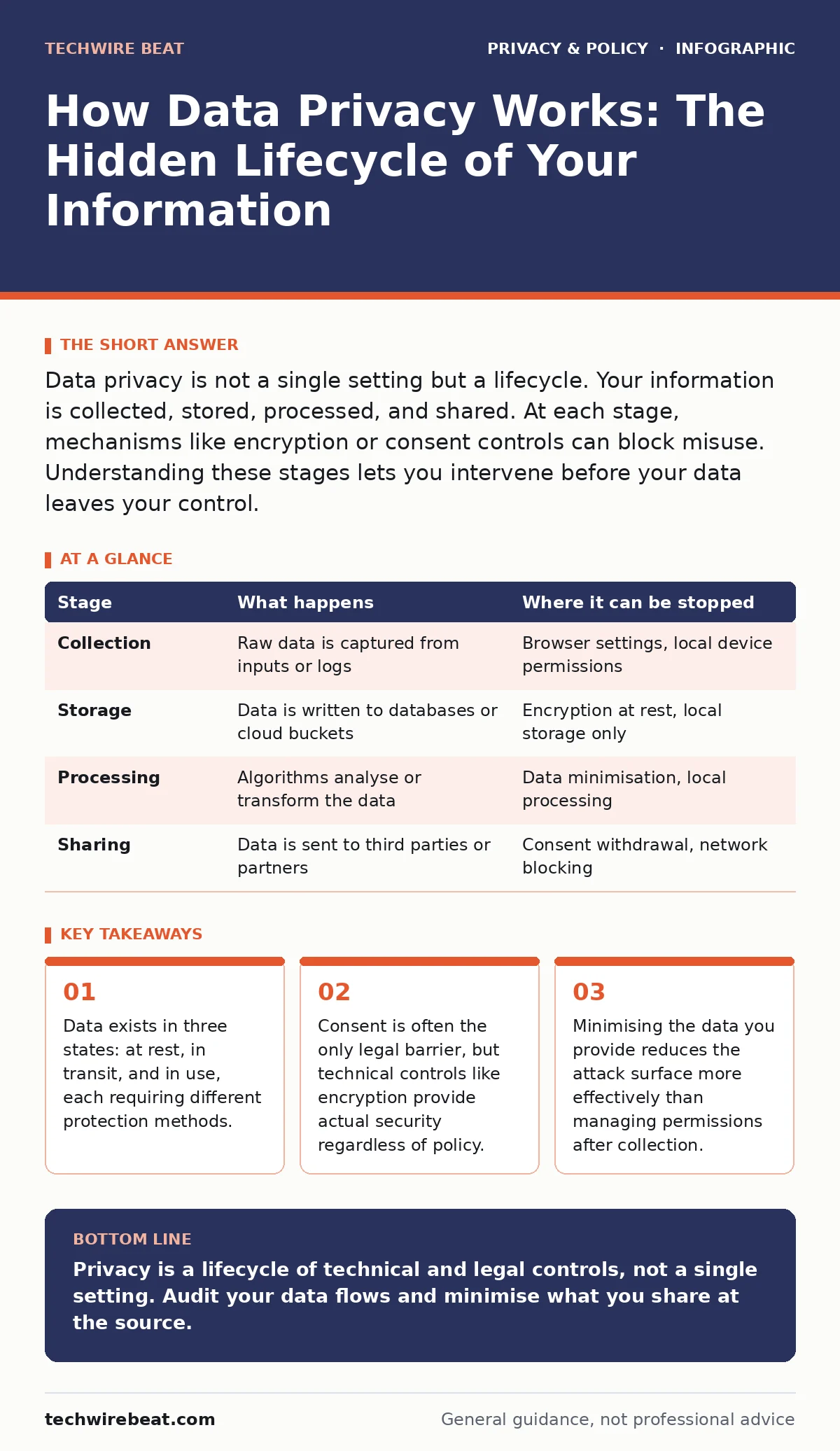
Data privacy is not a single setting but a lifecycle. Your information is collected, stored, processed, and shared. At each stage, mechanisms like encryption or consent controls can block misuse. Understanding these stages lets you intervene before your data leaves your control.
The Illusion of Static Storage
Many users imagine their personal information sitting quietly in a company’s server, like a letter in a drawer. This mental model is incorrect. Data is dynamic. It moves constantly between systems, is copied for backups, and is often processed by algorithms that never "see" the original format. This movement creates multiple points of failure. If you believe privacy is about hiding data in one place, you will overlook the risks inherent in its journey.
Stage 1: Collection and Ingestion
The lifecycle begins when you interact with a service. This is not limited to forms you fill out. It includes metadata generated by your device, such as screen resolution, battery level, and network type. This passive collection happens automatically. The system records what you do, not just what you say.
Imagine you visit a news site. The browser sends a request. That request contains headers with your IP address and user agent string. This data is collected before you even read an article. The cost of this stage is often invisible. You trade detailed behavioural signals for access to content. This trade-off is rarely explicit.
Stage 1: What You Can Control
You can limit passive collection by using tools that block trackers. This relates to the mechanics of ad blockers, which prevent scripts from executing. However, blocking ads does not stop the site from logging your visit. It only stops third-party companies from seeing it. The site operator still holds the data.
| Stage | What happens | Where it can be stopped |
|---|---|---|
| Collection | Raw data is captured from inputs or logs | Browser settings, local device permissions |
| Storage | Data is written to databases or cloud buckets | Encryption at rest, local storage only |
| Processing | Algorithms analyse or transform the data | Data minimisation, local processing |
| Sharing | Data is sent to third parties or partners | Consent withdrawal, network blocking |
Stage 2: Storage and Persistence
Once collected, data must be stored. This is where the concept of "data at rest" applies. If an attacker gains access to the server, they can read everything unless it is encrypted. Encryption transforms data into unreadable code without the correct key. This is a technical barrier, not a policy one.
Many services store more data than they need. This is known as data hoarding. The hidden cost is liability. If a company keeps your email address for ten years after you leave, it must protect that address for ten years. This increases the chance of a breach. You can mitigate this by requesting data deletion, but the burden of proof is on you.
Stage 3: Processing and Analysis
Storage is passive. Processing is active. This stage involves reading the data to derive value. This might mean calculating your average speed, training a machine learning model, or matching your profile to an advertising category. The risk here is inference. An algorithm might deduce sensitive information you never provided, such as health conditions or political leanings, based on non-sensitive data.
This is where privacy audits become relevant. Audits check whether the processing matches the stated purpose. If a weather app processes your location history to target real estate ads, it has exceeded its purpose. This is a policy violation, but technically, the data was processed correctly. The failure is in the intent, not the code.
Stage 4: Transmission and Sharing
Data often needs to move between systems. This is "data in transit". A common failure point is the lack of encryption during transfer. Secure DNS helps by ensuring that the address lookup itself is not intercepted. However, once the connection is established, the data payload must be protected by protocols like TLS.
Imagine a company shares your data with a partner for analytics. The partner receives a copy. You now have two points of failure. If the partner’s security is weaker, your data is exposed. This is the principle of weakest link. You cannot control the partner’s security, only the transfer mechanism.
See also: Social Media Privacy Concerns: How Platforms Use Your Data · Data Privacy Principles: How to Protect Your Digital Life
The Limits of Consent
Consent management platforms allow you to accept or reject cookies. This is a legal mechanism, not a technical one. Clicking "Accept" does not encrypt your data. It does not prevent the site from logging your IP address. It simply gives the company legal permission to process your data under certain regulations.
This creates a false sense of security. Users believe that managing consent controls their privacy. In reality, it only controls the legal relationship. The technical exposure remains unchanged. To truly reduce risk, you must reduce the data flow itself. This is where end-to-end encryption shines. It ensures that only you and the recipient can read the message, bypassing the platform’s ability to process the content.
Practical Application and Edge Cases
You can apply this understanding by auditing your digital footprint. Start with mobile app permission abuse. Check which apps access your microphone or contacts. Revoke permissions for apps that do not need them. This stops data at the collection stage.
Consider smart home privacy risks. Devices in your home collect ambient data. Even if you do not speak to them, they may process audio snippets. The edge case here is local processing. Some devices process commands locally, never sending audio to the cloud. This is significantly safer than cloud-based processing.
Another edge case is people-search sites. These aggregates data from public records and social media. You did not consent to this collection directly. The data was scraped from other sources. Deleting your data from one site does not remove it from others. This requires persistent effort.
The Role of Technical Controls
Policy tells you what should happen. Technology ensures it does. Without encryption, consent is meaningless. A company can promise not to read your data, but if the database is unencrypted, any employee or attacker can read it. Technical controls are the only reliable barrier.
Secure DNS prevents attackers from redirecting your traffic to fake sites. Ad blockers prevent tracking scripts from running. These are technical interventions. They work regardless of the company’s privacy policy. Relying solely on policy is risky. Policies change. Technical controls remain until explicitly removed.
Minimising the Attack Surface
The most effective privacy strategy is minimisation. If you do not provide the data, it cannot be stolen or misused. This is harder than it sounds. Many services require excessive data for basic functionality. You must decide what is essential.
For example, a weather app does not need your contact list. A calculator does not need your location. By denying these permissions, you stop the data lifecycle at stage one. This is more effective than trying to secure the data after it has been collected. It reduces the total amount of sensitive information in the wild.
The Reality of Anonymisation
Companies often claim to anonymise data. This means removing identifiers like names and email addresses. However, re-identification is often possible. By combining anonymised datasets, analysts can often link data back to individuals. This is known as the mosaic effect.
Imagine two datasets: one with your purchase history and another with your location. Neither contains your name. But if you bought a rare item at a specific store, the combination reveals your identity. True anonymity is difficult to achieve. It requires rigorous statistical techniques, not just the removal of names.
Key takeaways
- Data exists in three states: at rest, in transit, and in use, each requiring different protection methods.
- Consent is often the only legal barrier, but technical controls like encryption provide actual security regardless of policy.
- Minimising the data you provide reduces the attack surface more effectively than managing permissions after collection.
Privacy is a lifecycle of technical and legal controls, not a single setting. Audit your data flows and minimise what you share at the source.
Frequently asked questions
Does deleting my account remove all my data?
No. Companies often retain backups or anonymised data for legal compliance or analytics. You must check their retention policy to understand what persists.
Is end-to-end encryption enough for privacy?
It protects the content of messages in transit. It does not protect metadata, such as who you talk to or when, nor does it protect data stored on your devices.
How do I know if an app is misusing my data?
Check for permissions that do not match the app’s function. If a flashlight app requests access to your contacts, it is likely collecting data for other purposes.
Can I stop companies from sharing my data?
You can often opt out of sharing for marketing purposes. However, sharing for core functionality or legal requirements may not be optional.
How this guide was produced: written by the TechWire Beat editorial team with AI assistance, checked against the public references listed below, and reviewed when the facts change. See our editorial policy or report an error.