Why Personally Identifiable Information Defines Your Security Perimeter
Treating all data as equally sensitive creates blind spots, whereas mapping personally identifiable information reveals the true attack surface and dictates response speed.

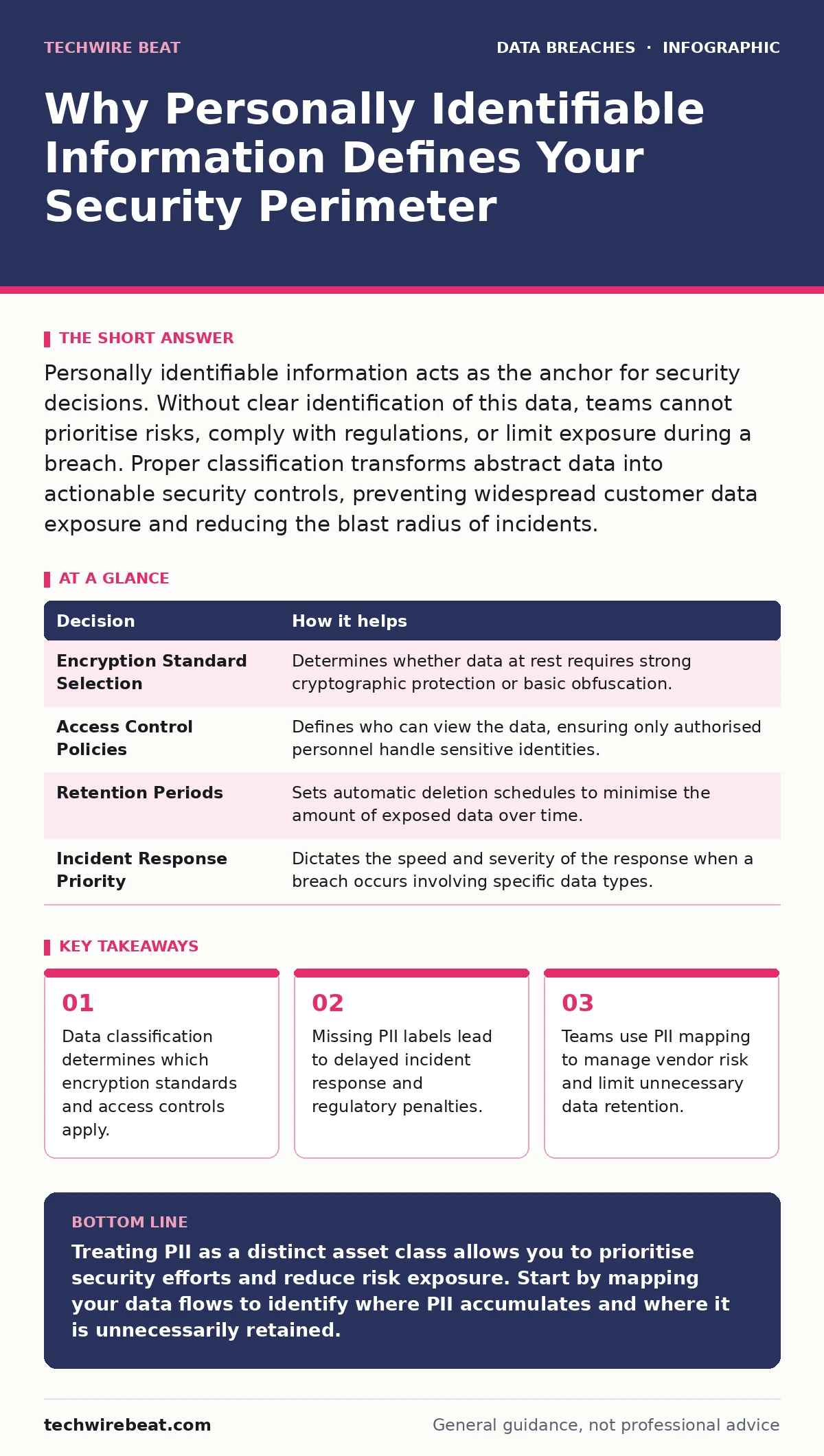
Personally identifiable information acts as the anchor for security decisions. Without clear identification of this data, teams cannot prioritise risks, comply with regulations, or limit exposure during a breach. Proper classification transforms abstract data into actionable security controls, preventing widespread customer data exposure and reducing the blast radius of incidents.
The Anchor of Security Strategy
Security is not about protecting every byte of data with equal intensity. That approach wastes resources and creates alert fatigue. Instead, you must identify which data elements carry the highest risk if compromised. Personally identifiable information, or PII, serves as that anchor. PII refers to any data that can identify a specific individual, such as names, addresses, or identification numbers.
When you label data correctly, you create a hierarchy of protection. High-value PII receives strict access controls and monitoring. Low-value operational data receives standard protections. This distinction allows your security team to focus on what actually matters. Without this distinction, you treat server logs with the same caution as patient records, diluting your defensive efforts.
Decisions Driven by Data Labels
Every security control you implement stems from a decision about data value. You cannot choose the right encryption method if you do not know what is inside the file. You cannot set appropriate retention periods if you do not know who the data belongs to. These decisions inform your architecture, your budget, and your incident response plans.
The table below illustrates how PII identification drives specific technical and operational choices.
| Decision | How it helps |
|---|---|
| Encryption Standard Selection | Determines whether data at rest requires strong cryptographic protection or basic obfuscation. |
| Access Control Policies | Defines who can view the data, ensuring only authorised personnel handle sensitive identities. |
| Retention Periods | Sets automatic deletion schedules to minimise the amount of exposed data over time. |
| Incident Response Priority | Dictates the speed and severity of the response when a breach occurs involving specific data types. |
The Cost of Ambiguity
Imagine a team that treats all database entries as generic records. They store customer names alongside session tokens and internal comments. When a misconfiguration exposes the database, the team does not know what was lost. They cannot notify affected users because they cannot isolate the personal data from the noise. This ambiguity turns a manageable incident into a crisis.
This scenario often leads to broader customer data exposure. Because the team cannot prove what was accessed, they must assume the worst case. They notify everyone, damage their reputation, and face regulatory scrutiny. The lack of clear PII boundaries forces them to over-communicate and under-act. Precision in data handling prevents this cascade of errors.
How Teams Use PII Mapping
Teams use PII mapping to visualise data flow. This process involves tracking how personal data moves from entry points, such as web forms, through processing systems, to storage locations. By mapping this flow, you identify where data accumulates unnecessarily. You might find that development environments contain copies of production PII, creating an unnecessary risk vector.
This mapping also supports vendor risk management. When you share data with third parties, you need to know exactly what you are sending. If you send PII to a cloud provider without clear contracts and technical safeguards, you expand your liability. Mapping ensures you only send what is necessary and that the recipient handles it correctly. It turns vague trust into verified security.
The Hidden Cost of Over-Collection
Many organisations collect more data than they need. They assume that having more information will improve services or analytics. This habit increases the attack surface. Every additional field of PII stored is another potential target for attackers. It also complicates deletion requests and compliance audits.
You should practice data minimisation. Collect only the PII required for the immediate transaction. If you do not need a date of birth to process a payment, do not ask for it. This reduces the value of your database to attackers. It also simplifies your security posture. Less data means fewer things to protect and fewer things to lose. This principle aligns with the goal of preventing medical identity theft or tax identity theft, where even small amounts of data can cause significant harm.
See also: Social Media Privacy Concerns: How Platforms Use Your Data · Data Privacy Principles: How to Protect Your Digital Life
Integrating with Broader Security Frameworks
PII management does not exist in isolation. It connects to other security domains. For instance, understanding where PII resides helps you implement effective encryption in transit. You know which connections carry sensitive data and require stronger protocols. It also informs how you handle leaked source code, as repositories often contain hardcoded credentials or sample data that includes PII.
Furthermore, PII classification is central to breach notification laws. These laws require you to report incidents within specific timeframes if PII is exposed. Without real-time visibility into your PII, you cannot meet these deadlines. You might fail to report a breach because you did not realise PII was involved. This delay can result in severe legal and financial consequences. Proactive identification ensures you are ready to respond immediately.
Building a Culture of Data Awareness
Technology alone cannot solve PII management. You need a culture that values data privacy. Developers must understand that adding a new field to a database has security implications. Analysts must know that exporting data requires justification. Regular training reinforces these concepts. It ensures that everyone from engineering to marketing understands the value of PII.
This cultural shift reduces accidental exposure. It encourages employees to question why they need access to certain data. It promotes the use of privacy-enhancing technologies by design. When PII protection becomes a shared responsibility, security becomes more resilient. You move from reactive patching to proactive prevention. This mindset is critical for long-term security success.
Key takeaways
- Data classification determines which encryption standards and access controls apply.
- Missing PII labels lead to delayed incident response and regulatory penalties.
- Teams use PII mapping to manage vendor risk and limit unnecessary data retention.
Treating PII as a distinct asset class allows you to prioritise security efforts and reduce risk exposure. Start by mapping your data flows to identify where PII accumulates and where it is unnecessarily retained.
Frequently asked questions
What is the difference between PII and PHI?
PII refers to any data that identifies an individual, while PHI specifically refers to health-related information. PHI is a subset of PII and is subject to stricter regulations in many jurisdictions.
How do I anonymise data effectively?
Effective anonymisation involves removing direct identifiers and altering quasi-identifiers so that individuals cannot be re-identified. This often requires statistical techniques to ensure the remaining data does not allow for unique identification.
Does encryption protect PII at rest?
Yes, encryption protects PII at rest by rendering it unreadable without the correct key. However, you must also manage the keys securely, as compromised keys can expose the encrypted data.
How often should I review my PII inventory?
You should review your PII inventory whenever you launch new features, change data storage methods, or update privacy policies. Regular reviews ensure that your security controls match your current data landscape.
How this guide was produced: written by the TechWire Beat editorial team with AI assistance, checked against the public references listed below, and reviewed when the facts change. See our editorial policy or report an error.