Medical Identity Theft: How Fraudsters Hijack Your Health Records
Medical identity theft hides longer than financial fraud, causing delayed diagnosis and erroneous treatments that can endanger your life before you notice the theft.

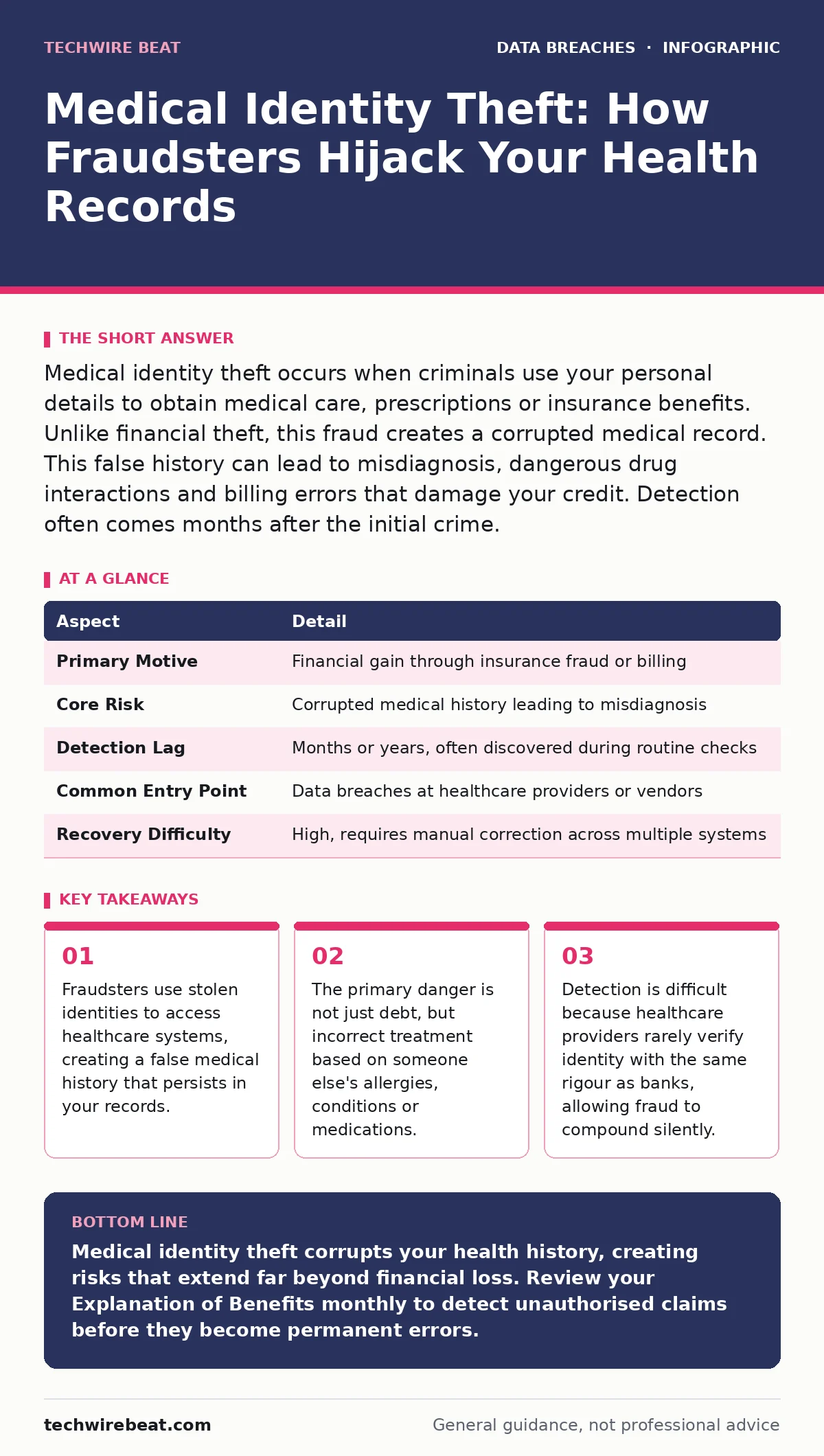
Medical identity theft occurs when criminals use your personal details to obtain medical care, prescriptions or insurance benefits. Unlike financial theft, this fraud creates a corrupted medical record. This false history can lead to misdiagnosis, dangerous drug interactions and billing errors that damage your credit. Detection often comes months after the initial crime.
The Silent Infection in Your Digital Health Record
Imagine you return from a holiday to find your bank account drained. You freeze the cards, dispute the charges and move on. Now imagine that same theft happened, but instead of money, someone used your name to buy insulin, claim surgery and register a blood type. You do not see a bank statement error. You see a new allergy listed in your file. When you eventually need care, the system warns you are allergic to a life-saving drug.
This is medical identity theft. It is the unauthorised use of personally identifiable information to obtain healthcare services, medical equipment or pharmaceuticals. The thief does not always want the treatment itself. They want the money the treatment generates. They use your identity to submit claims to insurers, leaving you with the bill or a corrupted health history.
Unlike financial fraud, which triggers immediate alerts from banks, medical theft is slow. Healthcare systems are complex and fragmented. A single error in one hospital’s database can propagate to others. By the time you notice an unusual charge, the fraudulent data may have been integrated into your permanent medical record.
| Aspect | Detail |
|---|---|
| Primary Motive | Financial gain through insurance fraud or billing |
| Core Risk | Corrupted medical history leading to misdiagnosis |
| Detection Lag | Months or years, often discovered during routine checks |
| Common Entry Point | Data breaches at healthcare providers or vendors |
| Recovery Difficulty | High, requires manual correction across multiple systems |
How the Hijack Happens
The theft usually begins with the acquisition of your data. Criminals do not need to hack a hospital mainframe directly. They often purchase your details from underground markets where data breaches have already occurred. A leak from a small clinic, a pharmacy or a third-party vendor is enough. Once they have your name, date of birth and insurance number, they can impersonate you.
Suppose a fraudster obtains your details from a leaked database. They approach a walk-in clinic or a prescription mill, presenting your insurance card or details. The staff, overwhelmed and trusting the insurance verification, provide the service. The claim is filed. You never visit the clinic, but the system now believes you did. The fraudster sells the medication on the black market or keeps the cash payment from a vulnerable insurer.
This process relies on weak identity verification. Many healthcare providers check an insurance card but do not verify the person holding it against a photo ID or biometric data. This gap allows the fraud to proceed. The stolen identity is often used for high-cost procedures, expensive medications or frequent visits to generate volume.
The Hidden Cost of Corrupted Records
The financial damage is obvious, but the clinical risk is far more dangerous. When a fraudster uses your identity, the medical provider records their findings under your name. If the thief has a rare disease, a specific allergy or a different blood type, that information becomes part of your profile.
Imagine you go to the emergency room after an accident. The nurse checks your history and sees a record of a severe penicillin allergy. You receive an alternative antibiotic. Later, you discover you were never allergic to penicillin. The allergy was recorded during a fraudulent visit. In a future emergency, you might be denied a standard treatment because of this false record.
This contamination of data affects decision-making at every level. Doctors rely on past history to diagnose current issues. If your record shows a history of diabetes that does not exist, they may misinterpret your symptoms. The error is not just a billing dispute; it is a potential threat to your physical health. Correcting this requires contacting every provider who accessed the tainted data, a process that can take years.
Who Is Most Vulnerable
Anyone with an insurance number or national ID is a target, but certain groups face higher risks. Children are particularly vulnerable. Their identities are clean, with no credit history to monitor. Parents often do not check children’s medical bills or Explanation of Benefits statements. A child’s identity can be used for years before anyone notices the irregularities.
Elderly individuals are also frequent targets. They may have complex medical histories that are easier to blend into, and they might not review their mail or digital statements as frequently. People with chronic conditions are attractive to fraudsters because they generate regular, predictable claims. The fraudster can mimic the pattern of a legitimate patient, making the theft harder to detect.
Those who receive care at multiple facilities are at greater risk due to data fragmentation. When information is siloed across different systems, inconsistencies are less likely to trigger automated alerts. The lack of a unified, real-time verification system across the entire healthcare sector leaves gaps that criminals exploit.
Common Forms of Medical Fraud
Medical identity theft manifests in several ways. One common form is drug diversion. The thief uses your identity to obtain controlled substances, such as opioids or stimulants, which are then sold. Another form is service fraud. The criminal claims they underwent expensive surgeries, lab tests or imaging procedures that never happened.
There is also "doctor shopping" fraud. The thief visits multiple providers using your identity to obtain overlapping prescriptions. This avoids the safeguards that single clinics might have. Additionally, criminals may use your identity to apply for medical loans or credit for equipment. This blends medical theft with financial fraud, compounding the damage.
In some cases, the thief is a co-worker or family member with access to your physical insurance cards or documents. Insider threats are significant because they bypass external security measures. They already have the credentials needed to access the system, making detection even more difficult.
See also: Password Hygiene Explained: Stop Reusing Keys to Secure Your Digital Life · Credential Dumps Explained: How Stolen Passwords Work
What People Usually Get Wrong
Many people believe that monitoring their bank account is sufficient. They check their financial statements monthly but ignore their medical bills. This is a critical error. Medical billing is complex, with terms like Explanation of Benefits and remittance advice that are often overlooked. Fraud hides in these documents, not in your bank feed.
Another misconception is that hospitals verify identity rigorously. In reality, the priority in healthcare is often speed and patient throughput. Verification steps are minimal compared to banking or aviation. You cannot assume that a clinic has checked your identity thoroughly. The burden of verification often falls on the patient.
Reducing Your Exposure
You must treat your medical records with the same scrutiny as your financial accounts. Request your Explanation of Benefits from your insurer every month, even if you did not receive care. Review every line item. Look for treatments, medications or visits you do not recognise. Dispute any error immediately.
Secure your physical documents. Shred insurance cards and medical bills before discarding them. Do not carry your insurance card in your wallet unless you are visiting a provider. Use a digital copy stored in a secure, encrypted app instead. This reduces the risk of theft if your wallet is lost.
Be cautious with how you share information. Healthcare providers often store your data on systems that may be vulnerable to data breaches or customer data exposure. Understand how your data is stored and shared. If a provider suggests a cloud-based portal, ensure they use encryption in transit to protect your data while it moves between systems.
Regularly check your credit report as well. Some medical debts are reported to credit bureaus. An unusual medical collection account can be an early warning sign of identity theft. If you suspect your identity has been compromised, place a fraud alert or freeze on your credit file. This does not stop medical fraud directly, but it prevents the thief from opening new lines of credit using your identity.
Engage in vendor risk management by choosing healthcare providers who demonstrate strong security practices. While you cannot control their internal systems, you can prefer organisations that publish their security standards and breach response plans. This encourages a culture of security across the industry.
The Path to Recovery
If you discover medical identity theft, act quickly. Contact your insurer and report the fraudulent claims. Request a copy of your complete medical record from any provider involved. Review it for errors. File a police report to create an official record of the crime.
Then, begin the arduous process of correction. You must contact every provider who accessed your tainted data. Request that they remove the fraudulent entries from their records. This may involve submitting proof of your identity and the police report. The process is manual and slow. There is no central "undo" button for medical data.
Consider placing a security freeze on your credit to prevent further financial exploitation. Monitor your accounts for several years. The theft may have created multiple aliases or variations of your identity that continue to generate fraud. Vigilance is the only tool you have to restore the integrity of your digital health profile.
Key takeaways
- Fraudsters use stolen identities to access healthcare systems, creating a false medical history that persists in your records.
- The primary danger is not just debt, but incorrect treatment based on someone else's allergies, conditions or medications.
- Detection is difficult because healthcare providers rarely verify identity with the same rigour as banks, allowing fraud to compound silently.
- Regular review of Explanation of Benefits documents is the most effective way to spot unauthorised medical activity early.
Medical identity theft corrupts your health history, creating risks that extend far beyond financial loss. Review your Explanation of Benefits monthly to detect unauthorised claims before they become permanent errors.
Frequently asked questions
How long can medical identity theft go undetected?
It can remain hidden for months or even years, as victims often do not review medical billing statements closely. Detection usually occurs when a bill arrives or during a routine medical visit.
Does health insurance cover the costs of identity theft recovery?
No, insurance typically covers the fraudulent medical services if they are deemed valid claims, but it does not cover the administrative costs of correcting your records or disputing bills.
Can medical identity theft affect my employment?
Yes, if your employer-sponsored insurance is used fraudulently, it may trigger internal audits. Additionally, false medical records could impact fitness-for-duty assessments or disability claims.
How is medical identity theft different from tax identity theft?
Tax identity theft uses your data to file fraudulent returns for immediate cash refunds. Medical theft uses your data to obtain services or drugs, creating long-term data corruption and billing issues.
How this guide was produced: written by the TechWire Beat editorial team with AI assistance, checked against the public references listed below, and reviewed when the facts change. See our editorial policy or report an error.