Stop Tax Identity Theft: The Controls That Actually Work
Freezing your credit file blocks new account openings but leaves existing financial data exposed to fraudsters who exploit dormant relationships.

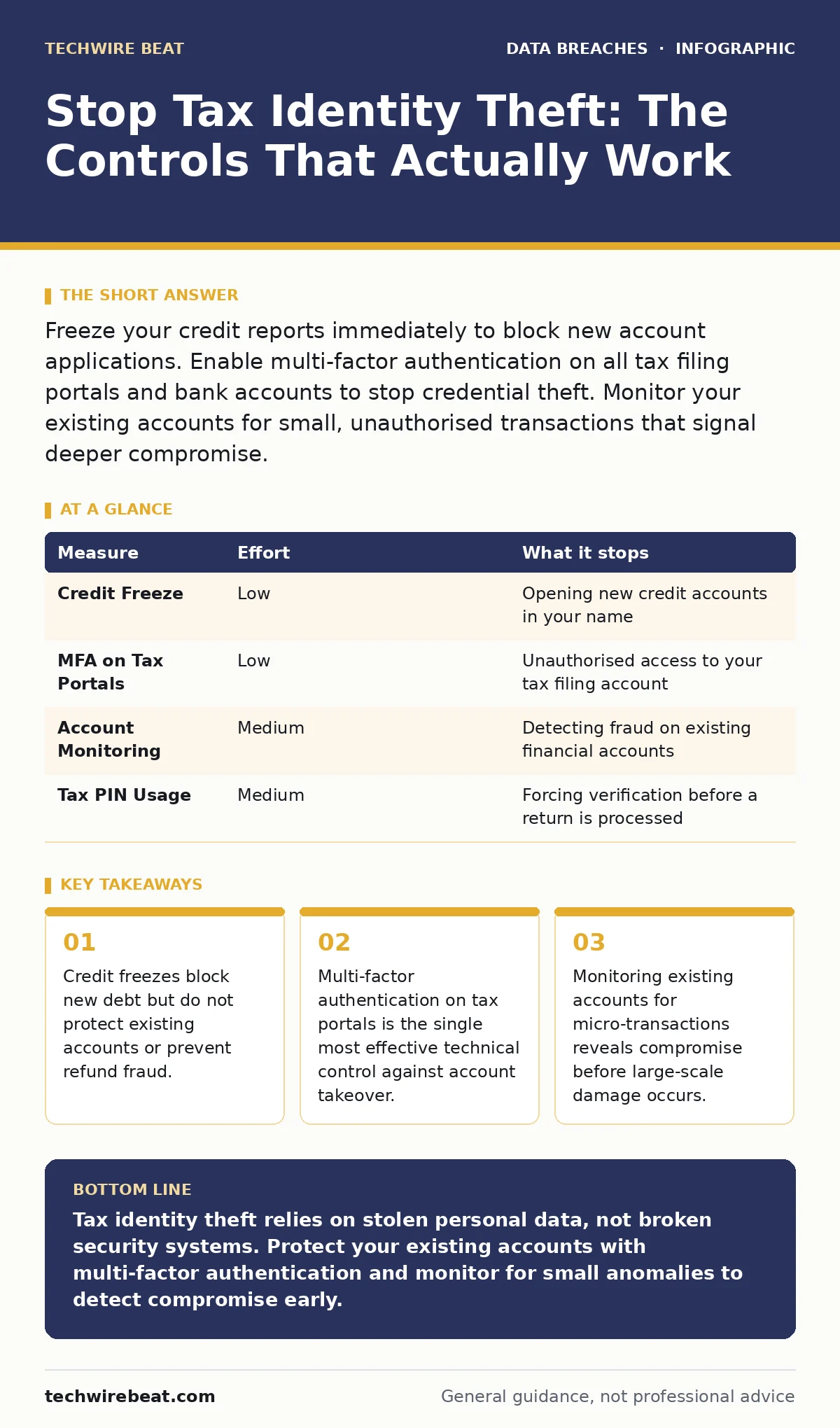
Freeze your credit reports immediately to block new account applications. Enable multi-factor authentication on all tax filing portals and bank accounts to stop credential theft. Monitor your existing accounts for small, unauthorised transactions that signal deeper compromise.
The Mechanics of Tax Identity Theft
Tax identity theft occurs when a fraudster uses your personal details to file a false tax return. The goal is usually to intercept a government refund or claim a credit that belongs to you. Attackers do not need to break into secure government servers. They only need your name, date of birth, and taxpayer identification number. This information is widely available through data breaches, phishing campaigns, and physical mail theft. The attacker files the return before you do. When you attempt to file, the system rejects your submission because a return has already been processed under your identity. By the time you realise the error, the attacker has often already collected the funds.
Why Credit Freezes Are Not Enough
A credit freeze restricts access to your credit report. This prevents lenders from checking your history, which stops attackers from opening new credit cards or loans in your name. This is a powerful tool, but it has a blind spot. Tax identity theft does not require a credit check. The tax authority verifies identity using personal details, not credit history. Therefore, a credit freeze does nothing to stop someone from filing a fake return using your existing identity. It is a shield against new debt, not against impersonation. You must treat credit freezes as one layer of defence, not the entire strategy.
| Measure | Effort | What it stops |
|---|---|---|
| Credit Freeze | Low | Opening new credit accounts in your name |
| MFA on Tax Portals | Low | Unauthorised access to your tax filing account |
| Account Monitoring | Medium | Detecting fraud on existing financial accounts |
| Tax PIN Usage | Medium | Forcing verification before a return is processed |
Multi-Factor Authentication as a Gatekeeper
Multi-factor authentication requires two forms of verification to access an account. Typically, this combines something you know, like a password, with something you have, like a mobile device. Without MFA, a stolen password is enough for an attacker to log in and file a return. With MFA, the attacker needs physical access to your phone or authentication app. This breaks the chain of attack for most remote criminals. Enable MFA on your tax filing portal, your email account, and your banking platforms. Email is particularly critical because it is the primary channel for password resets. If an attacker controls your email, they can bypass other security measures.
The Hidden Cost of Convenience
Many tax software providers offer "auto-fill" features that store your personal and financial data for future use. This convenience creates a high-value target. If the software vendor suffers a data breach, your stored information is exposed in plain text or weakly encrypted formats. This is a classic example of customer data exposure.
The risk is not just the current year’s data but a historical archive of your financial life. To mitigate this, use software that does not store sensitive data on their servers after processing. If the software requires storage, ensure the account is protected by MFA and a unique password that you do not use elsewhere. Consider the trade-off between speed and the accumulation of sensitive data in third-party systems.
Monitoring Existing Accounts for Micro-Fraud
Attackers often test stolen credentials with small, unnoticeable transactions before making large withdrawals. This is known as account testing. If you wait for large discrepancies, the damage is often irreversible. Instead, monitor your bank and credit card statements for small charges, such as a one-dollar purchase or a subscription renewal you do not recognise.
These micro-transactions are early warning signs. They indicate that your credentials have been compromised and are being probed. Set up real-time alerts for any transaction over a minimal threshold. This shifts your detection method from reactive review to proactive alerting. It also applies to your tax account. Log in periodically to check for activity you did not initiate.
See also: Bring Your Own Device: Real Benefits and Hidden Costs
What Does Not Work
Changing your password frequently is less effective than using a strong, unique password with MFA. Frequent changes lead to weaker passwords as users seek memorability. Similarly, ignoring unsolicited emails about tax refunds is not enough. Phishing emails become increasingly sophisticated, mimicking the exact branding and language of tax authorities.
The only reliable defence is to never click links in unsolicited emails. Instead, navigate directly to the tax authority’s website by typing the address manually. Also, be wary of advice suggesting you can "block" your identity from the tax system. You cannot opt out of being a taxpayer, but you can control access to your filing account.
Leveraging Tax PINs
Some tax authorities offer a taxpayer identification PIN. This is a six-digit code you choose when filing your return. The tax authority will only process the return if it includes this PIN. This adds a significant barrier for attackers who have stolen your name and identification number but not your PIN. It forces the attacker to obtain the PIN from you directly, which usually requires a more targeted social engineering attack. However, this measure requires you to remember the PIN and keep it secure. If you lose the PIN, you face administrative delays in filing. Weigh the added security against the inconvenience of managing an extra secret.
Closing Checklist for Immediate Action
- Freeze your credit reports with all major credit bureaus to prevent new account openings.
- Enable multi-factor authentication on your tax filing account and the email address linked to it.
- Review your recent bank statements for small, unrecognised transactions that signal account testing.
Key takeaways
- Credit freezes block new debt but do not protect existing accounts or prevent refund fraud.
- Multi-factor authentication on tax portals is the single most effective technical control against account takeover.
- Monitoring existing accounts for micro-transactions reveals compromise before large-scale damage occurs.
Tax identity theft relies on stolen personal data, not broken security systems. Protect your existing accounts with multi-factor authentication and monitor for small anomalies to detect compromise early.
Frequently asked questions
Can I freeze my credit and still file my taxes?
Yes, filing taxes does not require a credit check. A credit freeze only prevents lenders from accessing your report to issue new credit.
What should I do if I receive a notice that my return was rejected?
Contact the tax authority immediately to report identity theft. Do not call numbers provided in unsolicited emails. Use the official contact details from their website.
Is two-factor authentication secure enough for tax accounts?
Yes, using an authenticator app or hardware key is highly secure. Avoid SMS-based codes if possible, as they can be intercepted through SIM swapping attacks.
How long does it take to resolve tax identity theft?
Resolution times vary depending on the complexity of the case and the time of year. Start the process immediately to avoid delays in receiving your legitimate refund.
How this guide was produced: written by the TechWire Beat editorial team with AI assistance, checked against the public references listed below, and reviewed when the facts change. See our editorial policy or report an error.