How Encryption in Transit Works: The Hidden Mechanics and Limits
Encryption in transit protects data while it moves between devices, but it cannot stop attackers who intercept traffic at the endpoints where the cipher is stripped away.

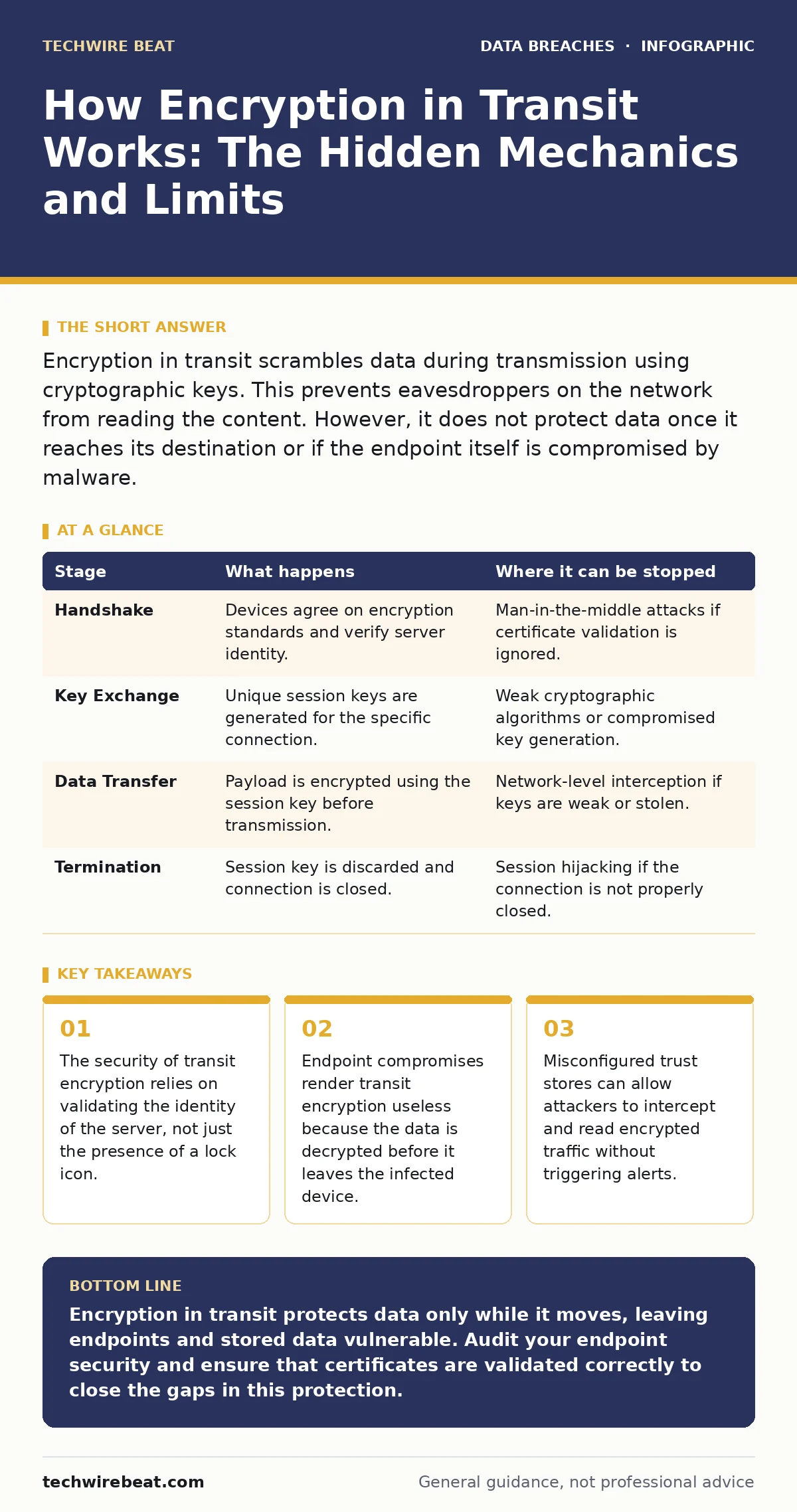
Encryption in transit scrambles data during transmission using cryptographic keys. This prevents eavesdroppers on the network from reading the content. However, it does not protect data once it reaches its destination or if the endpoint itself is compromised by malware.
The Illusion of Secure Pipes
You often assume that once data leaves your device, it is safe because it travels through an encrypted tunnel. This assumption creates a dangerous blind spot. Encryption in transit protects information only while it moves across the network. It does not secure the data before it is sent or after it is received.
Imagine sending a sealed letter through a public post office. The seal prevents the mail carrier from reading the contents. However, if the person writing the letter has a spy in their office, or if the recipient has a spy in theirs, the seal is irrelevant. The content is exposed at both ends.
This mechanism is fundamental to preventing customer data exposure during routine communications. Yet, many organisations treat the encryption layer as a silver bullet, ignoring the vulnerabilities that exist outside the tunnel. Understanding what happens behind the scenes reveals why this protection has hard limits.
The Handshake and Key Exchange
The process begins before any actual data is sent. Your device and the server must agree on how to talk to each other securely. This negotiation is known as the handshake. During this phase, they exchange cryptographic parameters and verify identities.
The server presents a digital certificate, which acts like a passport. Your device checks this passport against a list of trusted authorities. If the certificate is valid, the devices generate a unique session key. This key is used to encrypt the subsequent data stream.
If this step fails, the connection is usually dropped. However, users often bypass warnings to access services they trust, effectively handing over their data to an imposter. This is a common vector for tax identity theft, where attackers mimic legitimate government or financial sites to harvest credentials.
| Stage | What happens | Where it can be stopped |
|---|---|---|
| Handshake | Devices agree on encryption standards and verify server identity. | Man-in-the-middle attacks if certificate validation is ignored. |
| Key Exchange | Unique session keys are generated for the specific connection. | Weak cryptographic algorithms or compromised key generation. |
| Data Transfer | Payload is encrypted using the session key before transmission. | Network-level interception if keys are weak or stolen. |
| Termination | Session key is discarded and connection is closed. | Session hijacking if the connection is not properly closed. |
Encrypting the Payload
Once the handshake is complete, your device prepares the data for transmission. It breaks the information into small chunks called packets. Each packet is then scrambled using the session key established earlier.
This scrambling ensures that even if an attacker captures the packets, they appear as random noise. Without the correct key, reversing this process is computationally infeasible with current technology. The data remains unreadable as it travels through routers, switches, and undersea cables.
This protection is vital when transmitting personally identifiable information, such as names, addresses, and financial details. Without it, anyone with access to the network infrastructure could read your traffic. However, the encryption only applies to the payload. The headers, which contain routing information, often remain visible.
The Vulnerability of Endpoints
The most significant weakness in transit encryption is the endpoint. Your device and the server are the only places where the data exists in plain text. If either endpoint is compromised, the encryption provides no benefit.
Suppose your laptop is infected with malware that logs keystrokes. The malware captures your password before the encryption layer even sees it. Similarly, if the server is compromised, the attacker can read the data after it is decrypted.
This is why vendor risk management is critical. You may have perfect encryption in transit, but if your partner’s servers are poorly secured, your data is exposed once it arrives. The security chain is only as strong as its weakest link, and endpoints are frequently the weakest.
Certificate Trust and Validation
Your device trusts a server based on its digital certificate. This trust is managed by a store of root certificates pre-installed on your operating system. If an attacker can insert their own certificate into this store, they can impersonate any website.
Corporate networks often do this intentionally to inspect employee traffic. This is known as transparent inspection. While it allows security teams to block malicious sites, it also means that the encryption is terminated and restarted at the corporate firewall.
This creates a hidden cost. You lose the guarantee that only you and the server can read the data. The network administrator now has the ability to read it. This is a necessary trade-off for security monitoring, but it reduces the overall privacy of the connection.
See also: AI Governance for Small Teams: Practical Controls and Cost · Privacy Laws For Small Businesses: The Hidden Security Advantage
Limitations of Transit Encryption
Encryption in transit does not protect data at rest. Once the data reaches the server, it must be stored. If the server is not encrypted, the data is vulnerable to theft if the physical hardware is stolen or if an attacker gains unauthorized access.
It also does not protect against application-layer attacks. If a web application has a vulnerability that allows an attacker to inject malicious code, the encryption will faithfully transmit that malicious code. The encryption protects the integrity of the transmission, not the safety of the content.
Consider leaked source code. If an application contains hardcoded secrets, those secrets are transmitted in clear text within the application logic, even if the connection is encrypted. The encryption hides the transmission, but it does not fix the underlying application flaw.
Managing the Full Lifecycle
To truly protect data, you must manage it across its entire lifecycle. Encryption in transit is only one layer. You need encryption at rest to protect stored data and strong access controls to limit who can view it.
Regularly review your backup strategies to ensure that backups are also encrypted and securely stored. A breach of backup data can be just as damaging as a breach of live systems.
Implementing these controls requires a holistic approach. Do not rely on a single security measure. Layer your defenses so that if one fails, others remain. This reduces the risk of medical identity theft, where attackers target sensitive health records stored in poorly protected databases.
The Role of Protocol Selection
Not all encryption protocols are created equal. Older protocols may have known vulnerabilities that allow attackers to decrypt traffic. Always ensure that your devices and servers support modern, secure protocols.
Disable legacy protocols that are no longer considered safe. This reduces the attack surface and prevents attackers from forcing a downgrade to a weaker encryption method.
This is particularly relevant for breach notification laws. If you fail to maintain secure protocols and a breach occurs, you may be held liable for negligence. Keeping your systems updated is not just a technical requirement, but a legal one.
Key takeaways
- The security of transit encryption relies on validating the identity of the server, not just the presence of a lock icon.
- Endpoint compromises render transit encryption useless because the data is decrypted before it leaves the infected device.
- Misconfigured trust stores can allow attackers to intercept and read encrypted traffic without triggering alerts.
Encryption in transit protects data only while it moves, leaving endpoints and stored data vulnerable. Audit your endpoint security and ensure that certificates are validated correctly to close the gaps in this protection.
Frequently asked questions
Does encryption in transit protect against hackers on public Wi-Fi?
Yes, it prevents eavesdroppers on the same network from reading your data. However, it does not protect you if you visit a fake website that looks like a legitimate service.
Can encryption in transit be bypassed?
It can be bypassed if the endpoint is compromised or if the user ignores certificate warnings. Attackers can also use man-in-the-middle attacks if they control the network path and the user’s trust settings are misconfigured.
Is HTTPS enough to secure my data?
HTTPS secures the transmission, but it does not secure the data on the server or the device. You still need strong passwords, multi-factor authentication, and secure storage practices to fully protect your information.
What is the difference between encryption in transit and at rest?
Encryption in transit protects data moving between devices. Encryption at rest protects data stored on disks or databases. Both are necessary for comprehensive data protection.
How this guide was produced: written by the TechWire Beat editorial team with AI assistance, checked against the public references listed below, and reviewed when the facts change. See our editorial policy or report an error.